



Cybersecurity AI Prompts
DarcPrompt: Your Cognitive Exoskeleton for Cyber Intelligence
We do the prompt engineering so you don't have to. Discover the architecture that transforms validated external data into highly structured, persona-driven execution plans ready for your secure Enterprise AI.
Cybersecurity AI Prompts DarcPrompt
The End of Prompt Engineering
In an industry saturated with reactive chatbots and "Copilots," the burden of knowledge falls on the user. Legacy tools require exhausted analysts to know exactly what to ask, forcing them to become prompt engineers just to get basic answers.
ThreatNG takes a "Service-as-a-Software" approach. DarcPrompt (Data Assessment and Repeatable Context Prompt) is the tangible, interactive product of our Contextual AI Abstraction Layer. It automatically packages verified ground truth, regulatory context, and optimal instruction parameters into a single, highly engineered payload. We tell your AI exactly what the risk is and how to fix it, allowing a Level 1 analyst to instantly deliver the strategic value of a seasoned auditor or an elite threat modeler.
The Anatomy of a DarcPrompt
A DarcPrompt is not a simple chat query. Every prompt in our library is built upon a rigorous, repeatable framework designed to eliminate AI hallucinations and guarantee highly structured, board-ready outputs. This architecture is defined by three strict constraints:
1: Persona Definition
We force your Enterprise LLM to adopt a highly specific, authoritative role rather than acting as a generic assistant.
2: Data Constraints & Ground Truth
An AI is only as intelligent as the facts it is fed. DarcPrompts strictly bind the LLM to ThreatNG's proprietary intelligence, making it an external-only, connectorless solution. Because it does not perform internal network functions or scan internal mainframes, the AI is forced to process only externally validated ground truth.
3: Structure Output Requirements
Unbounded AI generates rambling text. DarcPrompts strictly dictate the final format, mandating visual-style step breakdowns, prioritized triage tables, mapped compliance controls, and concise executive summaries.
DarcPrompt Personas in Action:
A Look Under the Hood
We don't just ask your AI to "analyze this data." We force it to adopt highly specialized, authoritative personas bounded by strict analytical frameworks. Here is a look at how DarcPrompt orchestrates elite cyber intelligence across our expanded library:
Threat Modeler | Third-Party Assessor | Business Translator | CTEM Strategist | Digital Strategist | GRC Auditor | Validation Specialist | Growth Strategist

The Offensive Threat Modeler
External Attack Path Analysis
Externally answer the following questions, and more:
How can seemingly isolated external exposures be chained together into realistic, multi-step attack paths?
What are the most critical initial access vectors and entry points from an adversary’s perspective?
What are the estimated levels of impact and complexity for each simulated attack path?
Where are the exact "choke points" where a single remediation can disrupt the kill chain early?
What strategic defensive controls (such as Zero Trust enforcement or strict network segmentation) are required to mitigate systemic weaknesses?
Decomposes initial access vectors from an attacker’s perspective, highlighting how chained exposures enable multi-step compromises, while providing actionable, forensic-based defensive strategies to disrupt the kill chain.
External Attack Paths: Offensive Threat Modeling
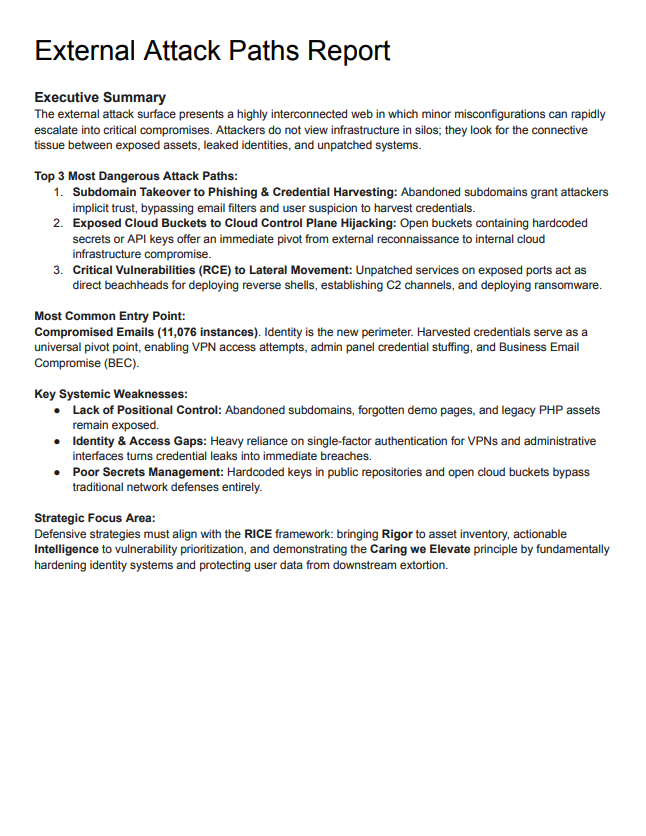
Identifying how isolated misconfigurations, abandoned assets, and leaked identities can chain together to create catastrophic breaches is a common challenge for security teams. The sample report provided here is the direct output of the External Attack Paths DarcPrompt, which correlates ThreatNG's outside-in telemetry to automatically identify and uncover these hidden kill chains. This intelligence can be used to deploy defensive chokepoints, allowing you to break the attack path before adversaries execute a multi-stage compromise.
The TPRM Assessor
Third-Party External Risk Assessment
Externally answer the following questions, and more:
What is the true external security posture of our third-party vendors, suppliers, and partners?
Which third parties represent the highest supply chain risks based on external exposures like credential leaks or cloud misconfigurations?
How do specific vendor exposures directly translate into business impact and dependency risk for our organization?
What immediate actions, such as enforcing SLAs, requiring questionnaires, or triggering contractual escalations, should be initiated with high-risk partners?
How should we structure our continuous monitoring strategy to maintain accountability and align vendor risks with internal compliance policies?
Evaluates vendor dependencies to identify potential attack paths that traverse third-party infrastructure and score external supply chain exposures.
TPRM Assessor: Third Party External Risk Assessment
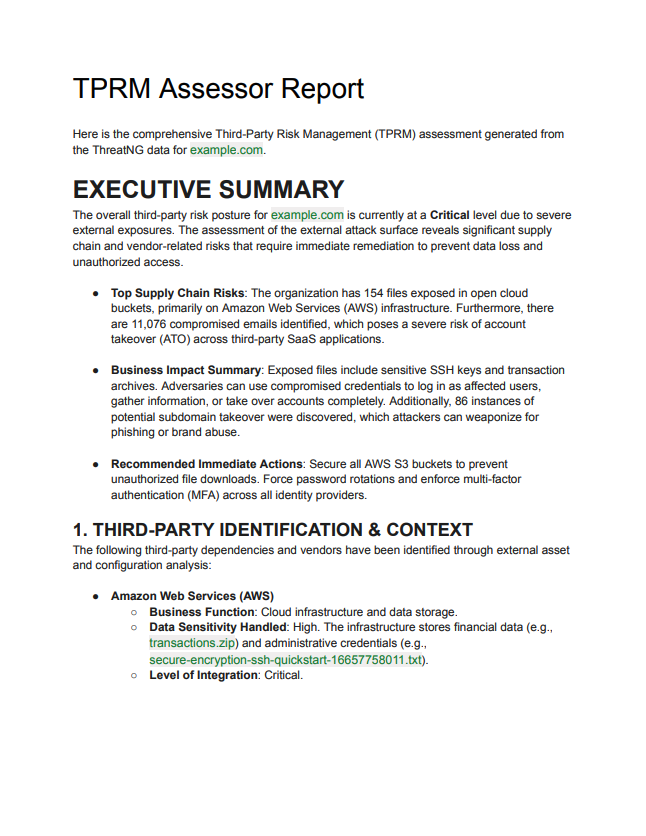
Evaluating third-party dependencies often relies on static, unreliable security questionnaires that create dangerous visibility gaps. The sample report provided here is the direct output of the Third Party External Risk Assessment DarcPrompt, which correlates ThreatNG's outside-in telemetry to automatically identify and uncover hidden vendor exposures. Use this intelligence to enforce vendor accountability and proactively disrupt supply chain attack paths.
The Business Translator
Contextual Risk Appetite Assessment
Externally answer the following questions, and more:
Are we currently operating within our board-defined risk thresholds?
What is the quantifiable financial exposure of our external attack surface?
How do our hidden vulnerabilities impact our cyber insurability and premiums?
Which external risks should the organization actively accept, mitigate, transfer, or avoid?
Which critical threats require an immediate, day-one remediation strategy?
Translate raw external exposures into a business-aligned risk framework, bridging the gap between technical telemetry and executive decision-making.
Cyber Insurance: Underwriting Risk Assessment
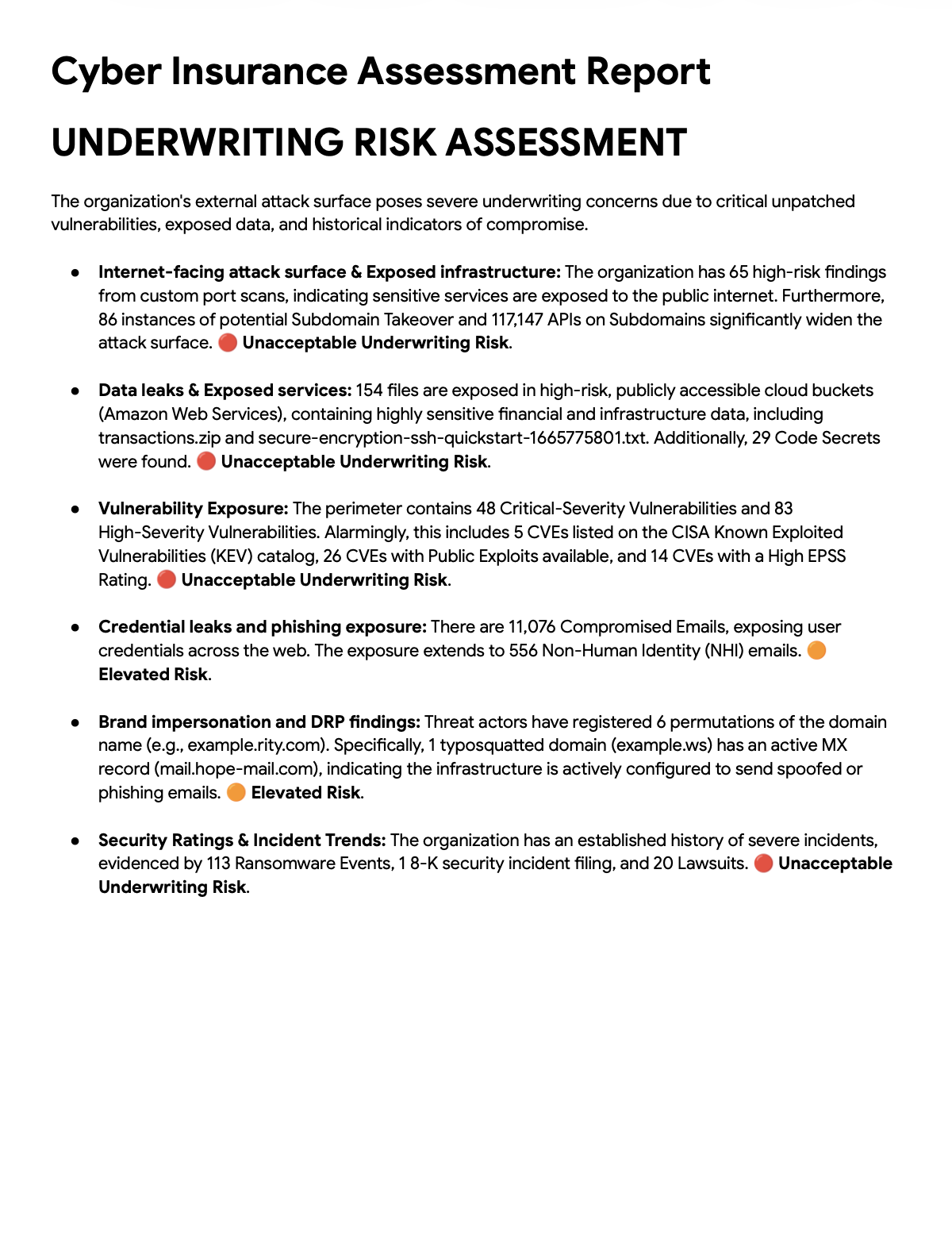
Navigating cyber insurance renewals is a massive challenge when external exposures and vulnerabilities remain hidden from underwriting models. This Cyber Insurance DarcPrompt solves this by correlating ThreatNG's connectorless external data to map your exact insurability profile and prioritize risk reduction prior to an audit.
Quantify Risk with the Financial Impact DarcPrompt
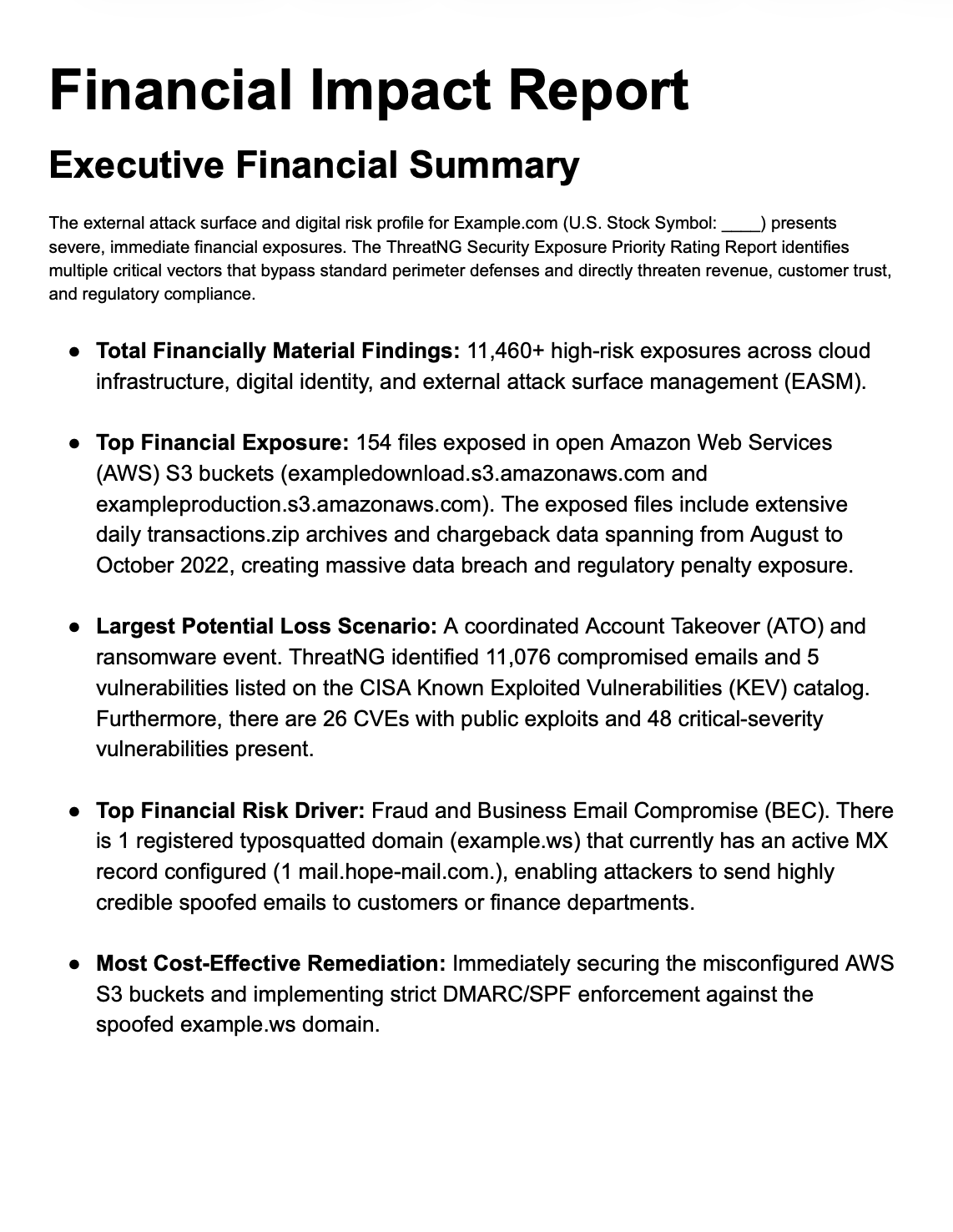
Technical vulnerabilities often fail to convey the true financial exposure facing executive leadership and boards. The Financial Impact DarcPrompt bridges this gap by translating ThreatNG’s connectorless external attack surface telemetry into quantified loss ranges, business interruption estimates, and clear remediation ROI.
Contextual Risk Appetite External Assessment
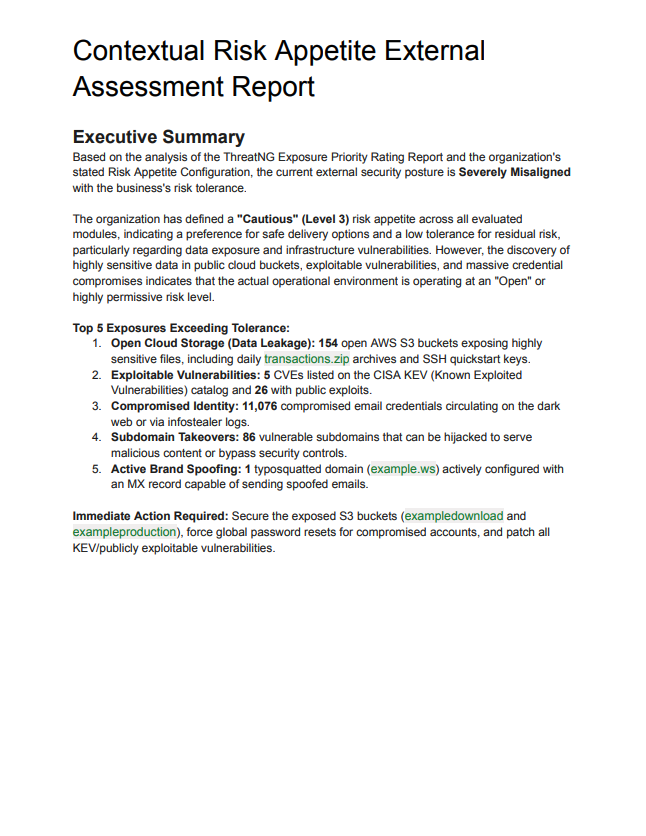
Consistently, many entities struggle to reconcile their theoretical risk policies with the sprawling reality of their actual digital footprint. This DarcPrompt correlates ThreatNG's outside-in telemetry to automatically uncover true operational risk, allowing you to swiftly close the dangerous gap between stated business tolerances and actual external exposure.
Day-One External Exposure Response and Reduction Plan
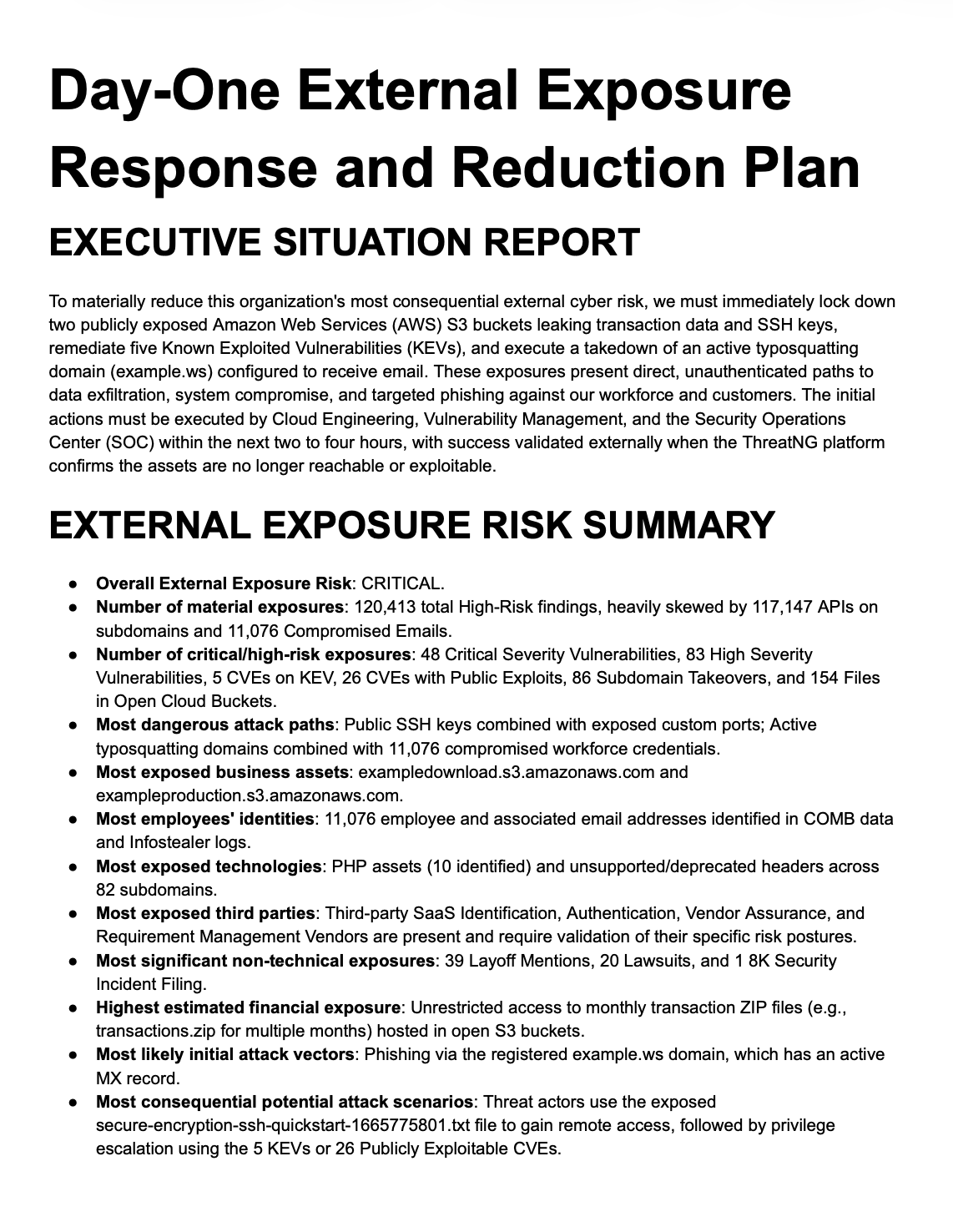
Security leaders face a constant barrage of disconnected alerts, making it impossible to prioritize the most critical threats to the business. This DarcPrompt uses connectorless ThreatNG intelligence to instantly correlate complex attack paths into an actionable, prioritized executive mitigation strategy.
The CTEM Strategist
Continuous Exposure Strategy
Externally, answer the following questions and more:
What is our comprehensive external asset inventory, and where do visibility or coverage gaps exist?
Which external exposures pose the highest likelihood of exploitation in the real world?
How do we prioritize remediation efforts using combined X-Susceptibility (XS) and X-Exposure (XE) scores?
What immediate, short-term, and long-term steps are required to sustainably reduce our attack surface?
How can we transition from reactive patching to a continuous, measurable exposure management lifecycle?
Analyzes exposure susceptibility and facilitates increasing its priority, helping teams build a sustainable, continuous remediation strategy.
CTEM and External Exposure Strategy Blueprint
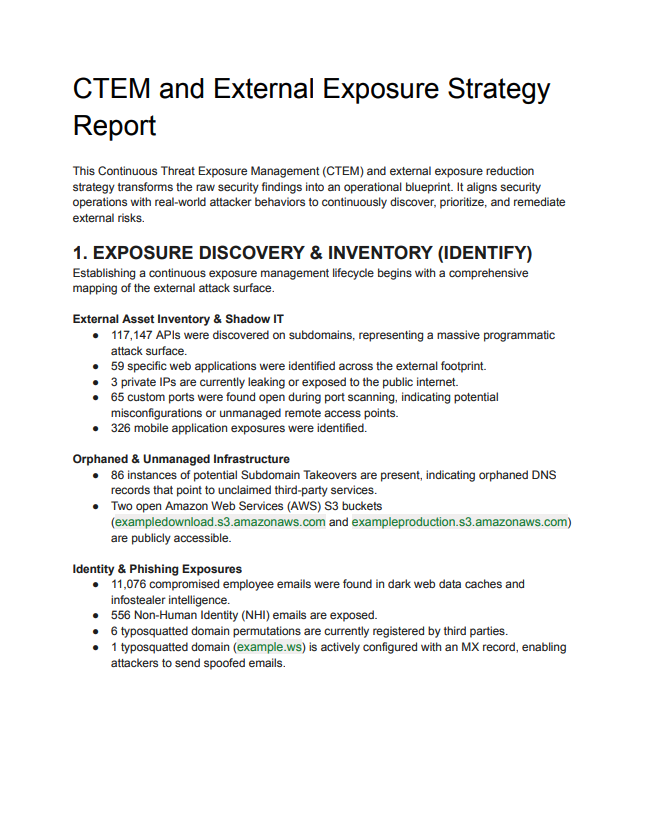
Security teams often struggle to transition from chaotic, reactive patching to a sustainable, continuous exposure management program. The sample report provided here is the direct output of the CTEM and External Exposure Strategy DarcPrompt, which correlates ThreatNG's purely outside-in telemetry to automatically identify and uncover prioritized real-world risks. Use this intelligence to deploy a living, intelligence-driven roadmap that reduces your external attack surface over time.
End-to-End Analysis: Prioritized Risk Remediation
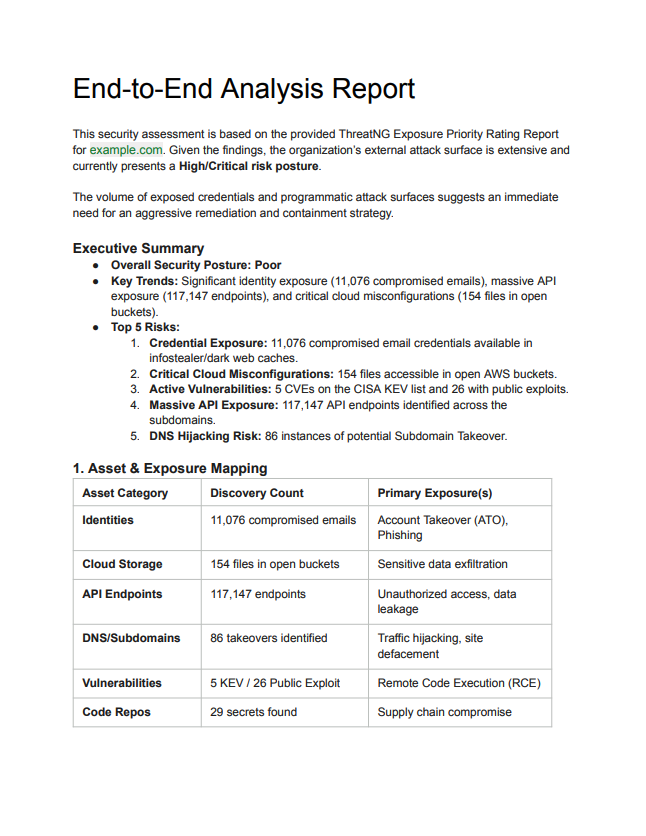
Security operations are frequently paralyzed by disjointed alerts, making it impossible to quickly isolate the vulnerabilities that pose the greatest business risk. The sample report provided here is the direct output of the End-to-End Analysis DarcPrompt, which correlates ThreatNG's outside-in telemetry to automatically identify and uncover your most critical exposures. Use this definitive intelligence to deploy a prioritized remediation plan and rapidly secure your digital footprint.
Susceptibility and eXposure Scores Risk Prioritization
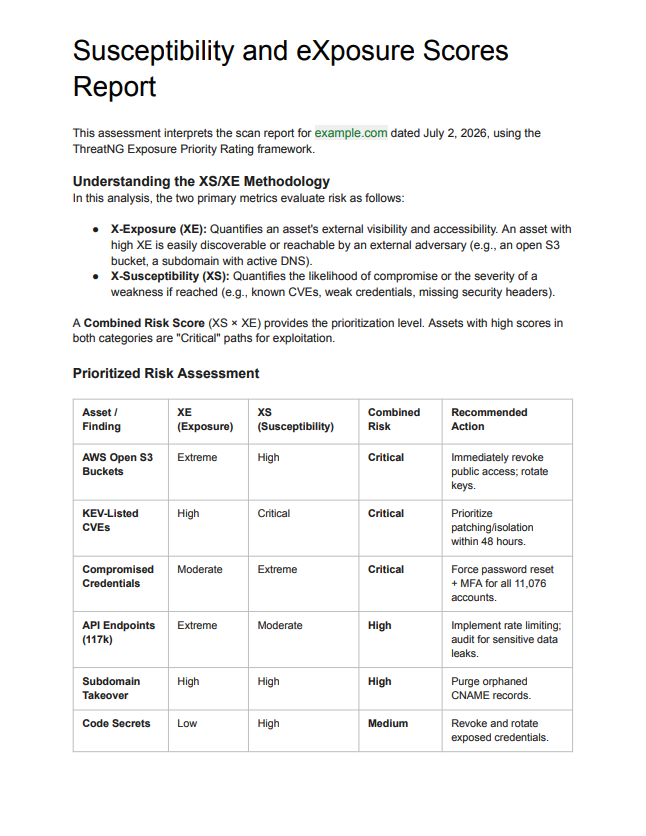
Cybersecurity professionals are often overwhelmed by disconnected alerts, making it challenging to identify which vulnerabilities require immediate action. The sample report provided here is the direct output of the X Susceptibility and eXposure Scores DarcPrompt, which correlates ThreatNG's outside-in telemetry to automatically identify and uncover your true risk posture. Use this intelligence to focus your remediation efforts on the critical exposures adversaries are poised to exploit.
Drive ROI: Security Technology Stack Optimization
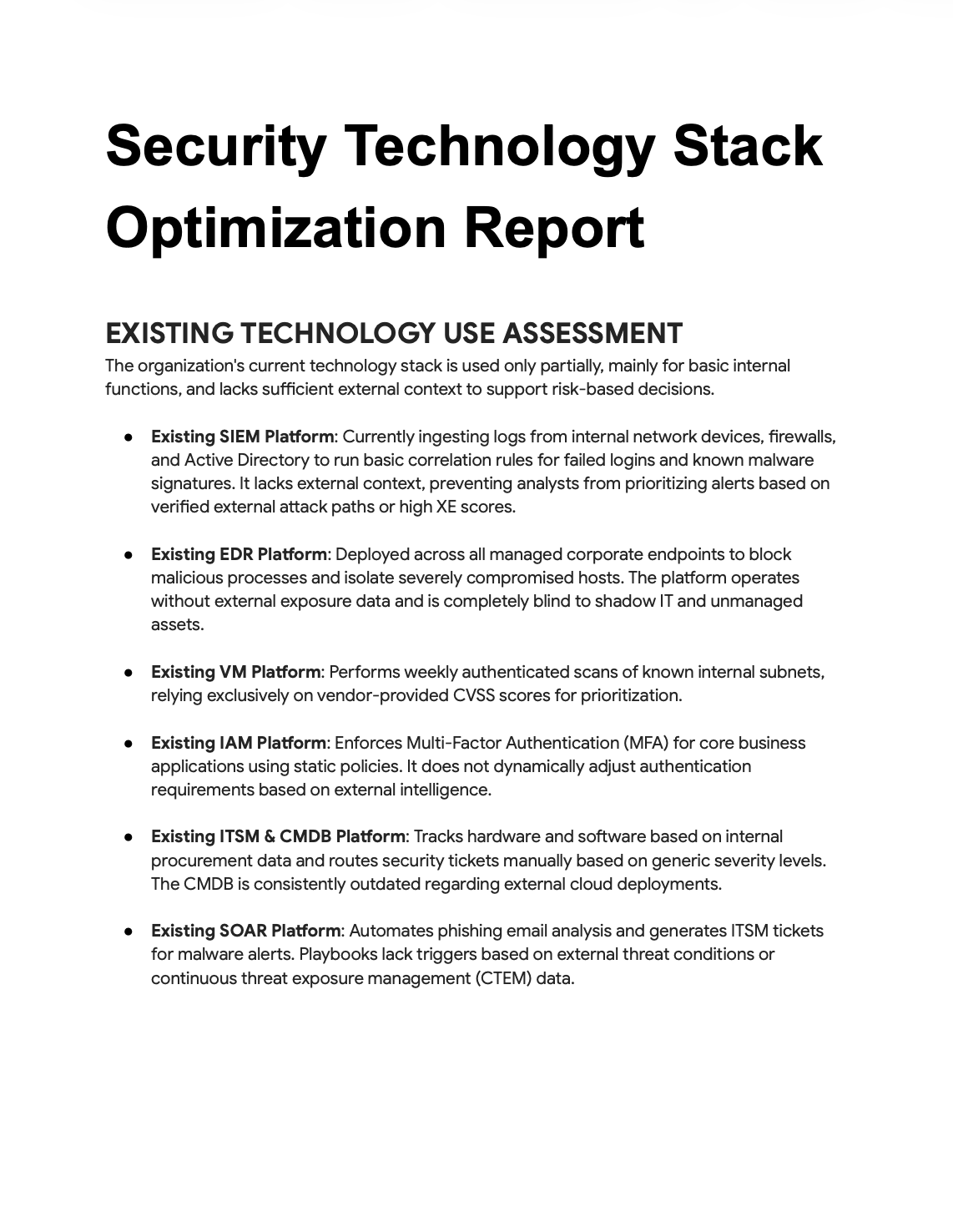
Many organizations struggle to extract maximum value from their siloed security investments because they lack critical external, internet-facing context. This DarcPrompt solves that challenge by correlating ThreatNG's external exposure intelligence with your existing tools so you can use them more effectively. The sample report provided is the direct output of this specific prompt, delivering a concrete roadmap for integration and automation.
Drive Technology Stack Optimization via ThreatNG
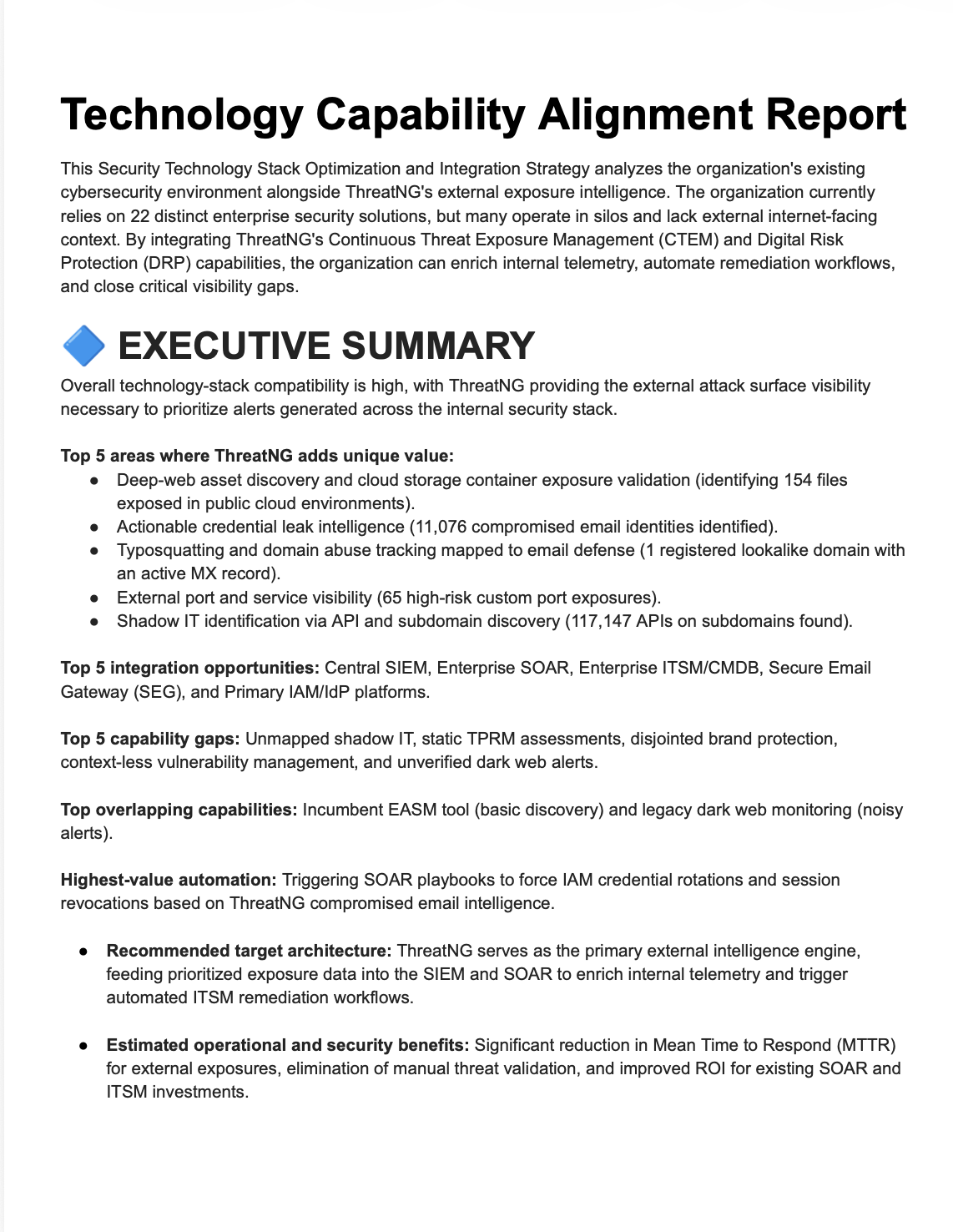
Security teams often struggle to extract maximum value from existing tools that lack context on external exposures. This specific DarcPrompt correlates ThreatNG's connectorless external intelligence with your internal capabilities to prioritize threats and optimize configurations. The sample report shown here is the direct, unedited output of this powerful prompt in action.
Day-One External Exposure Response and Reduction Plan
Security leaders face a constant barrage of disconnected alerts, making it impossible to prioritize the most critical threats to the business. This DarcPrompt uses connectorless ThreatNG intelligence to instantly correlate complex attack paths into an actionable executive strategy. The sample report shown here is the exact, direct output generated by this specific prompt.
The Digital Strategist
Takedown and Brand Protection
Externally, answer the following questions and more:
How could publicly exposed data be chained together by attackers to conduct AI-enabled social engineering, spear-phishing, or executive impersonation?
What are the active attack campaigns and most critical brand abuse vectors currently targeting the organization?
Which specific domains, archived pages, pastes, or unauthorized mobile apps present immediate takedown opportunities?
What are the estimated financial and reputational impacts of our current digital risk exposures on the business?
What strategic investments and protection services are required to proactively defend brand equity and disrupt adversary infrastructure?
Analyzes publicly exposed data to assess an organization's susceptibility to AI-amplified social engineering, spear-phishing, and executive impersonation. While the platform does not perform takedowns directly, this capability identifies brand abuse and sets it up well for a takedown service, while providing a proactive roadmap for reducing exposure.
AI Narrative: Phishing and Social Engineering Defense
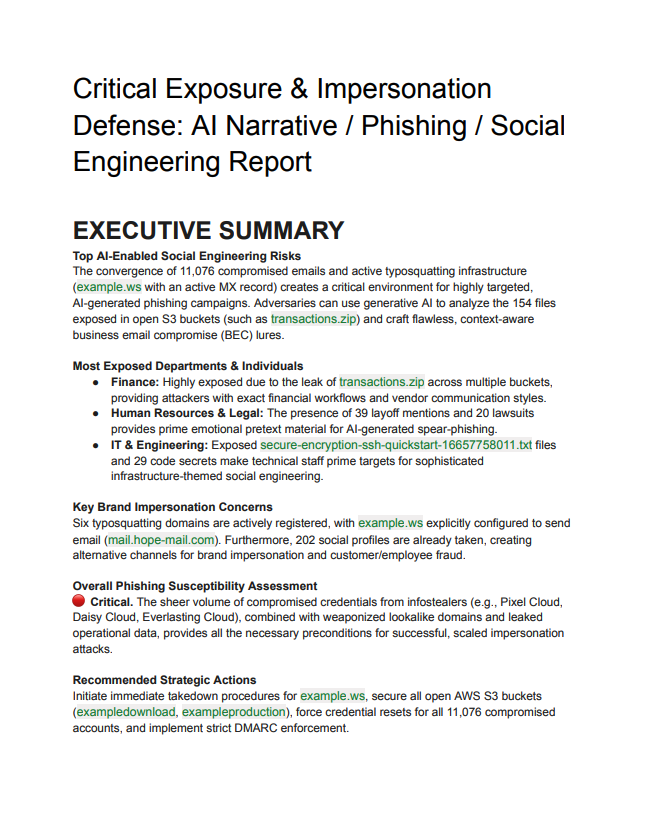
Security teams often lack visibility into how exposed corporate data and compromised credentials are weaponized by adversaries to launch highly convincing, AI-amplified attacks. The sample report provided here is the direct output of the AI Narrative / Phishing / Social Engineering DarcPrompt, which correlates ThreatNG's outside-in telemetry to automatically identify and uncover your susceptibility to targeted impersonation and wire fraud. Use this intelligence to deploy proactive defensive playbooks and disrupt attacker campaigns before they reach your employees.
Opportunity Finder: Takedown and Brand Protection
Organizations consistently struggle to identify hidden brand abuse and digital impersonation vectors that adversaries link together to execute devastating attacks. The sample report provided here is the direct output of the Opportunity Finder (Takedown and Brand Protection) DarcPrompt, which correlates ThreatNG's outside-in telemetry to automatically identify and uncover these external threats. Use this intelligence to deploy a prioritized, risk-driven strategy that disrupts attacker infrastructure and protects your brand equity.
The External GRC Auditor
Compliance Translation
Externally, answer the following questions and more:
How do our technical external exposures map directly to regulatory and compliance frameworks (e.g., ISO 27001, NIST CSF, SOC 2, DPDPA)?
What specific control gaps, deficiencies, or failures exist within our current security architecture?
What is our estimated audit readiness level based purely on externally verifiable evidence?
Which remediation actions will provide the highest ROI by satisfying overlapping controls across multiple frameworks simultaneously?
What systemic weaknesses (such as asset inventory failures or IAM gaps) are driving repeated compliance violations?
Aligns external findings directly with regulatory and compliance frameworks rather than calculating financial risk values on its own.
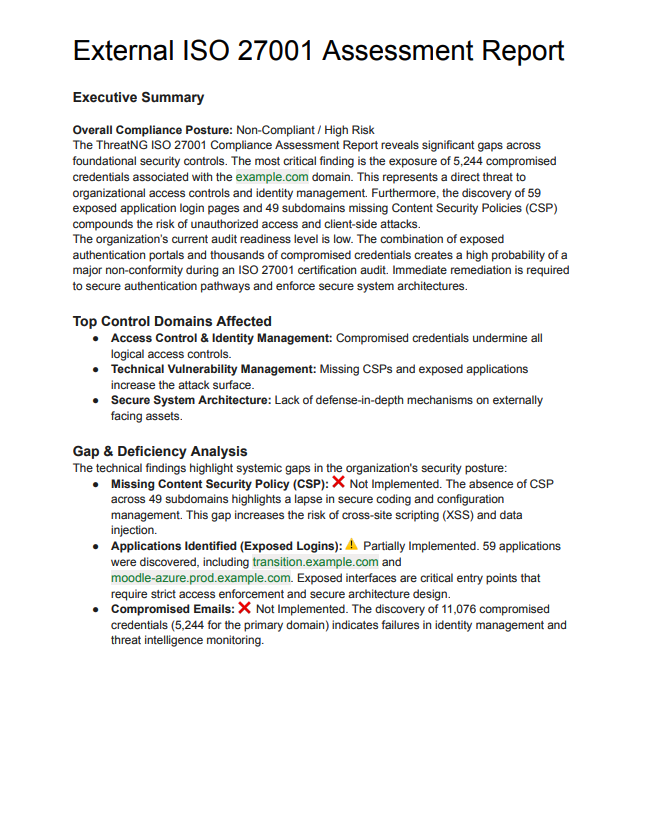
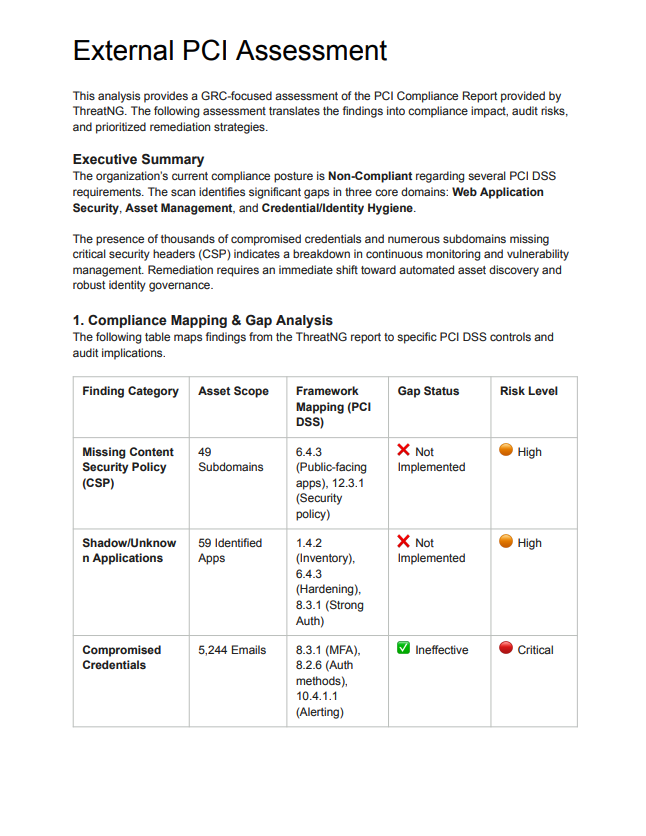
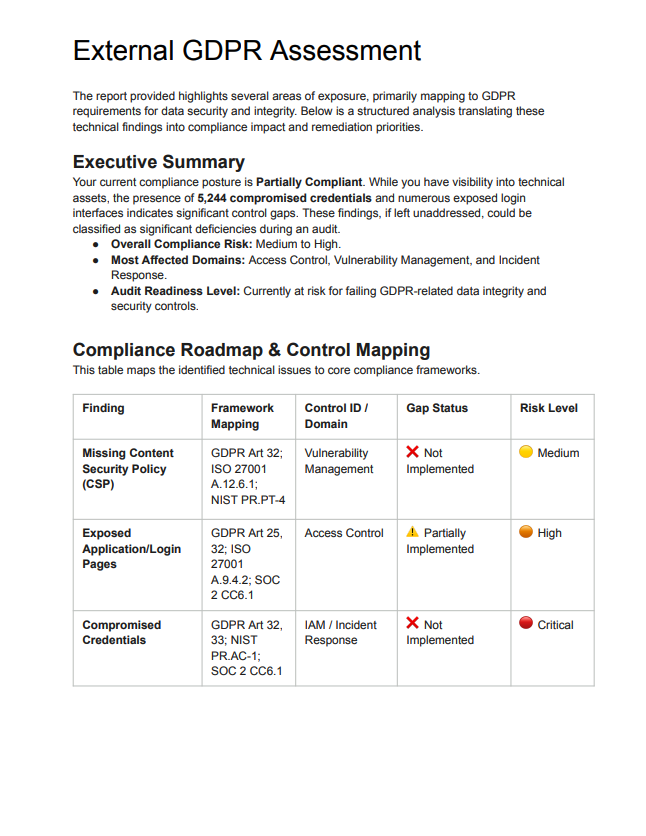
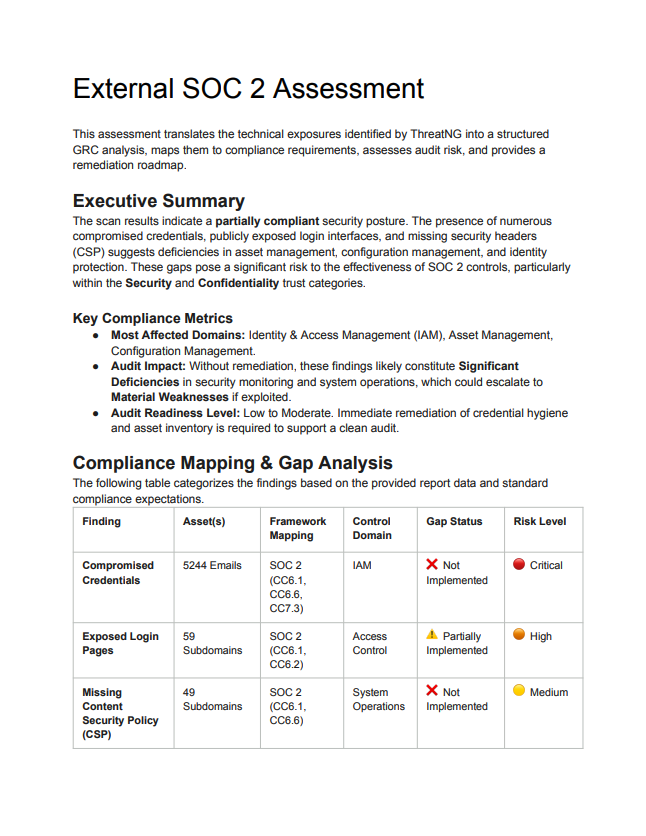
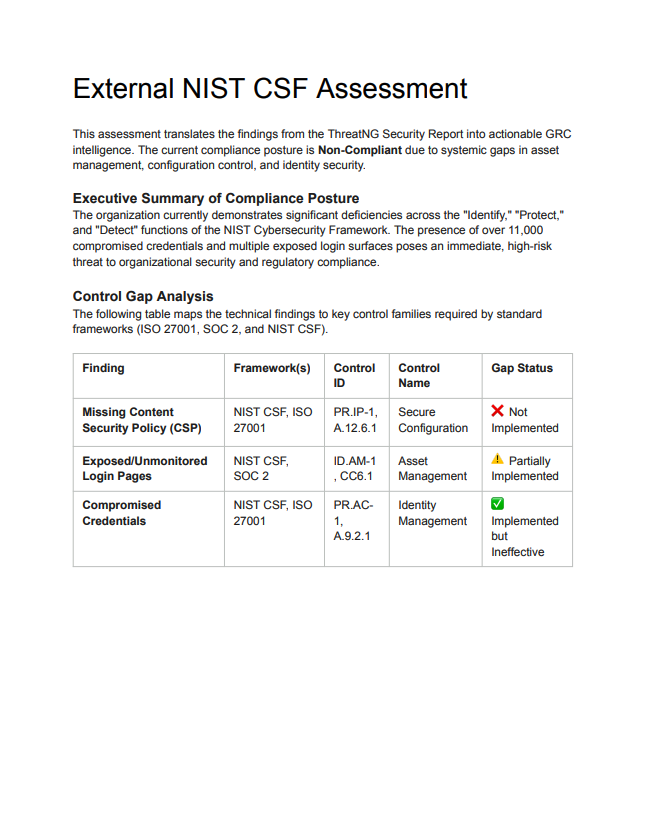
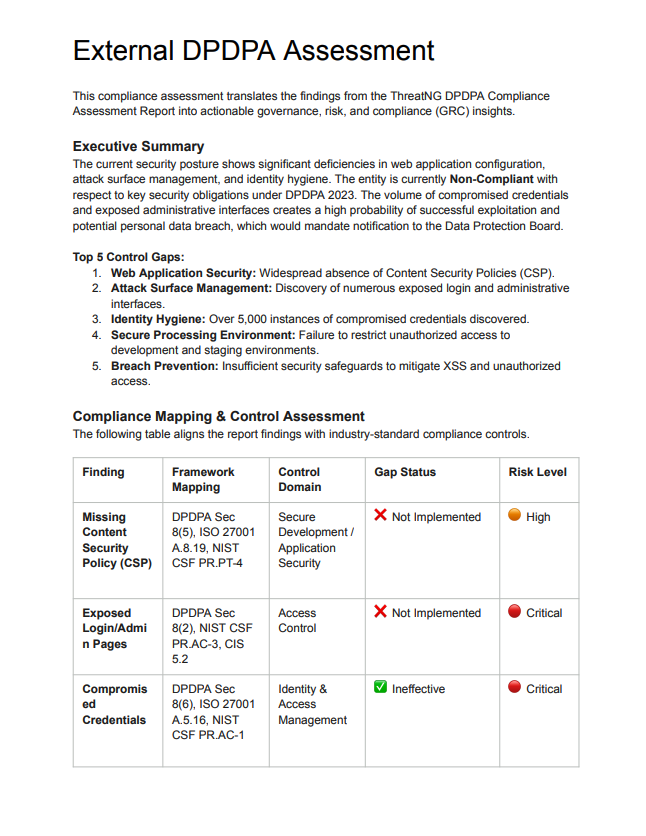
External GRC Assessment: Compliance Translation Blueprint
Security and risk teams waste countless hours manually crosswalking technical vulnerabilities into complex regulatory frameworks. The sample reports provided here are the direct output of the External GRC Assessment DarcPrompt, which correlates ThreatNG's outside-in telemetry to automatically map your external exposures to mandates like SOC 2, ISO 27001, and NIST CSF. Use this intelligence to rapidly identify control gaps and deploy an audit-ready remediation strategy.
📋 View Compliance Assessment Examples
NIST SP 800-63-4 Digital Identity Assessment
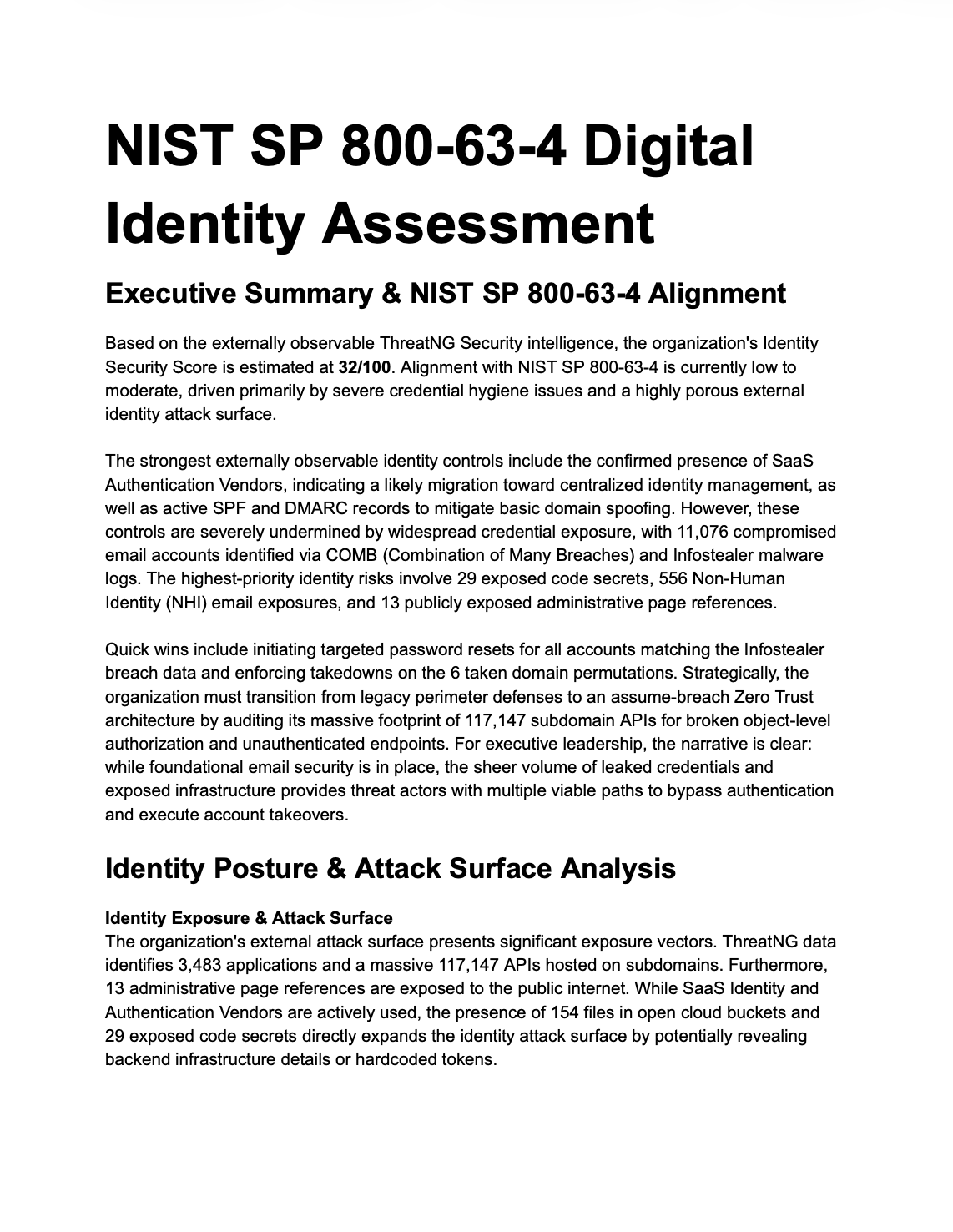
Threat actors increasingly target weak external identity controls, such as exposed APIs and leaked credentials, to bypass internal authentication defenses and execute account takeovers. This DarcPrompt uses connectorless external intelligence to map your identity attack surface directly against federal standards, uncovering critical gaps. The sample assessment shown here is the exact, direct output generated by this specific prompt.
The Validation Specialist
Zero-Noise Triage
Externally, answer the following questions and more:
Which discovered assets and exposures can be strictly and verifiably attributed to the organization, completely eliminating false positives?
Where is shadow IT, such as unknown cloud services, unregistered IPs, and orphaned domains, operating outside of standard governance?
What unsanctioned AI/ML tools or public-facing generative AI endpoints are in use, and do they expose sensitive corporate data?
What immediate triage actions must be taken to secure, block, or remove unmanaged shadow IT and AI assets?
What does our verified, zero-noise dataset reveal about our baseline security posture for audit-ready executive reporting?
Filters broad data into high-confidence, attributable findings by validating ownership and technical status, ensuring that only verified exposures are surfaced for remediation.
Direct Attribution: High-Confidence Threat Validation
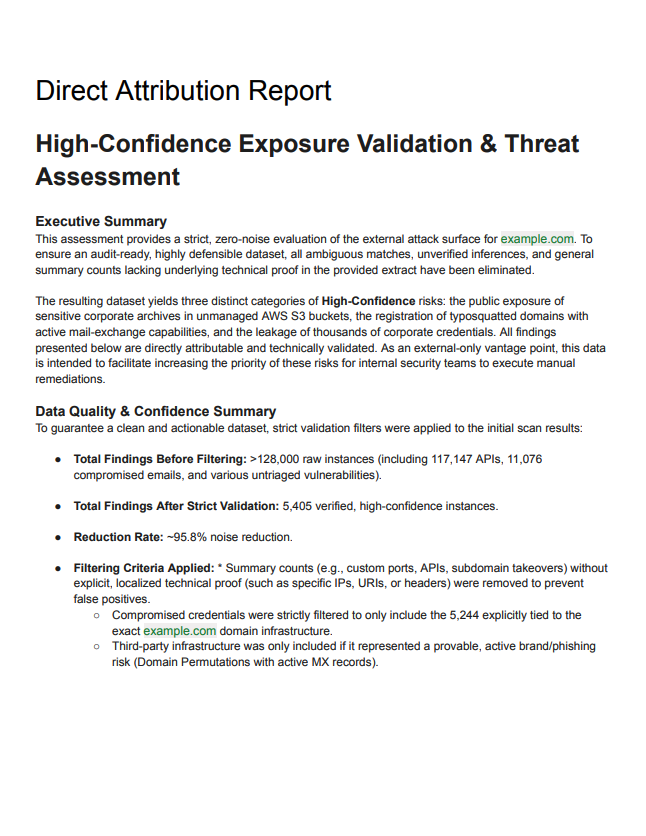
Security operations are frequently paralyzed by false positives and ambiguous alerts that drain critical resources. The sample report provided here is the direct output of the Direct Attribution DarcPrompt, which correlates ThreatNG's outside-in telemetry to automatically identify and uncover only your verifiably owned external risks. Use this high-confidence intelligence to eliminate noise and deploy a definitive, zero-guesswork defensive strategy.
Shadow IT and AI: Risk Discovery Assessment
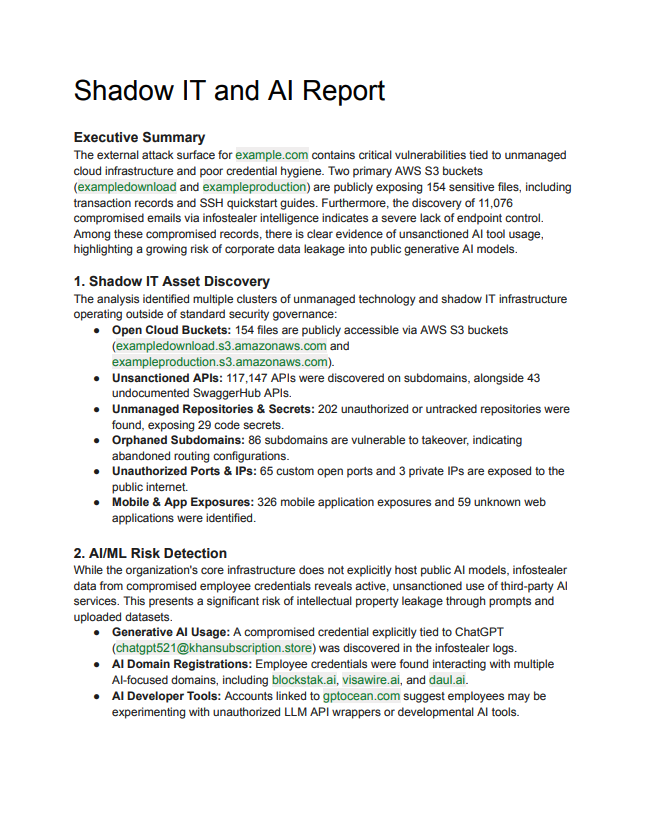
Security teams frequently lose visibility as employees adopt unsanctioned generative AI tools and spin up unmanaged cloud infrastructure. The sample report provided here is the direct output of the Shadow IT and AI DarcPrompt, which correlates ThreatNG's outside-in telemetry to automatically identify and uncover these hidden technology assets. Use this intelligence to regain governance over sprawling infrastructure and prevent devastating corporate data leakage.
Uncover Adversary Targeting: The Counterintelligence AI Prompt
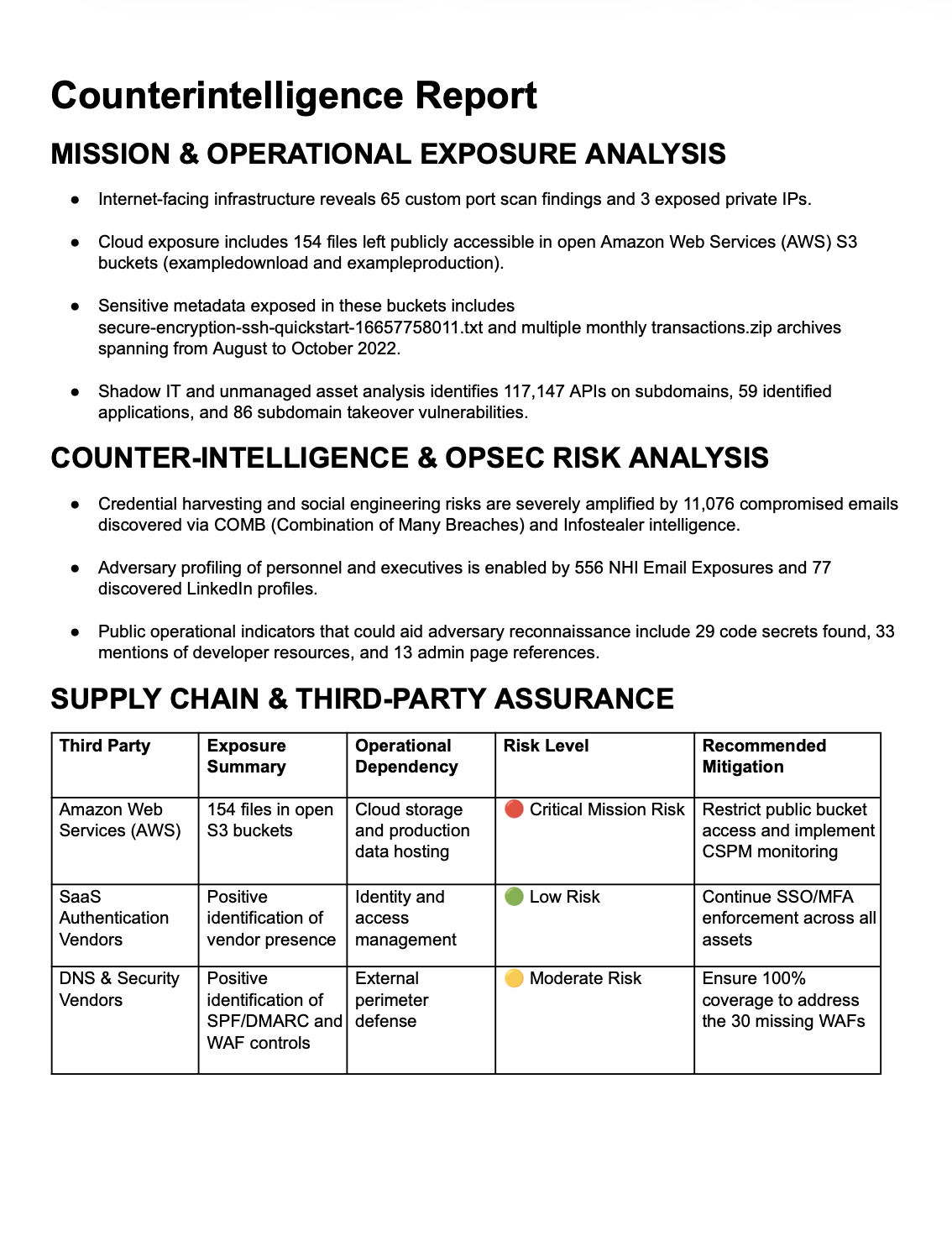
Modern defensive operations struggle with visibility blind spots that leave critical infrastructure and executive personnel exposed to targeted reconnaissance by adversaries. By correlating connectorless external intelligence, the Counterintelligence DarcPrompt models your exact attack paths before they are exploited. The executive assessment shown here is the direct, real-world output generated by running this specific prompt.
Day-One External Exposure Response and Reduction Plan
Security leaders face a constant barrage of disconnected alerts, making it impossible to prioritize the most critical threats to the business. This DarcPrompt uses connectorless ThreatNG intelligence to instantly correlate complex attack paths into an actionable executive strategy. The sample report shown here is the exact, direct output generated by this specific prompt.
The Growth Strategist
Pipeline Generation
Externally, answer the following questions and more:
What specific security gaps, digital risks, and external vulnerabilities indicate a commercial opportunity for additional products or services?
How can raw threat telemetry be translated into monetizable business cases for continuous brand protection and takedown retainers?
How should we prioritize sales pipeline opportunities based on risk severity, potential business impact, and likelihood of purchase?
What is the expected benefit (e.g., compliance, visibility, efficiency) for the client if they invest in the recommended solution?
What are the most effective engagement approaches and immediate next steps for targeted prospect outreach?
Transforms external attack surface intelligence into a powerful sales engine by uncovering high-impact security gaps; builds a compelling business case for upselling, justifies managed service retainers, and prioritizes actionable opportunities, such as takedown services, to accelerate revenue cycles.
Opportunity Finder: Strategic Business Case Generation
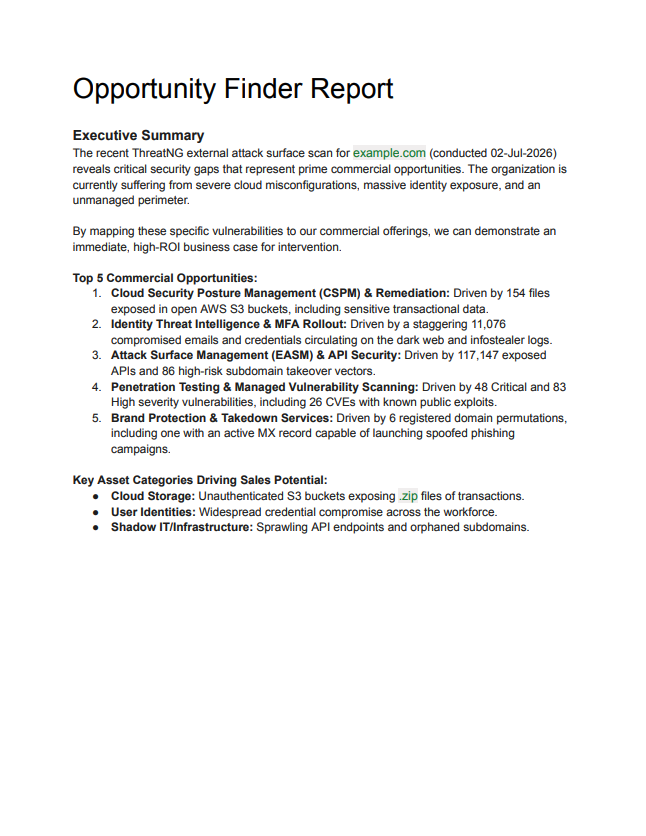
Security service providers and business development teams often struggle to translate raw technical vulnerabilities into compelling, monetizable proposals. The sample report provided here is the direct output of the Opportunity Finder DarcPrompt, which correlates ThreatNG's outside-in telemetry to automatically identify and uncover high-value commercial opportunities. Use this definitive intelligence to map an organization's external exposures directly to your specialized services and accelerate security-led growth.
Opportunity Finder: Takedown and Brand Protection
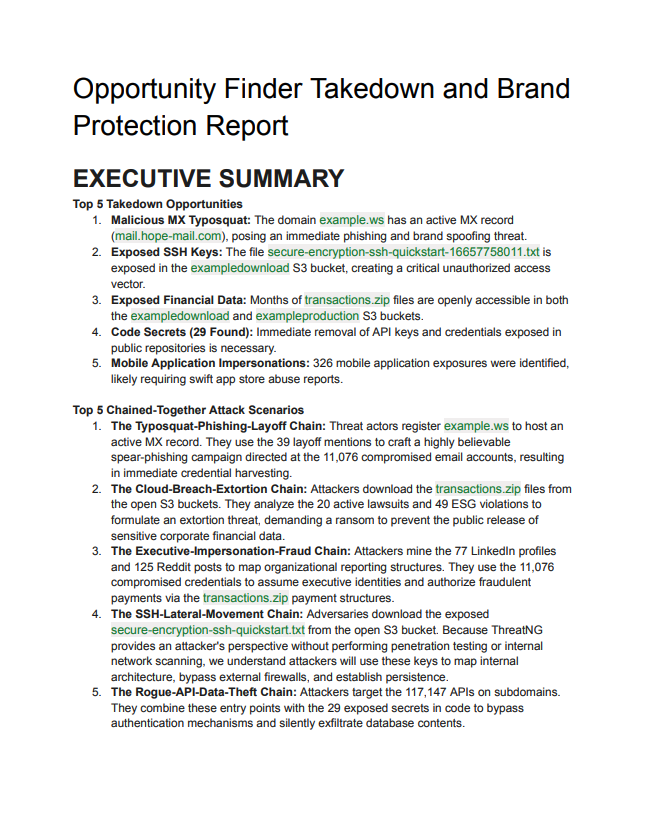
Organizations consistently struggle to detect hidden brand abuse and digital impersonation vectors before adversaries chain them into devastating multi-stage attacks. The sample report provided here is the direct output of the Opportunity Finder (Takedown and Brand Protection) DarcPrompt, which correlates ThreatNG's purely outside-in telemetry to automatically identify and uncover these external threats. Use this intelligence to deploy a prioritized, risk-driven strategy that disrupts attacker infrastructure and protects your brand equity at the source.
The Air-Gapped Handoff:
Zero API Privacy Traps
To power their in-app chat windows, legacy EASM vendors must stream your highly sensitive attack-surface data through third-party APIs. For highly regulated enterprises, routing live infrastructure vulnerabilities through a vendor's external LLM pipeline is a massive compliance red flag.
DarcPrompt allows you to use your AI safely through the Air-Gapped Handoff:
1: Synthesize
ThreatNG's Contextual AI Abstraction Layer structures the intelligence and generates the DarcPrompt within our platform.
2: Transfer
You copy the highly engineered DarcPrompt payload.
3: Execute
You paste it directly into your own secure, internal Enterprise AI (e.g., Microsoft Security Copilot, ChatGPT Enterprise, or a localized LLM).
This physical action guarantees Bounded Autonomy. The AI does the heavy lifting, but you maintain strict data privacy, physical control, and the undeniable human-verified supervision that auditors demand.
The "Service-as-a-Software" ROI
For enterprise SOCs and MSSPs, DarcPrompt is an operational multiplier. By automating the hardest part of AI interaction context injection and prompt engineering, you eliminate the "Hidden Tax on the SOC." Analysts no longer waste hours staring at noisy spreadsheets trying to figure out the right questions to ask. DarcPrompt hands them the answer key, ensuring immediate operational velocity and driving Security-Led Growth without increasing headcount.
Ready to see these prompts in action?
Explore the Reporting Command Center to see what the DarcPrompt can execute.

Frequently Asked Questions: DarcPrompt and The Contextual AI Abstraction Layer
-
Legacy External Attack Surface Management (EASM) and Digital Risk Protection (DRP) tools often rely on the "Thin Wrapper" illusion bolting a generic, natural-language chatbot onto an asset inventory. This forces exhausted SOC analysts to become prompt engineers; if they don't know the exact question to ask, the AI is useless.
DarcPrompt is fundamentally different. It is a highly engineered, persona-driven instruction set automatically generated by ThreatNG's Contextual AI Abstraction Layer. Instead of making you guess what to ask, DarcPrompt automatically packages verified Attack Path Intelligence, regulatory context, and optimal instruction parameters into a single payload. It provides your AI with the exact analytical lens required to deliver an instant, structured mitigation plan.
-
The cybersecurity industry faces a massive talent shortage and severe alert fatigue. DarcPrompt acts as a "Cognitive Exoskeleton," instantly augmenting the capabilities of your existing team.
By automating complex context injection, a Level 1 (L1) analyst or a non-technical account manager is instantly empowered to deliver the strategic, high-value output of a seasoned GRC auditor, an elite offensive threat modeler, or a digital risk strategist. It eliminates the "Burden of Knowledge," allowing junior staff to independently generate senior-level blueprints and dramatically reduce investigation times.
-
To power in-app chat windows, many legacy vendors stream your highly sensitive, unpatched infrastructure vulnerabilities through third-party Large Language Model (LLM) APIs. For highly regulated enterprises, transmitting live vulnerability data outside the organization's secure boundary constitutes a massive compliance liability.
DarcPrompt eliminates this risk entirely through the "Air-Gapped Handoff." ThreatNG does the heavy lifting of prompt engineering internally, allowing your analyst to manually copy the generated DarcPrompt and paste it directly into your own internally governed Enterprise AI (such as Microsoft Security Copilot). This guarantees absolute data sovereignty, ensures "Bounded Autonomy," and provides the undeniable proof of human supervision that auditors demand.
-
Security tools often hand teams a "pile of bricks"—massive, noisy spreadsheets of disconnected alerts that force human analysts to manually correlate data. This manual triage is the hidden tax that burns out security teams.
DarcPrompt solves this by strictly binding your LLM to ThreatNG's proprietary, hallucination-free ground truth. The prompts mandate the use of specific inputs like DarChain Attack Path Exports and eXposure Priority Reports. Instead of wasting hours manually interpreting flat severity scores (CVSS), analysts use DarcPrompt to force the AI to map multi-stage exploit narratives and identify exact "Attack Path Choke Points," telling your team exactly what to fix first to disrupt an adversary.
-
The traditional "triage and ticket" model is financially unsustainable for Managed Security Service Providers (MSSPs) because it requires linear headcount growth to scale. DarcPrompt acts as a catalyst for Security-Led Growth.
With DarcPrompts tailored for personas like the Growth Strategist or Business Translator, MSSPs can transform technical noise into monetizable, board-ready business cases without requiring internal access to a prospect's network. Sales engineers and vCISOs can walk into a Quarterly Business Review (QBR) with a customized proposal that clearly demonstrates the ROI of takedown services, continuous brand-protection retainers, and remediation projects. When paired with ThreatNG’s entity-centric pricing model, MSSPs can scale their client base faster and dramatically expand profit margins.
-
DarcPrompt forces your Enterprise LLM to adopt highly specific, authoritative roles bounded by strict analytical frameworks. Some of the core personas include:
The CTEM Strategist: Translates raw findings into a sustainable Continuous Threat Exposure Management (CTEM) program, aligning security operations with real-world attacker behaviors.
The Business Translator: Evaluates external exposures against your organization’s defined risk appetite, translating technical findings into business-aligned priorities for the C-suite and Board of Directors.
The External GRC Auditor: Maps technical exposures directly to major compliance frameworks (such as ISO 27001, NIST CSF, and SOC 2), translating vulnerabilities into clear audit readiness insights.
The Offensive Threat Modeler: Decomposes initial access vectors from an attacker’s perspective, highlighting how chained exposures enable multi-step compromises and providing forensic-based defensive strategies.
The TPRM Assessor: Evaluates vendor dependencies to identify potential attack paths traversing third-party infrastructure, scoring external supply chain exposures for proactive Vendor Risk Management.
By employing DarcPrompt, organizations move away from reactive, unstructured guesswork and step into a mature, preemptive cybersecurity posture.