


External Attack Surface Management (EASM)
Managing the Noise. Start Commanding the Attack Surface.
Legacy EASM tools demand manual seed data and tax your SOC with endless false positives. ThreatNG’s patented unauthenticated discovery eliminates the blind spots, curing the Contextual Certainty Deficit by transforming the chaotic noise of the internet into a definitive, threat-informed blueprint.

The Problem with Legacy EASM: You Can't Secure What You Don't Know
Traditional EASM platforms operate like sophisticated port scanners because they only find what you tell them to look for. By relying heavily on manual "seed data" (lists of known IPs and domains), legacy tools remain completely blind to your biggest risks: rogue cloud buckets, shadow IT, and infrastructure from newly acquired subsidiaries.
Furthermore, when legacy Security Rating Services (SRS) algorithms misattribute third-party assets to your organization, this creates the Ghost Asset problem. As a result, your highly paid security analysts are forced to pay the Hidden Tax on the SOC. This situation leads to wasted hours gathering server logs simply to prove an algorithm wrong and protect your cyber insurance premiums.

The ThreatNG Difference: Zero-Input Discovery & Legal-Grade Attribution
ThreatNG was engineered from the ground up to operate completely frictionlessly.
Legal-Grade Attribution
Stop accepting the burden of proof. ThreatNG uses its proprietary Context Engine™ to mathematically verify asset ownership before any alert is generated. We provide the irrefutable, observed evidence you need to act as a "Score Auditor"—empowering you to instantly dispute erroneous rating agency penalties, correct your public scores, and protect your corporate reputation.
Patented Recursive Discovery
Driven by US Patent No. 11,962,612 B2, our engine requires absolutely zero input, zero seeds, and zero internal agents. Starting with just a primary domain, it dynamically and recursively maps your true external footprint in the same way a sophisticated adversary or regulatory auditor would perceive it.
From a Pile of Bricks to the Architectural Blueprint
You don't need another disorganized list of thousands of low-level vulnerabilities. You need the strategic narrative.
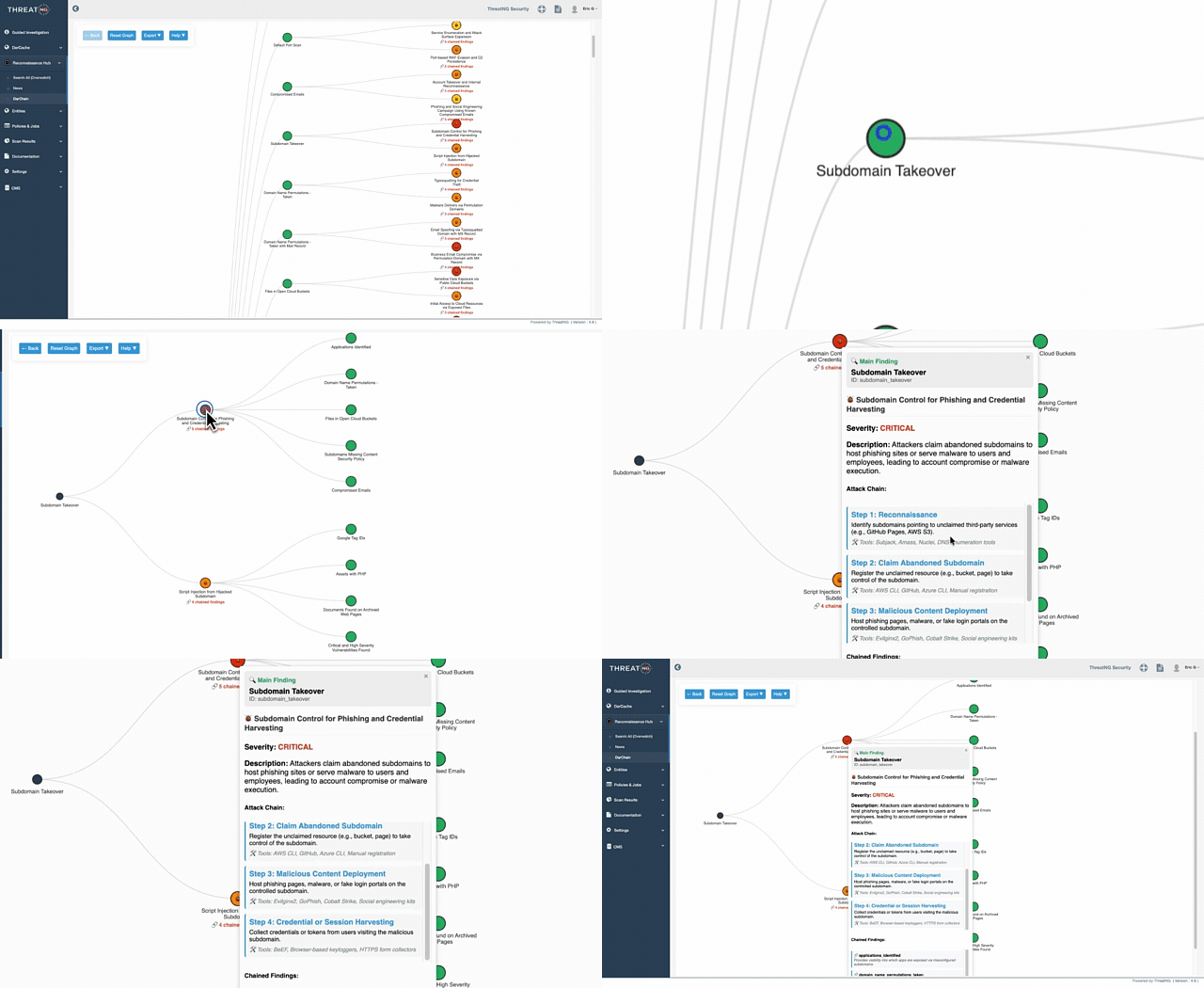
ThreatNG uses DarChain (External Contextual Attack Path Intelligence) to iteratively correlate isolated technical, social, and regulatory exposures into a structured, threat-informed Threat Model. By cross-referencing exposed assets with active adversary behavior, DarChain maps the precise exploit chain showing exactly how a missing security header leads to an exploited PHP vulnerability, resulting in the compromise of a private IP. By identifying the exact "Attack Choke Points," your team can disrupt the adversary's narrative before a threat ever escalates into a crisis.
Protecting the Boardroom: Global Regulatory Defense and Shadow AI
In a landscape defined by global regulatory volatility, ignorance of your external attack surface is increasingly classified as gross negligence. Regulators worldwide are holding boards and executives directly liable for compliance failures.
Global Compliance & Executive Defense: Whether navigating the EU's Digital Operational Resilience Act (DORA), the NIS 2 Directive, sector-specific mandates, or SEC cyber disclosure rules, organizations must demonstrate continuous evidence of resilience. ThreatNG's External GRC Assessment natively maps external findings to these critical global frameworks, providing the mathematically verifiable evidence required to prevent high-profile disclosure events, navigate audits, and protect executive leaders from personal liability.
Non-Human Identity (NHI) & Shadow AI Exposure: As organizations rapidly adopt AI, autonomous agents bypass traditional MFA protections. ThreatNG specifically quantifies NHI exposure by scanning global marketplaces and code repositories for inadvertently leaked API tokens, AWS keys, and high-privilege machine identities, eliminating your most critical modern blind spots.

Seeing the Full Picture: ThreatNG EASM for Comprehensive External Attack Surface Management
ThreatNG EASM offers a holistic approach to external attack surface management (EASM) beyond mere discovery scanning and provides a comprehensive view of potential security risks across all digital presence areas. This empowers organizations to proactively manage their external attack surface and mitigate cyber threats before they can exploit vulnerabilities.

Domain Intelligence
DNS, Subdomain, Certificate, and IP Intelligence: ThreatNG EASM goes beyond simply identifying domains. It delves into the details, uncovering subdomains, certificates, and IP addresses associated with the organization, third parties, and the supply chain. This provides a holistic view of the entire attack surface.
Exposed API and Development Environment Discovery: ThreatNG EASM identifies publicly accessible APIs and development environments, which are potential entry points for attackers.
VPN Discovery, Application Discovery, and Known Vulnerability Scans: It finds exposed VPNs, applications, and known vulnerabilities across the attack surface, enabling remediation efforts to be prioritized.

Cloud and SaaS Exposure
Cloud Service Scrutiny: ThreatNG EASM identifies sanctioned and unsanctioned cloud services, potential impersonations, and open cloud buckets, providing a clear picture of the cloud landscape.
SaaS Implementation Discovery: It identifies various SaaS applications the organization uses, such as CRM, CMS, or marketing tools, assessing their potential security risks.

Sensitive Code Exposure
Discovers public code repositories containing passwords, API keys, or configuration files that attackers could exploit.
Identifies mobile applications with security flaws.

Online Sharing Exposure
ThreatNG EASM investigates data-sharing platforms like Pastebin for leaks of sensitive information related to the organization.

Sentiment and Financials
Analyzes news, lawsuits, and financial filings to identify potential negative press or economic issues that attackers could exploit to damage the organization's reputation.

Archived Web Pages
ThreatNG EASM can analyze archived web pages for potential security risks, such as exposed credentials or outdated configurations.

Dark Web Presence
Identifies mentions of the organization on the dark web, potentially revealing leaked credentials, association with cyberattacks, or involvement in illegal activities.
Technology Stack
It creates an inventory of the organization's technologies, allowing for the identification of known vulnerabilities associated with specific software or platforms.

Search Engine Exploitation
Uncovers sensitive information unintentionally exposed through search engines, such as error messages, leaked credentials, or public cloud storage buckets.

Social Media
ThreatNG EASM goes beyond just identifying social media accounts. It analyzes content, hashtags, links, and tags, providing insights into potential security risks or public relations concerns.

Curing the Contextual Certainty Deficit
Modern security teams are drowning in a "Contextual Certainty Deficit" burdened with massive lists of isolated technical vulnerabilities but lacking the strategic business context to prioritize them. Legacy tools hand you a disorganized pile of bricks; ThreatNG delivers the architectural blueprint. By using our proprietary Context Engine™, ThreatNG translates chaotic technical findings into irrefutable, observed evidence, delivering Legal-Grade Attribution. This empowers the CISO to stop reacting to alert noise and step into the empowered role of the "Score Auditor," armed with the exact mathematical proof needed to dispute unjust third-party security ratings and keep legacy rating agencies honest.

BEC & Phishing Susceptibility
This assessment is derived from an in-depth analysis considering sentiment and exposed employee credentials, domain intelligence, and dark web presence. By understanding which departments or individuals are most at risk based on these factors, you can implement targeted security awareness training and minimize the likelihood of successful attacks.

Brand Damage Susceptibility
A comprehensive assessment of your organization's vulnerability to risks that could damage your brand is provided by ThreatNG EASM. It incorporates attack surface intelligence, digital risk intelligence related to ESG practices and financial health (including lawsuits, SEC filings, and negative news), sentiment analysis, and domain intelligence. Additionally, it helps identify threats from phishing attacks and other social engineering techniques. This empowers proactive public relations efforts to mitigate potential damage and safeguard your brand reputation.

Breach & Ransomware Susceptibility
This assessment thoroughly analyzes domain intelligence, exposed sensitive ports, known vulnerabilities, and even your dark web presence. By aggregating this intelligence, ThreatNG EASM offers a threat-informed view of your overall breach and ransomware risk levels. This data-driven approach enables you to prioritize remediation efforts based on the vulnerabilities attackers are actively exploiting in the wild,, ultimately reducing the likelihood of a security breach or costly ransomware attack.

Cyber Risk Exposure
This assessment considers critical areas like Domain Intelligence, Code Secret Exposure (discovering and analyzing exposed code repositories for sensitive data), Cloud and SaaS Exposure (evaluating cloud services and SaaS solutions), and compromised credentials found on the dark web. This multi-faceted analysis accurately evaluates your organization's cyber risk exposure, empowering leadership to make data-driven decisions and proactively mitigate exploitable vulnerabilities before attackers can exploit them.
Data Leak Susceptibility
By analyzing Cloud and SaaS Exposure, ThreatNG EASM gauges the probability of sensitive data from your organization being leaked. It uncovers exposed cloud buckets and assesses your Dark Web Presence and Domain Intelligence. This evaluation empowers leadership to prioritize critical information security, minimizing the risk of costly breaches with a clear understanding of these potential leak points.

Mobile App Exposure
Assesses how exposed an organization's mobile apps are in marketplaces and within their content for sensitive information. The rating helps identify potential entry points for attackers by checking for leaked access credentials, security credentials, and platform-specific identifiers.

ESG Exposure
Beyond sentiment analysis, ThreatNG EASM incorporates financial health checks and publicly available information. It delves into specific areas such as competition, consumer issues, employment practices, environmental impact, economic standing, government interactions, healthcare data security, and safety incidents. By providing a holistic view of these ESG risk factors, organizations are empowered to identify potential problems, assess compliance with regulations, and ultimately improve their overall ESG performance while reducing exposure to reputational and financial risks.

Supply Chain & Third Party Exposure
Security vulnerabilities in your third-party ecosystem can pose a significant risk to your organization. ThreatNG EASM assesses the external attack surface of your third-party vendors, allowing you to identify and mitigate potential risks before they can impact your organization. This reduces the likelihood of disruptions to your operations and protects your reputation.

Subdomain Takeover Susceptibility
A compromised subdomain can be used for phishing attacks or malware distribution, damaging your brand reputation and potentially leading to customer data breaches. ThreatNG EASM identifies takeover susceptibility for subdomains hosting sensitive information or supporting business-critical functionalities. This ensures leadership prioritizes securing these assets to minimize reputational and financial losses.

Web Application Hijack Susceptibility
Understanding the business context of a potential web application hijack is critical. ThreatNG EASM assesses the hijack susceptibility of mission-critical applications. This allows leadership to prioritize remediation efforts based on potential disruption to revenue streams, customer service, or other essential business functions.

Non-Human Identity (NHI) Exposure
Achieve unparalleled visibility by continuously identifying high-privilege Non-Human Identity (NHI) sprawl, such as hardcoded API keys and exposed cloud service accounts, using an external, unauthenticated perspective. This dedicated A-F security rating transforms these chaotic technical findings into prioritized, actionable intelligence for immediate EASM remediation.

External Adversary View
Your Attack Surface Isn't Just What You Own—It's How an Attacker Sees You
Managing your external attack surface requires more than just listing assets; it requires understanding how those assets could be exploited. The ThreatNG External Adversary View offers this essential threat-informed perspective. It goes beyond cataloging open ports and subdomains by linking separate findings, such as compromised credentials, vulnerable applications, and cloud misconfigurations, with active threat intelligence into coherent attack paths that an adversary is most likely to follow. By aligning these paths with frameworks like MITRE ATT&CK, we help you understand how your attack surface may be targeted, enabling you to prioritize and address the most critical threats.

External GRC Assessment
Securing the C-Suite: Aligning Global External Risk with Global Regulatory Demands
In 2026, global regulatory shifts have redefined cybersecurity as a fundamental pillar of corporate governance, making it a critical priority for boards across all industries, from multinational enterprises to specialized service providers. As oversight bodies worldwide demand greater transparency and faster incident reporting, organizations can no longer afford to have gaps in their external risk visibility. ThreatNG’s External GRC Assessment addresses this by mapping global digital findings directly to essential compliance frameworks, including the SEC’s 8-K requirements, GDPR, PCI DSS, and NIST CSF. By providing mathematically verifiable proof of operational resilience, we enable leadership teams and legal counsel to demonstrate due diligence, successfully navigate audits, and protect executives from the personal liability risks inherent in today's interconnected landscape.









AI-Enabled External CTEM
Fueling AI-Enabled External CTEM with Foundational EASM
While External Attack Surface Management (EASM) gives your security team the critical tools to identify, monitor, and secure your internet-facing assets, raw visibility alone can quickly lead to alert fatigue. EASM is most effective when it serves as the foundational discovery layer within a broader Continuous Threat Exposure Management (CTEM) framework. By integrating this continuously updated view of your external exposure into ThreatNG’s Contextual AI Abstraction Layer, we prioritize real-world risk over static vulnerability scores. This verified, hallucination-free ground truth directly feeds our Cybersecurity AI Prompts (DarcPrompt), empowering you to safely generate board-ready mitigation strategies using your own Enterprise AI.

Eradicating the Seed Data Blind Spot
Legacy EASM tools act as sophisticated port scanners, requiring manual domain lists to begin scanning, which leaves you blind to your biggest risks. ThreatNG breaks the "Connector Trap". Using our patented, unauthenticated recursive discovery (US Patent No. 11,962,612 B2), we require zero API keys, internal credentials, or manual seed data to operate. We dynamically map your true digital footprint from the outside in, uncovering hidden subsidiaries, rogue multi-cloud storage, and unsanctioned Shadow IT exactly as an adversary sees them.

Contextualizing the Attack Path
Stop chasing thousands of contextless vulnerabilities. ThreatNG’s Context Engine™ uses Multi-Source Data Fusion to eliminate the "Crisis of Context". We move beyond generic technical severity by evaluating risks like BEC & Phishing Susceptibility, Brand Damage, and Non-Human Identity (NHI) Exposure. Powered by DarChain, the platform iteratively correlates technical flaws and social exposures into a visual exploit chain, pinpointing the exact "Attack Choke Points" where a single remediation can disrupt multiple adversarial narratives before a crisis occurs.
Delivering Legal-Grade Attribution
Security reporting shouldn't be a multi-day manual fire drill. ThreatNG delivers "Legal-Grade Attribution," transforming chaotic security noise into irrefutable, mathematically verified evidence. Through dynamically generated Correlation Evidence Questionnaires (CEQs), we provide the exact evidentiary ammunition you need to act as a "Score Auditor," allowing you to confidently dispute erroneous penalties from legacy rating agencies and protect your cyber insurance premiums. All intelligence is securely routed via granular Role-Based Access Control (RBAC) to ensure precise, prioritized operational mandates.

Automated Resilience and CTEM Alignment
In an era of intense regulatory scrutiny, annual audits are no longer sufficient. ThreatNG provides continuous visibility to support Continuous Threat Exposure Management (CTEM) initiatives, shifting your posture from reactive alert triage to threat-informed continuous attack surface validation. By continuously refreshing our DarCache intelligence repositories with the latest active threats and automatically aligning findings with SEC 8-K cyber reporting and DORA compliance mandates, ThreatNG ensures your boardroom has real-time, mathematically proven visibility into your corporate resilience.

Eliminating the Hidden Tax on the SOC
Your most elite security personnel should be hunting threats, not acting as administrative clerks. Legacy rating agencies and high-volume Digital Risk Protection (DRP) vendors impose a massive "Hidden Tax on the SOC," forcing analysts to waste hundreds of hours manually gathering logs to dispute erroneous algorithmic penalties and false positives. ThreatNG eliminates this operational bloat entirely through intelligent governance.
Role-Based Access Control

Granular Role-Based Access Control (RBAC) ensures that this sensitive intelligence and evidentiary reporting are securely routed only to the authorized stakeholders. By automating asset validation and streamlining secure collaboration, ThreatNG replaces multi-day manual fire drills with instant, frictionless clarity.
Correlation Evidence Questionnaires

When external validation is required, the platform dynamically generates Correlation Evidence Questionnaires (CEQs). These CEQs replace subjective, claims-based security assessments with irrefutable, observed evidence of external risk, providing the exact evidentiary ammunition needed to resolve rating disputes instantly.
Policy Management

Through customizable Policy Management, organizations can define their specific cyber risk appetite and dynamically tailor risk scoring, ensuring teams only focus on vulnerabilities that violate internal thresholds.

Seeing the Bigger Picture: ThreatNG EASM's Intelligence Repositories Fortify Your Security Posture
ThreatNG EASM provides a superior assessment of your external online environment by leveraging a comprehensive suite of intelligence repositories called DarCache. These repositories, encompassing dark web data, ESG violation tracking, and ransomware event monitoring, provide a holistic view of your organization's threats and its extended ecosystem, empowering proactive risk mitigation.

Dark Web
ThreatNG archives, normalizes, and indexes the first level of the Dark Web to allow for safe, sanitized searching of organizational mentions and threats. This capability enables early detection of planned attacks and illicit discussions without exposing security teams to the inherent risks of direct Dark Web navigation.

ESG Violations
This repository tracks publicly disclosed Environmental, Social, and Governance (ESG) violations to identify lapses that could damage brand reputation or incur regulatory fines. By scanning relevant data sources for these offenses, ThreatNG empowers organizations to uphold ethical standards and maintain investor confidence.

Infostealer Logs
This repository aggregates data from malware logs to identify active infections where "infostealers" have exfiltrated valid session cookies and login details from employee or customer devices. Detecting these specific indicators allows security teams to revoke compromised sessions and prevent account takeovers that might otherwise bypass Multi-Factor Authentication (MFA).
Ransomware Events
ThreatNG monitors a diverse landscape of ransomware groups and their activities, analyzing documented events and criminal chatter to identify emerging trends. This intelligence allows organizations to proactively implement defenses against specific adversarial tactics and mitigate the risk of encryption or extortion attacks.

Compromised Credentials
Derived from the DarCache Rupture repository, this feature continuously monitors for organizational emails and passwords exposed in data breaches. Early detection of these compromised credentials facilitates immediate remediation steps, such as password resets, to prevent unauthorized system access.

SEC Form 8-Ks
This repository aggregates SEC Form 8-K filings to analyze how peer organizations disclose material cybersecurity incidents and their financial impacts. Gaining insights from these real-world breach disclosures enables companies to benchmark their own defenses and anticipate emerging sector-specific threats.

Known Vulnerabilities
ThreatNG transforms raw data into decision-ready verdicts by fusing National Vulnerability Database (NVD) severity with real-time exploitation evidence and predictive scoring. This threat-informed approach prioritizes remediation efforts for vulnerabilities that pose an immediate, proven threat to the organization's specific external attack surface.

Bank Identification Numbers (BINs)
This repository allows organizations to scan exposed data, for specific Bank Identification Numbers (BINs) associated with their financial operations. Identifying these exposed financial identifiers triggers immediate alerts, allowing teams to swiftly contain leaks and minimize potential financial fraud.

Bug Bounty Programs
By analyzing data from documented in-scope and out-of-scope bug bounty programs, ThreatNG provides crucial insights into common vulnerabilities across various industries. This crowdsourced intelligence helps security teams identify systemic weaknesses and prioritize remediation based on real-world research findings.

Mobile Applications
ThreatNG assesses mobile applications across various marketplaces to uncover embedded risks, including hardcoded API keys, exposed credentials, and platform-specific identifiers. This deep analysis enables organizations to secure their mobile ecosystem by identifying and addressing vulnerabilities that are often overlooked in standard perimeter scans.

Frequently Asked Questions: Reclaiming the External Attack Surface with ThreatNG
-
The Contextual Certainty Deficit refers to the systemic failure of legacy security tools to provide internal business context alongside technical findings, resulting in a paralyzing volume of unprioritized, context-free data. When your team receives massive lists of isolated vulnerabilities without knowing the strategic impact, they suffer from severe alert fatigue. ThreatNG cures this deficit by converting chaotic technical findings into a structured, mathematically verifiable threat model, providing a precise and prioritized operational mandate rather than endless noise.
-
Legacy Security Rating Services (SRS) like BitSight and SecurityScorecard operate as context-blind algorithms, routinely penalizing organizations for vulnerable IP addresses or subdomains that actually belong to third-party vendors or were relinquished years ago. ThreatNG solves this through Legal-Grade Attribution. By providing irrefutable, observed evidence confirming actual asset ownership, ThreatNG empowers CISOs to act as "Score Auditors". You can take this mathematical proof directly to rating agencies to instantly dispute erroneous algorithmic penalties, correct your scores, and protect your cyber insurance premiums from unjust inflation.
-
Many legacy EASM platforms act merely as sophisticated port scanners that require you to manually input known domains and IPs (seed data) to begin scanning. This inherently misses your "unknown unknowns," such as rogue cloud buckets spun up by third-party marketing agencies or infrastructure from newly acquired subsidiaries. ThreatNG eliminates this blind spot through its patented Recursive Discovery process (US Patent No. 11,962,612 B2), which requires zero input, zero seeds, and no internal agents to dynamically map your entire true digital estate from the outside in.
-
By 2026, non-human identities, such as service accounts and autonomous AI agents, vastly outnumber human identities in the enterprise, frequently operating with high privileges and bypassing traditional Multi-Factor Authentication (MFA). Furthermore, when employees utilize unvetted AI tools ("Shadow AI"), they risk placing proprietary code and sensitive data into public training sets. ThreatNG specifically quantifies NHI Exposure by scanning global marketplaces and code repositories for inadvertently leaked API tokens, AWS keys, and high-privilege machine identities, eliminating this massive, modern blind spot.
-
While legacy tools hand you a "pile of bricks"—a disorganized list of vulnerabilities—DarChain provides the architectural blueprint. DarChain is ThreatNG's External Contextual Attack Path Intelligence engine, which iteratively correlates isolated technical exposures into a coherent step-by-step adversary narrative. For example, DarChain maps exactly how an adversary uses a missing security header to exploit a PHP Remote Code Execution (RCE) vulnerability, ultimately leading to the compromise of private, internal IPs. This pinpoints the exact "Attack Choke Points" you need to remediate to break the kill chain before a crisis occurs.
-
Yes. Modern regulatory frameworks mandate continuous validation of the attack surface, not just point-in-time scanning. Under SEC rules, failing to monitor discoverable assets can lead to severe penalties, and companies must disclose material cybersecurity incidents within four business days. ThreatNG’s External GRC Assessment directly maps your external attack surface findings to crucial frameworks including SEC 8-K filing requirements, PCI DSS, GDPR, and NIST CSF, giving boardrooms real-time, mathematically proven visibility into corporate resilience.
-
Traditional security reporting focuses exclusively on negative findings and vulnerabilities, which fails to show the return on investment for existing defensive stacks. ThreatNG actively scans for Positive Security Indicators—detecting the presence and effectiveness of beneficial controls like Web Application Firewalls (WAFs), Multi-Factor Authentication (MFA), and robust SPF/DMARC policies. This allows MSSPs and internal security leaders to definitively prove to their clients and boards that the defensive tools they previously deployed are actively working, providing a balanced, comprehensive view of the organization's true security posture.
External Attack Surface Management (EASM) Use Cases
Delve into the various use cases for EASM and how it can benefit your organization's security posture. With cyber threats evolving constantly, it's critical to have a clear understanding of your organization's attack surface and potential vulnerabilities that may exist. At ThreatNG, we specialize in providing advanced solutions for EASM, and we're thrilled to share our knowledge with you. Our platform offers powerful features to help you identify and mitigate potential threats, manage third-party risks, and ensure regulatory compliance. So, click through to learn more about how the ThreatNG Security Platform can help you safeguard your organization against external threats.
Predictive External Intelligence
Subsidiary Monitoring and M&A Due Diligence
Subsidiary & Third Party Security Monitoring
Supply Chain / Third Party Risk Management
Threat-Informed External Attack Surface Management
Threat Intelligence and Response
Threat Hunting and Investigations