


External DPDPA Assessment
Secure Your Legacy, Not Just Your Network: The First "No Connector" External DPDPA Assessment
The Digital Personal Data Protection Act, 2023 (DPDPA) has shifted the ground beneath Indian CISOs. You are no longer just managing operational risk; you are managing personal fiduciary liability. Under Section 8(5) of the DPDPA, a single overlooked "Shadow IT" asset can trigger a penalty of ₹250 Crore for failure to implement reasonable security safeguards. The regulator does not check your internal dashboards; they audit you from the outside. ThreatNG provides that exact Regulator’s View instantly. We bridge the gap between technical vulnerability and legal liability by mapping your external attack surface directly to DPDPA mandates. Best of all, we do it with Zero Touch. In other words, no agents, no credentials, and no "Connector Tax" giving you the immediate clarity needed to protect your organization and your reputation before a notice arrives.
Transform Technical Chaos into Fiduciary Confidence

Eliminate the "Connector Tax" and Stop Shelf-ware Fatigue
The Pain: You are overwhelmed by tools that demand months of integration, firewall modifications, and agent management. This hidden "Connector Tax" transforms costly software into ineffective shelfware. In a market dealing with a significant skills shortage, you cannot afford any additional friction.
The ThreatNG Solution: ThreatNG respects your time and your team’s sanity. Our External Discovery engine operates entirely Outside-In, replicating the reconnaissance tactics of nation-state attackers and DPDPA auditors.
No Agents, No APIs, No Credentials: Get a comprehensive audit of your digital estate in hours, not months.
Total Visibility: Explore the concept of "unknown unknowns," including rogue marketing sites, overlooked cloud buckets, and third-party SaaS applications that internal scanners often fail to detect because of the need for installation.
The Payoff: Stop managing tools and start managing risk. Experience the relief of instant time-to-value.
Transform Technical Vulnerabilities into "Legal-Grade" Fiduciary Defense
The Pain: When the Board asks, "Are we compliant with DPDPA Section 8(5)?", showing them a list of 10,000 unpatched CVEs is meaningless. It creates confusion, not confidence. You fear the ₹250 Crore fine because you cannot prove "reasonable security safeguards" for assets you don't know exist.
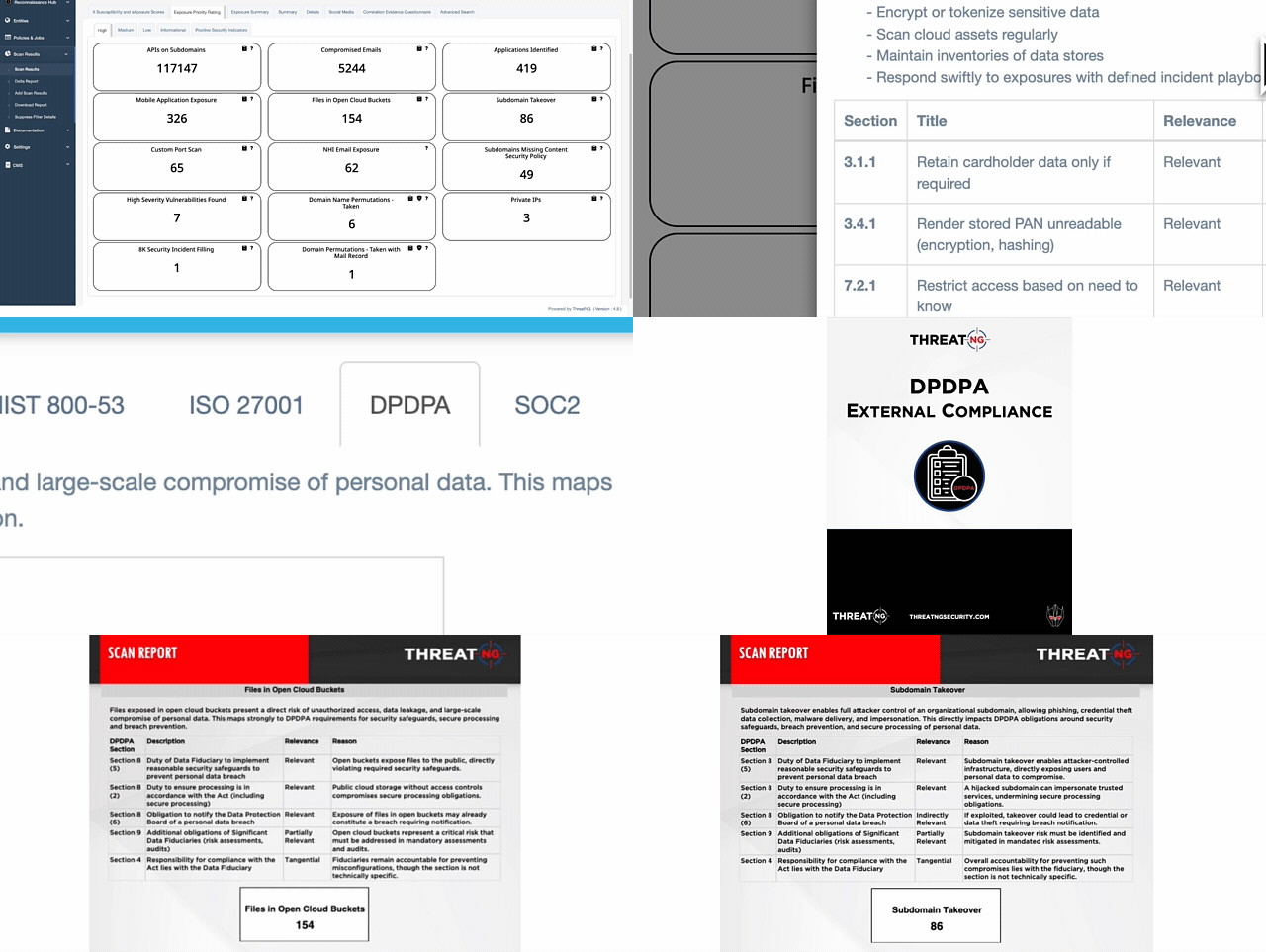
The ThreatNG Solution: We translate technical chaos into business clarity. Our External DPDPA Assessment module automatically maps technical findings such as Subdomain Takeovers, Open Cloud Buckets, and Exposed Databases, directly to specific legal violations.
Fiduciary Shield: Generate reports that serve as evidence of "Due Diligence" for the Data Protection Board of India (DPBI).
Prioritized Remediation: Use DarcRadar to filter out noise and focus purely on the 1% of risks that carry regulatory liability.
The Payoff: Walk into the boardroom with Validation. You aren't just a tech leader; you are a strategic guardian of the company's future.
Shatter the "Green Dashboard" Illusion Before the Breach Happens
The Pain: The most terrifying breaches happen via assets that showed "Green" on internal dashboards because they were never monitored in the first place. Past incidents have proved that data leaks via third-party bots and shadow assets can destroy trust overnight.
ThreatNG Solution: We shine a light on the blind spots. Using DarChain (Attack Path Intelligence), we don't just find a bug; we show you the path to a breach.
Prevent Data Leakage: Detect Compromised Emails and exposed Bank Identification Numbers (BINs) in mobile apps before they are weaponized.
Supply Chain Vigilance: Audit your vendors (Data Processors) from the outside to ensure they aren't dragging you into a Section 8(2) violation.
The Payoff: Replace the fear of the "inevitable breach" with the power of Preemption. Find the leak. Fix the leak. Silence the threat.
External DPDPA Compliance Visibility
Map Technical Risks to Legal Obligations
The ThreatNG External DPDPA Assessment Report delivers a proactive, outside-in analysis of your organization’s digital footprint, directly correlating external exposures with specific Digital Personal Data Protection Act (DPDPA) mandates. By aggregating publicly accessible intelligence such as exposed cloud buckets, compromised credentials, and missing security headers, this report identifies vulnerabilities that threaten "reasonable security safeguards" (Section 8(5)) and "secure processing" (Section 8(2)) requirements. Designed for Data Fiduciaries, the assessment bridges the gap between technical security findings and legal accountability, helping organizations prioritize remediation efforts to prevent personal data breaches and ensure regulatory compliance.
Why ThreatNG?
For End Organizations
You get a "Digital Mirror" that reflects exactly what the regulator sees, allowing you to fix liabilities before they become fines.
For Service Providers (MSSPs)
Stop selling hours; start selling Compliance Assurance. Offer your clients instant, continuous DPDPA audits without the deployment headaches.

Frequently Asked Questions (FAQ): DPDPA External Risk and Compliance
The Regulatory Risk
-
Under the Digital Personal Data Protection Act (DPDPA), 2023, the regulator views your organization from the outside-in. Unlike internal policies, your external attack surface, which includes exposed cloud buckets, forgotten subdomains, and shadow IT, is public evidence of negligence. If a data breach occurs via an external asset you didn't know about, it directly violates Section 8(5) (Duty to implement reasonable security safeguards), exposing your organization to penalties up to ₹250 Crore. You cannot defend what you cannot see, and traditional internal tools cannot see what is outside the firewall.
-
Yes. The DPDPA operates on a strict liability model regarding the "Data Fiduciary." You are responsible for all personal data processing undertaken by your organization, regardless of whether IT authorized the infrastructure. A rogue marketing microsite or a developer's test server leaking data is considered a failure of "reasonable security safeguards." ThreatNG’s External DPDPA Assessment is designed specifically to find these unauthorized "Shadow" assets before the Data Protection Board of India (DPBI) does.
-
While the penalty is decided case-by-case, the maximum fine targets the failure to prevent a personal data breach. The most direct triggers visible from the outside include:
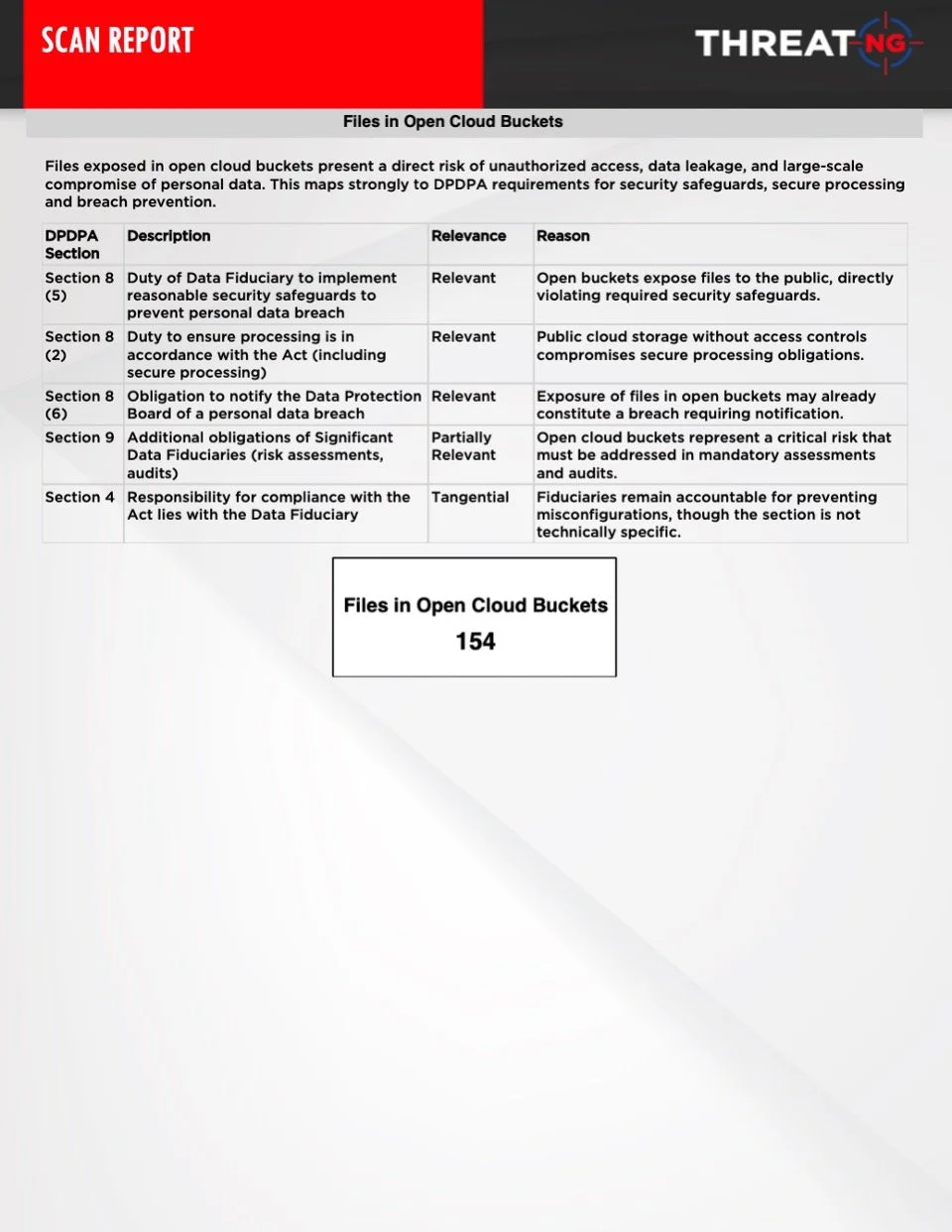
1. Open Cloud Buckets: Files containing PII exposed publicly (AWS S3, Azure Blob).
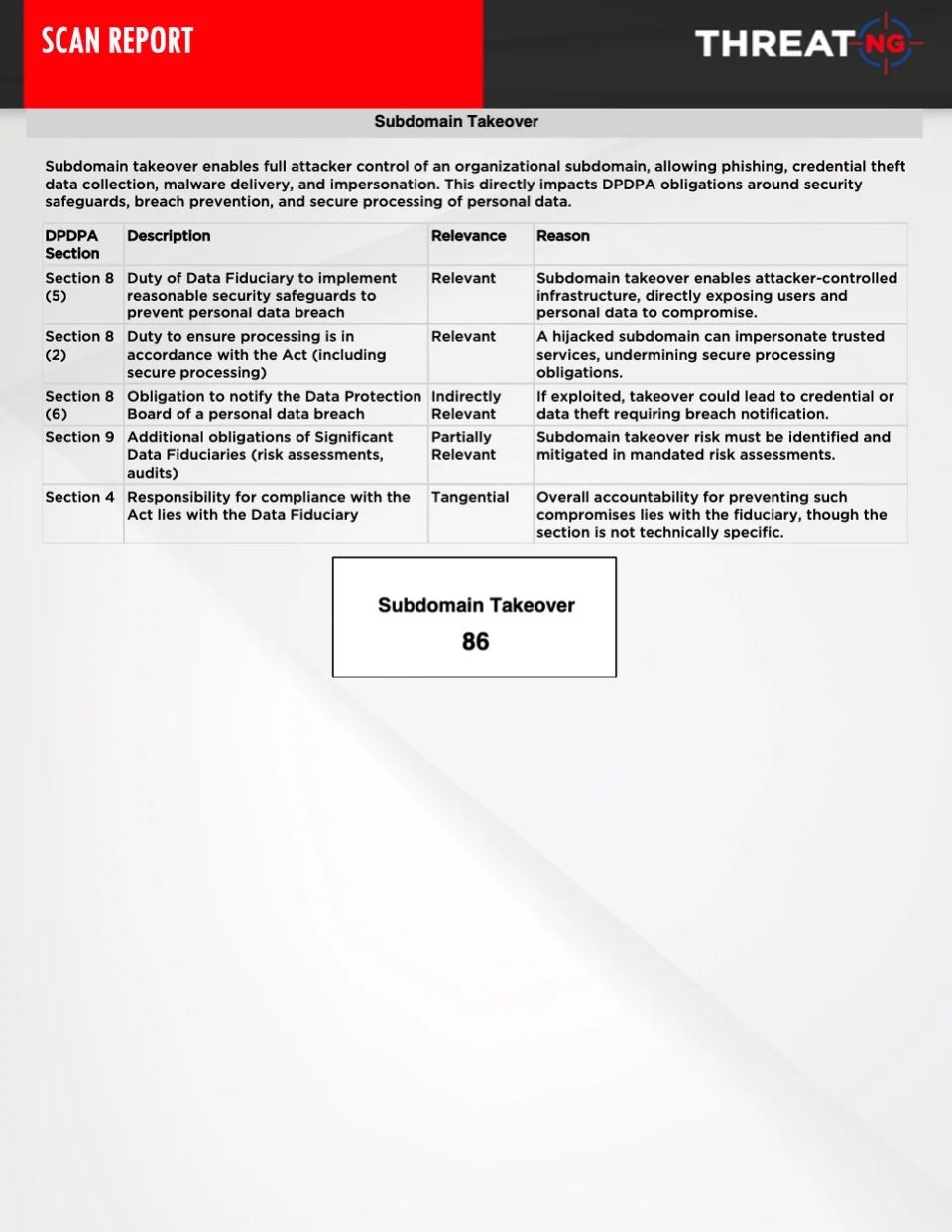
2. Subdomain Takeovers: Allowing attackers to host phishing sites on your legitimate domain.
3. Exposed Databases: Default ports open for MongoDB, Elasticsearch, or SQL.
ThreatNG maps these specific technical findings directly to Section 8(5) violations in its reports.
-
Technical gaps such as a missing Content Security Policy (CSP) directly impact your obligation under Section 8(5) to implement "reasonable security safeguards." A lack of CSP exposes users to Cross-Site Scripting (XSS) and data exfiltration risks, which can be cited as a failure to prevent a personal data breach. Additionally, this finding is relevant to Section 8(2) regarding the duty to ensure secure processing environments.
-
Compromised credentials are a critical indicator that your security safeguards (mandated by Section 8(5)) have failed or been degraded. If these credentials lead to unauthorized access of personal data, it constitutes a personal data breach that triggers the mandatory notification requirement to the Data Protection Board under Section 8(6).
-
Files exposed in open cloud buckets present a direct risk of large-scale compromise of personal data, mapping strongly to a violation of Section 8(5) (Security Safeguards). Furthermore, if the exposed files contain personal data, this exposure may already constitute a reportable breach under Section 8(6), requiring immediate action to avoid penalties for non-notification.
-
Mentions of your organization on the dark web often indicate that data or credentials have already been compromised. This is directly relevant to Section 8(6), as it may be the first evidence of a personal data breach that requires notification to the Board and affected Data Principals. It also serves as evidence that existing safeguards under Section 8(5) may need immediate strengthening.
The ThreatNG Solution
-
ThreatNG uses a proprietary "No Connector" / "Outside-In" discovery engine. We replicate the reconnaissance techniques used by nation-state attackers and regulators. We scan the entire public internet, associating digital assets (domains, subdomains, cloud buckets, code repositories) to your organization using open-source intelligence (OSINT) and advanced attribution methods. This means you get a comprehensive audit of your DPDPA liability in hours, not months, with zero integration effort.
-
Internal scanners suffer from the "Green Dashboard Fallacy." They only scan known assets where you have installed an agent or provided credentials. They are blind to "Shadow IT," which is assets created by employees outside of central IT's knowledge. DPDPA regulators penalize you for the unknowns. ThreatNG complements your internal tools by highlighting the unmanaged external attack surface that internal scanners miss.
-
The "Connector Tax" is the hidden cost of traditional security tools: the weeks spent getting approval for firewall rules, configuring API keys, and managing software agents. In the current Indian market, where security teams are facing high burnout, this friction prevents compliance. ThreatNG requires no configuration, credentials, or agents, eliminating this tax completely and providing immediate time-to-value.
Operational Benefits
-
Under Section 29, Significant Data Fiduciaries must undergo periodic independent data audits. ThreatNG acts as a continuous, automated pre-auditor. Our External GRC Assessment provides a timestamped, third-party report detailing your external data posture. This allows you to proactively fix issues (like exposed PII in mobile apps) before the official auditor arrives, ensuring a clean report and demonstrating "due diligence" to the Board.
-
For all Data Fiduciaries, critical vulnerabilities create pathways for compromise that violate Section 8(5). However, for Significant Data Fiduciaries, these findings are especially critical under Section 9. SDFs are required to conduct periodic Data Protection Impact Assessments (DPIAs) and independent audits; unmitigated high-severity vulnerabilities would be material findings in these mandatory assessments.
-
Most security tools increase workload by generating thousands of unprioritized alerts. ThreatNG reduces burnout through Contextual Prioritization. We don't just list vulnerabilities; we use DarChain (Attack Path Intelligence) to show you only the risks that lead to a significant breach or regulatory fine. For example, we differentiate between a "low risk" server and a "critical risk" server that is exposing customer data and violating DPDPA Section 8(5). This helps teams focus on the 1% of alerts that actually matter.
-
Yes. The Star Health incident highlighted the dangers of data leakage and lack of external visibility. ThreatNG prevents similar scenarios by:
1. Detecting Leaked Credentials: Finding compromised employee emails on the dark web before they are used for initial access (preventing ransomware).
2. Identifying Mobile App Leaks: Scanning mobile apps in public stores for hardcoded API keys or PII exposure.
3. Monitoring Telegram/Dark Web: Alerting you if your sensitive data is being discussed or sold, allowing for rapid containment.
Technical and Legal Validation
-
When you present a compliance report to your Board or a regulator, you cannot afford false positives ("guessing"). Legal-Grade Attribution is ThreatNG’s ability to definitively prove that a specific external asset (like a rogue server) belongs to your organization. This turns a technical suspicion into a confirmed fiduciary liability, empowering the CISO to demand immediate remediation from IT or business units.
-
Section 8(2) mandates that Data Fiduciaries ensure their Data Processors (vendors) handle data securely.[1] ThreatNG’s Supply Chain Exposure module scans your vendors externally, providing a risk rating for each partner. You can see whether your marketing agency has an open cloud bucket or whether your HR software provider has a lapsed SSL certificate, allowing you to enforce contract compliance without their cooperation.
-
Yes. We offer a complimentary "Attacker's View" DPDPA Assessment. In 24 hours, we will map your external attack surface and highlight your top 3 risks, each directly mapped to DPDPA penalties.