


External FedRAMP Assessment
Conquer the Contextual Certainty Deficit: Automate FedRAMP 20x Persistent Validation and Eradicate the Hidden Tax on Your SOC
The End of Compliance Theater. The transition to FedRAMP 20x is fundamentally changing how cloud service providers operate, permanently replacing static compliance documents with continuous, machine-readable, persistent validation. For CISOs, 3PAO Practice Directors, and MSSP SOC Managers, relying on legacy scanners that dump uncontextualized vulnerabilities onto your team creates a massive "Contextual Certainty Deficit". This forces your highly compensated analysts into a reactive state, manually hunting down algorithmic false positives, a "Hidden Tax on the SOC" that drains enterprise resources and stalls engineering velocity. ThreatNG's External FedRAMP Assessment provides a definitive, unauthenticated attacker's perspective of your boundary, discovering the "Ghost Assets" your internal tools miss. By automatically mapping external findings directly to NIST 800-53 controls and FedRAMP Key Security Indicators (KSIs), ThreatNG empowers you to definitively defend your perimeter, secure your Authority to Operate (ATO), and turn compliance into a strategic revenue engine.
From Algorithmic Guesswork to Mathematical Proof:
Conquer the FedRAMP 20x Mandate, Secure Your Perimeter, and Reclaim Your Security Operations

Eradicate the "Hidden Tax on the SOC" with Legal-Grade Attribution
Stop paying the operational penalty of chasing ghost assets and algorithmic false positives generated by context-blind tools. ThreatNG operates frictionlessly from the outside in, using unauthenticated Recursive Discovery to find the shadow IT, forgotten SaaS applications, and orphaned subdomains that traditional internal scanners overlook. Our Context Engine™ then mathematically verifies asset ownership, providing the irrefutable "Legal-Grade Attribution" required to eliminate alert fatigue. This allows your elite security personnel to stop acting as administrative clerks and return to proactively defending the business.
Achieve "Contextual Certainty" for NIST SC-7 Boundary Validation
In the fight against sophisticated adversaries and bureaucratic audit friction, traditional document reviews are dead. ThreatNG provides a definitive advantage by continuously assessing your external perimeter, exactly as an advanced attacker would. We translate raw technical findings, such as exposed RDP ports or missing Web Application Firewalls, into direct, deterministic failures of NIST SC-7 Boundary Protection controls. This grants you and your 3PAO auditors undeniable, mathematical proof of your security posture, ensuring your authorization boundary matches reality before the formal assessment even begins.
Automate Persistent Validation for the FedRAMP 20x Mandate
With the FedRAMP 20x machine-readable mandate approaching, manual document gathering is no longer just an expensive operational burden; it is a direct threat to your federal contract pipeline. ThreatNG serves as your automated compliance translation engine, converting continuous external reconnaissance data directly into the structured Key Security Indicators (KSIs) demanded by the new federal framework. Through dynamic Correlation Evidence Questionnaires (CEQs), we instantly generate questionnaires backed by the evidence collected by ThreatNG, requiring policy validation and enabling you to effortlessly produce continuous, state-based authorization data.
Automated GRC Reporting: Translating External Exposures into FedRAMP Compliance Evidence
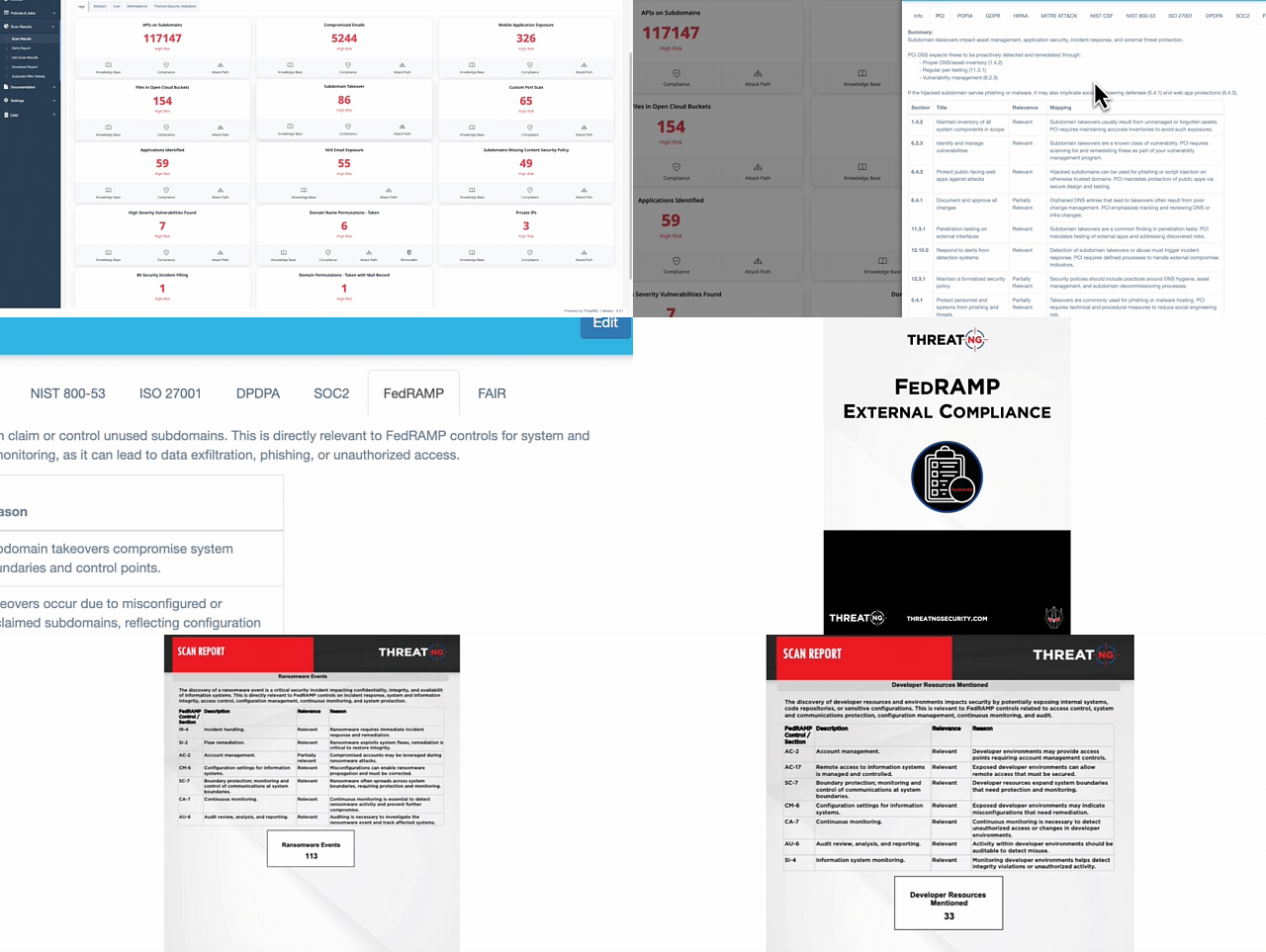
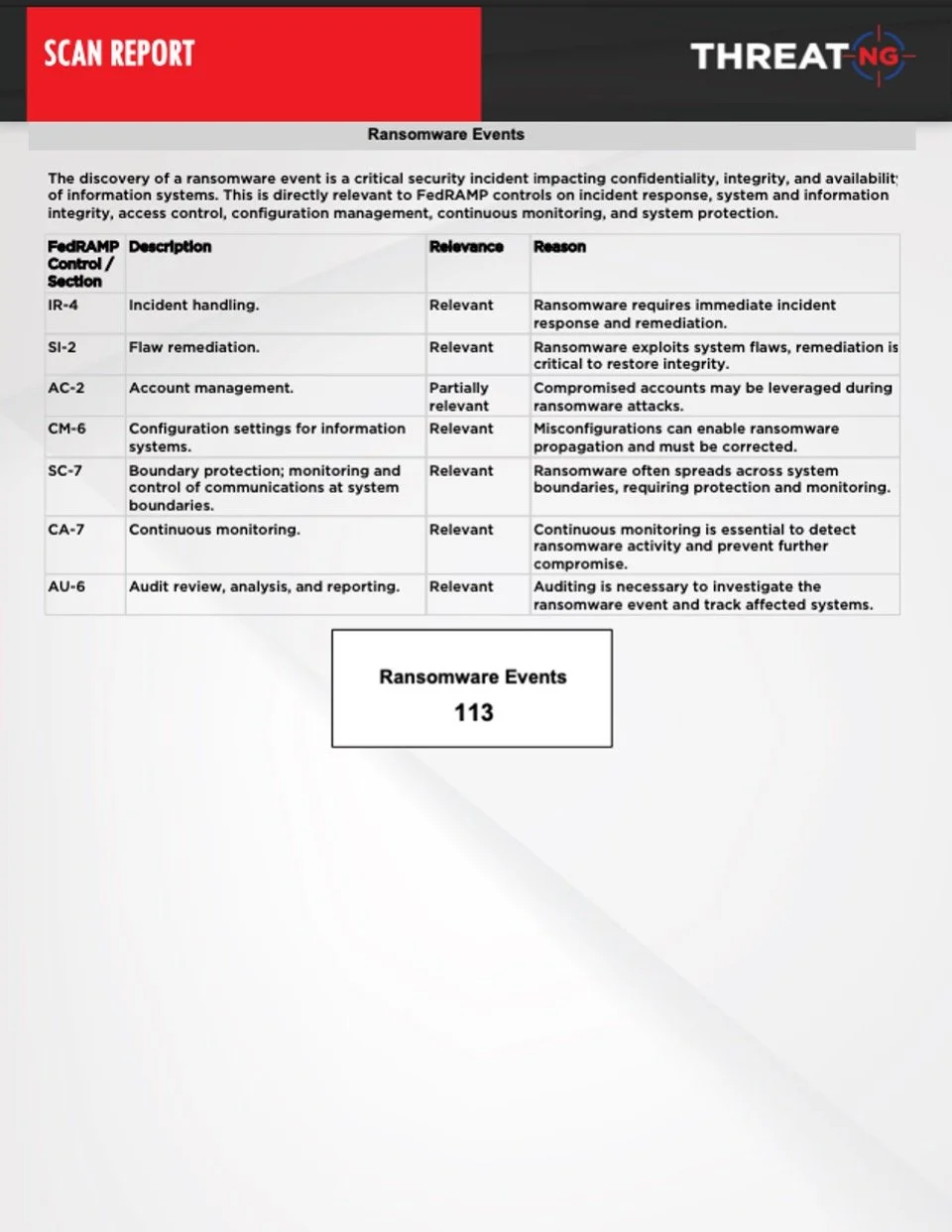
ThreatNG’s External GRC Assessment reporting capability automatically translates unauthenticated external findings into customizable, prioritized reports that map directly to specific FedRAMP and NIST 800-53 control IDs. For example, the discovery of a missing Web Application Firewall (WAF) or a vulnerable public-facing login page is explicitly documented in the report as a definitive failure of the NIST SC-7 (Boundary Protection) control. Similarly, if the platform detects subdomains missing a Content Security Policy (CSP), the generated evidence maps this directly to deficiencies in configuration settings (CM-6) and continuous monitoring (CA-7). By converting raw technical flaws into clear, auditable compliance documentation, ThreatNG delivers the mathematically verifiable proof required for security leaders to demonstrate proactive risk management (RA-3, RA-5), successfully navigate rigorous federal audits, and protect the organization from the severe revenue losses associated with delayed or revoked authorizations.
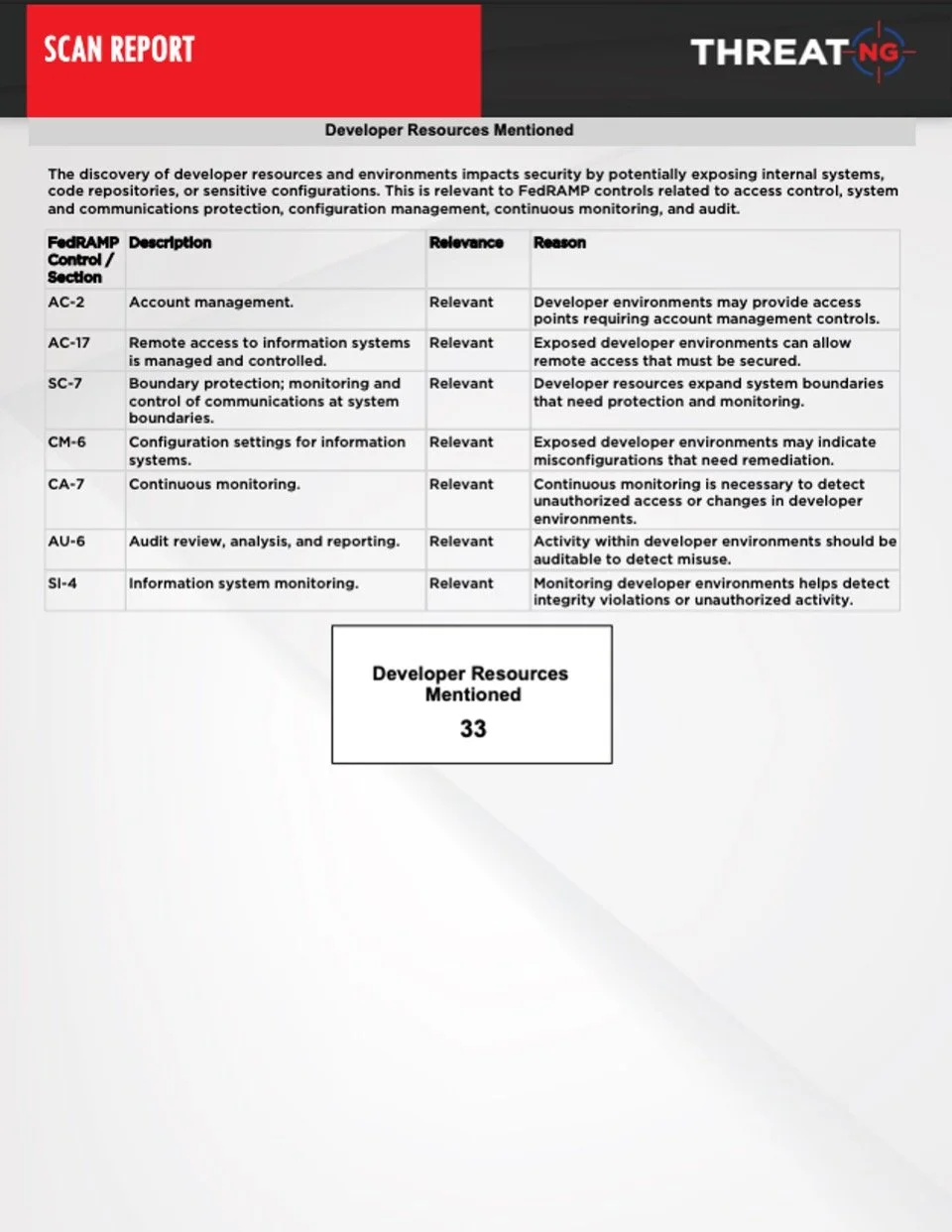
Why ThreatNG?
For End Organizations (Cloud Service Providers)
Replace the anxiety of subjective, point-in-time audits with the absolute certainty of continuous, machine-driven validation. ThreatNG’s External FedRAMP Assessment automatically discovers "unknown" external blind spots, such as Shadow IT, stale DNS entries, and exposed infrastructure, and maps them directly to your required federal compliance controls, such as NIST 800-53 and FedRAMP 20x Key Security Indicators (KSIs). By translating these technical vulnerabilities directly into deterministic compliance data, ThreatNG provides the objective, empirical evidence required to fuel your persistent validation pipelines. This empowers you to confidently accelerate your path to an Authority to Operate (ATO), effortlessly generate the machine-readable authorization packages required by 2026, and definitively prove your continuous security posture to 3PAO auditors before an assessment ever begins.
For Service Providers (MSSPs & 3PAOs)
Differentiate your continuous monitoring (ConMon) and advisory services and drive high-margin revenue by offering automated "Persistent Validation as a Service." With our automated mapping to FedRAMP KSIs, you can provide a continuous "Adversary’s View" and an evidentiary record of external boundary due diligence that internal scanners simply cannot capture. This capability enables your federal and enterprise clients to translate complex external threat data into the precise machine-readable evidence and Quarterly Ongoing Authorization Reports required to maintain their federal contracts. As a result, you can effortlessly justify continuous security retainers, eliminate the "Hidden Tax on the SOC" associated with manual evidence collection, and elevate your role from a technical vendor to an indispensable strategic partner in federal compliance.

Frequently Asked Questions: External FedRAMP Assessment & Persistent Validation
-
Under FedRAMP 20x, traditional document-based compliance is replaced by "Persistent Validation," requiring continuous, machine-readable evidence that security policies are implemented exactly as expected. ThreatNG automates NIST 800-53 SC-7 (Boundary Protection) validation by continuously scanning the external perimeter from an attacker's perspective without needing internal connectors. When an exposure, such as an open RDP port or a missing Web Application Firewall (WAF), is discovered, the platform automatically translates this technical finding into a deterministic failure of Key Security Indicators (KSIs) and SC-7 controls. This provides the exact machine-readable authorization data required by the new framework, proving your perimeter controls are actively effective.
-
The "Hidden Tax on the SOC" is the massive financial and operational drain caused by highly paid security analysts manually investigating algorithmic false positives and chasing uncontextualized alerts. For mid-sized enterprises, this can cost upwards of $468,750 annually in wasted labor. ThreatNG eliminates this operational bloat entirely through Legal-Grade Attribution powered by its Context Engine. Instead of dumping thousands of context-free vulnerabilities onto your team, the platform mathematically verifies asset ownership before generating an alert and dynamically generates Correlation Evidence Questionnaires (CEQs). This replaces multi-day manual fire drills with instant, frictionless clarity and irrefutable proof for auditors.
-
Traditional Cloud Security Posture Management (CSPM) and legacy External Attack Surface Management (EASM) platforms often act as sophisticated port scanners that require you to manually input known domains and IPs (seed data) to begin scanning. Because they only monitor known internal assets, they are inherently blind to the "unknown unknowns" on your perimeter, such as orphaned subdomains, unsanctioned SaaS applications, or stale DNS entries left behind by third-party vendors. ThreatNG eliminates this dangerous blind spot through its patented Recursive Discovery process (US Patent No. 11,962,612 B2), which operates entirely unauthenticated from the outside looking in, requiring zero input to dynamically map your true digital estate.
-
The Contextual Certainty Deficit is the systemic failure of legacy security tools to provide decisive internal business context alongside external technical findings, leaving organizations with a paralyzing volume of unprioritized, context-free data. In FedRAMP continuous monitoring, this deficit creates an "Attribution Chasm": you know an external risk exists, but you cannot definitively prove who owns it, why it matters, or how it maps to your compliance framework. ThreatNG cures this deficit by using multi-source data fusion to provide irrefutable Legal-Grade Attribution. This translates chaotic technical findings into a structured, mathematically verifiable threat model that provides a precise, prioritized operational mandate.
-
FedRAMP 20x fundamentally shifts compliance from static, text-heavy narratives to structured, outcome-based data points. By September 2026, legacy Rev 5 providers are expected to begin producing machine-readable authorization packages (such as OSCAL formats) to maintain their Authority to Operate (ATO), with a final deadline in 2027, subject to ATO revocation. ThreatNG directly supports this impending regulatory cliff by acting as an automated translation layer. It automatically converts unauthenticated external reconnaissance into the deterministic, machine-readable Key Security Indicators (KSIs) required for these continuous authorization packages, allowing you to easily maintain compliance without paralyzing your engineering velocity.