


External SOC 2 Assessment
Transform "Unknown" Shadow IT Risks into Audit-Ready Evidence
Stop hoping your perimeter is secure and start proving it. You have invested millions securing your known internal environment, but in the era of sprawling Shadow IT and strict SEC cybersecurity disclosure rules, what you do not see can cost you your certification and your reputation. Traditional "point-in-time" audits leave a dangerous Compliance Gap between your internal policies and your external reality. ThreatNG’s External SOC 2 Assessment bridges this gap by performing continuous, unauthenticated discovery that mimics an external auditor (and an adversary). We identify forgotten subdomains, open cloud buckets, and exposed APIs that cause SOC 2 Type II exceptions, and map them directly to the Trust Services Criteria so you can remediate risks before the evidence collection period begins. Move from the anxiety of the "Audit Surprise" to the confidence of Continuous Assurance.
Gain Unshakeable Audit Confidence:
How ThreatNG’s External SOC 2 Assessment Eliminates Anxiety and Liability

Eliminate "Audit Anxiety" with Continuous Visibility
The Pain: The weeks leading up to an audit are often filled with the dread of the unknown unknown, the rogue marketing server or forgotten test environment that could trigger a Qualified Opinion.
The ThreatNG Solution: We replace periodic panic with Contextual Certainty. By continuously monitoring your external attack surface and identifying risks like Subdomain Takeovers, we provide the "Outside-In" visibility that internal scanners miss. You gain the peace of mind that comes from knowing your external reality perfectly aligns with your internal CC6.1 (Logical Access) and CC7.2 (Monitoring) controls.
The Payoff: Sleep better knowing there are no skeletons in your digital closet waiting to derail your audit.
The "Liability Shield" for the Modern CISO
The Pain: With new regulatory mandates, a material breach originating from an unmanaged asset is no longer just an operational failure; it is a potential personal liability for security officers who failed to demonstrate due diligence.
The ThreatNG Solution: ThreatNG acts as your automated chain of evidence. By mapping external technical findings (such as open S3 Buckets) directly to SOC 2 Criteria C1.1 (Confidentiality) and P1.1 (Privacy), we create an irrefutable audit trail of proactive risk management. This capability transforms your security program from a "best effort" into a legally defensible posture of "Continuous Due Diligence."
The Payoff: Protect your professional reputation and career capital by demonstrating that you are managing the risks others ignore.
Proactive Remediation: Be the Hero, Not the Victim
The Pain: Learning about a vulnerability from an auditor or, worse, a news headline puts you in a reactive, defensive posture that erodes trust with the board and customers.
ThreatNG Solution: We empower you to be the "Audit Hero" by identifying and fixing issues like exposed credentials and missing security headers months before the auditor arrives. ThreatNG’s DarChain intelligence shows you exactly how a minor misconfiguration leads to a breach, allowing you to present a "Clean" report and a mature, hardened exterior to your stakeholders.
The Payoff: Shift the dynamic from "scrambling to fix findings" to "proudly demonstrating resilience."
Clear SOC 2 Alignment Through Actionable External Assessments
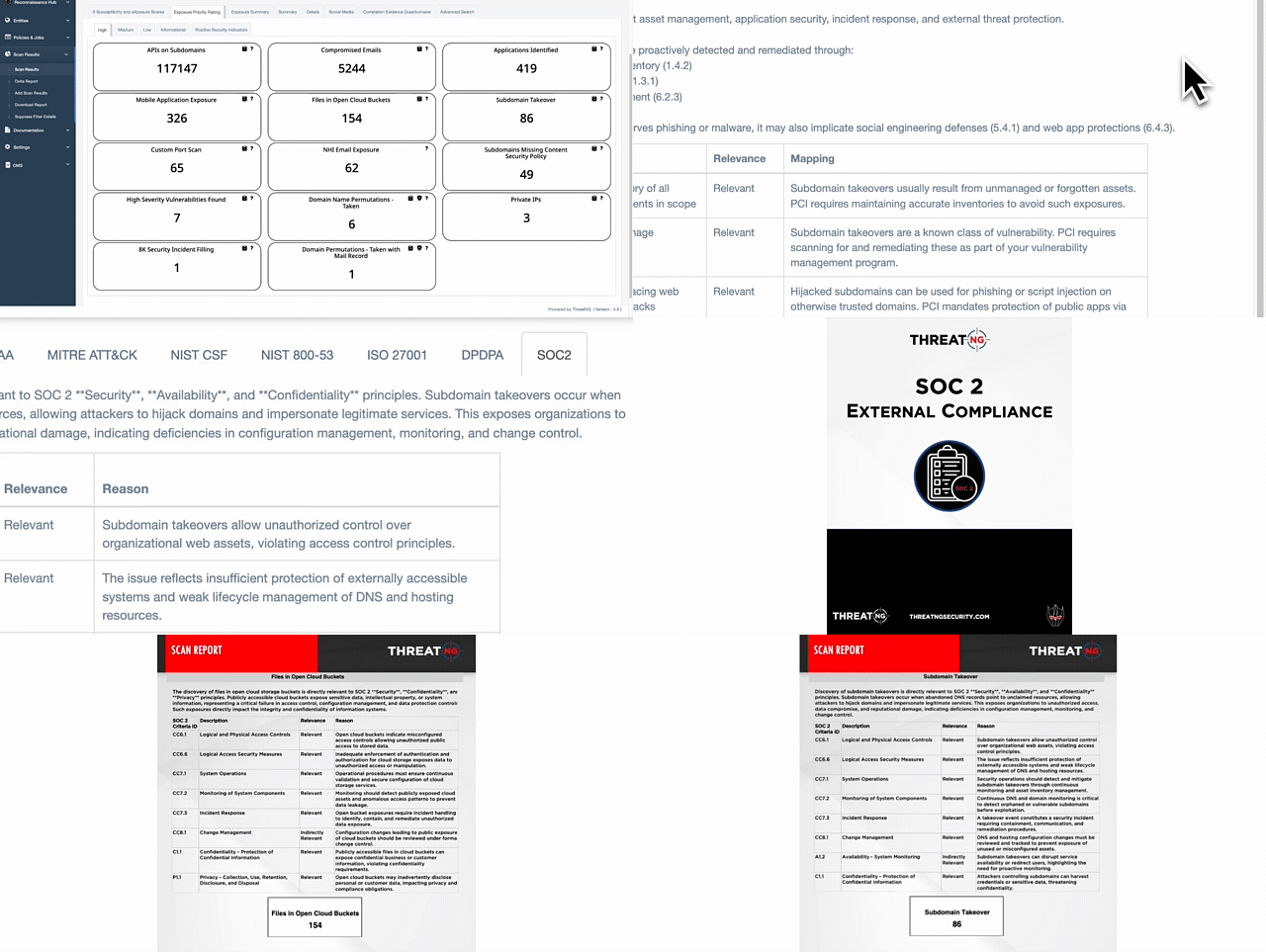
ThreatNG streamlines your external SOC 2 assessment by providing clear, actionable insights into your security posture from an attacker's perspective. Our easy-to-read reports detail crucial findings, including unencrypted data in open cloud buckets, missing security headers, exposed administrative interfaces, and vulnerabilities across unmanaged shadow IT. Each finding is meticulously mapped to the relevant SOC 2 Trust Services Criteria, enabling organizations to understand their ongoing compliance status and prioritize remediation efforts to strengthen their security defenses and maintain operational trust.
Why ThreatNG?
For End Organizations
Replace the anxiety of point-in-time audits with the certainty of continuous assurance, automatically discovering and mapping 'unknown' Shadow IT risks directly to your SOC 2 controls before they become liabilities.
For Service Providers (MSSPs)
Differentiate your vCISO services and drive high-margin revenue by equipping your clients with the 'Auditor’s View', a continuous evidentiary record of external due diligence that internal scanners simply cannot see.

Frequently Asked Questions (FAQ): ThreatNG External SOC 2 Assessment
The Core Concept
-
An External SOC 2 Assessment is an automated, continuous evaluation of your organization's security posture from the "Outside-In"—viewing your digital footprint exactly as an attacker or external auditor would. Unlike a traditional SOC 2 audit, which is often a "point-in-time" review of internal policies and known assets, an External Assessment continuously discovers unmanaged assets (Shadow IT) and maps external risks directly to SOC 2 Trust Services Criteria (TSC). This ensures your audit scope matches your actual attack surface, preventing surprise exceptions.
-
Internal scanners and agent-based tools only assess what they know about—the assets you have already inventoried. They have a critical blind spot: Shadow IT. If a marketing team spins up a rogue server or a developer leaves an S3 bucket open, your internal tools won't see it, but an external attacker will. ThreatNG fills this "Compliance Gap" by performing unauthenticated external discovery to find and secure these "unknown unknowns" before auditors flag them as control failures.
Solving the Audit Anxiety
-
Yes, and it is a leading cause of "Qualified Opinions." If an auditor discovers an external asset (like a forgotten subdomain or test environment) that processes data but was excluded from your population, it is a finding. Specifically, unmanaged external assets often violate CC3.1 (Risk Assessment) because your risk assessment failed to include the full scope of your environment, and CC6.1 (Logical Access) because the asset lacks the controls defined in your policies. ThreatNG identifies these assets so you can bring them into scope or decommission them before the observation period ends.
-
New SEC cybersecurity rules require the disclosure of material risks and incidents, placing personal liability on officers who fail to manage their entire risk profile. A breach originating from a "forgotten" external asset can be viewed as a failure of governance. By using ThreatNG to continuously map external risks to controls such as CC7.1 (System Operations), a CISO creates an audit trail of "Continuous Due Diligence," proving they actively monitored the perimeter and mitigating negligence claims and personal liability exposure.
-
Absolutely. One of the biggest drains on GRC teams is the manual evidence collection and the "fire drill" of fixing issues weeks before the audit. ThreatNG automates the collection of evidence for external controls (e.g., proving TLS configuration for CC6.6 or proper error handling for CC7.1). By identifying and proactively fixing external issues, you reduce remediation time during the audit window and eliminate the back-and-forth friction with auditors.
Technical Mappings and Evidence
-
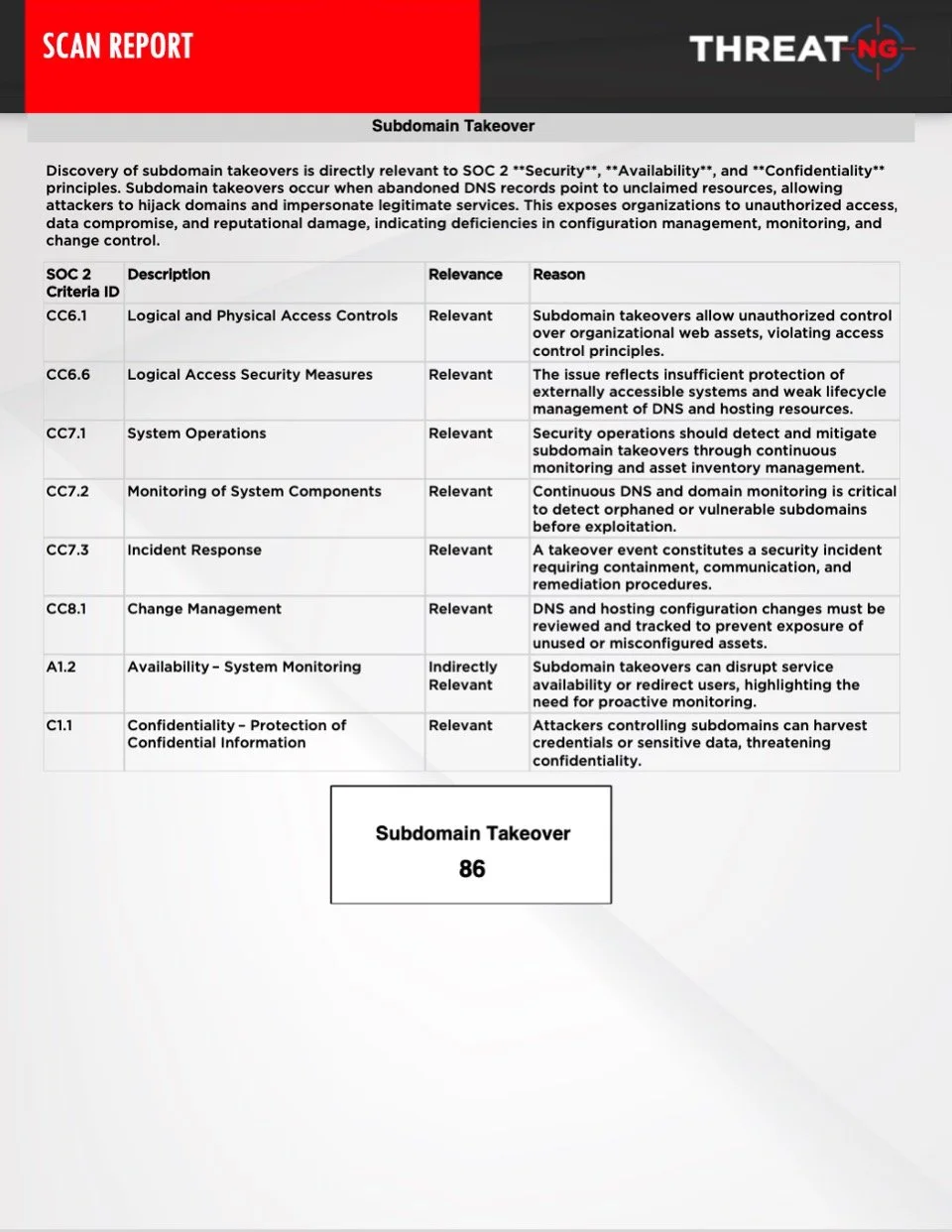
A subdomain takeover occurs when a DNS record points to a third-party service (like AWS or GitHub) that you no longer use, allowing an attacker to claim it. In SOC 2 terms, this is a critical failure of CC6.1 (Logical Access) and CC6.6 (Boundary Protection). It allows an attacker to host malicious content on your trusted domain, bypassing your internal access controls. ThreatNG detects these "dangling" records instantly, preventing the specific attack path of Subdomain Takeover -> Phishing -> Credential Harvesting.
-
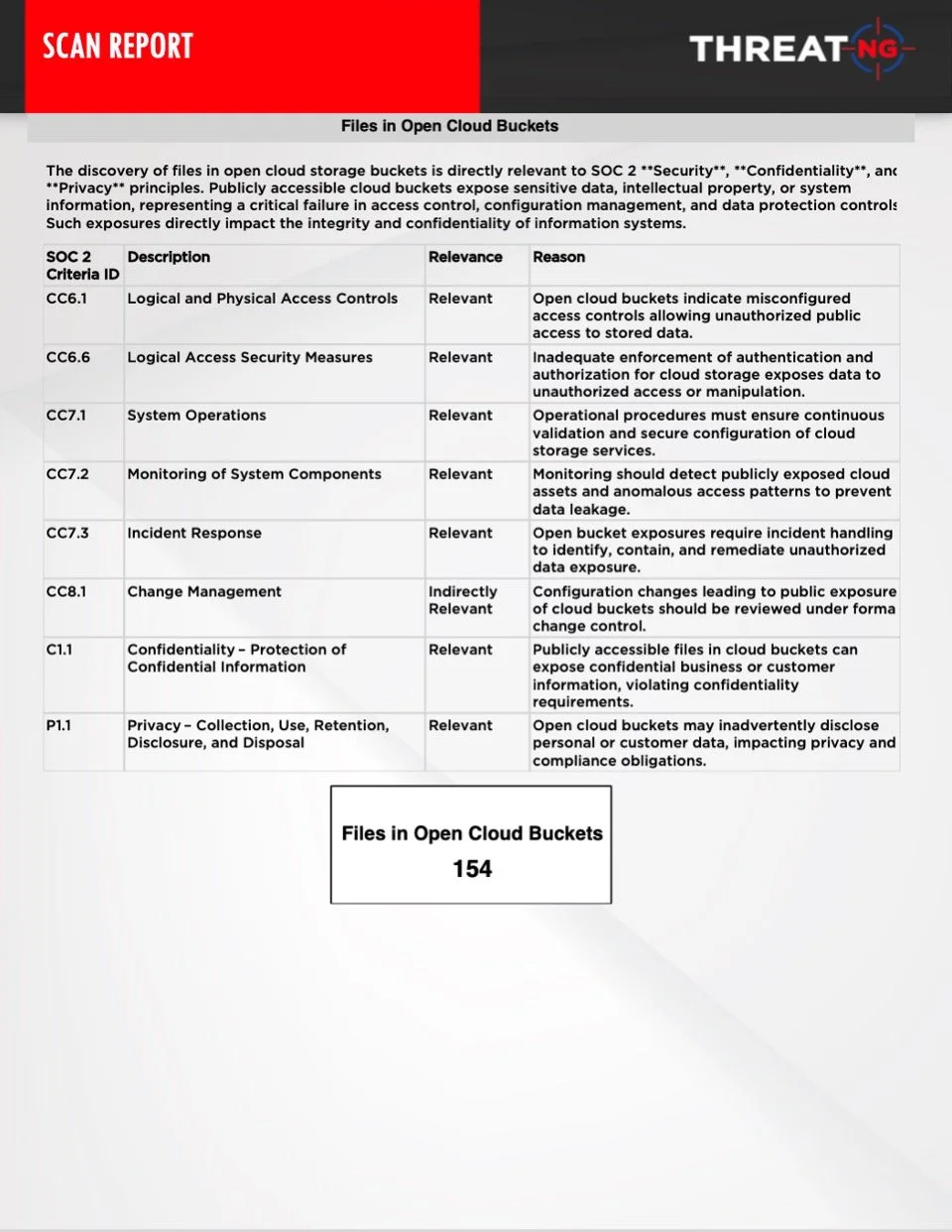
An exposed S3 bucket containing sensitive data is a direct violation of C1.1 (Confidentiality) and P1.1 (Privacy). It demonstrates a failure to protect confidential information from unauthorized disclosure. ThreatNG’s external discovery identifies these buckets and maps the finding directly to these criteria, allowing you to close the breach risk and satisfy the control requirement simultaneously.
-
Yes. CC9.2 requires you to assess the risks associated with vendors and business partners. Traditional methods rely on static questionnaires that vendors can answer subjectively. ThreatNG provides an objective, "Outside-In" security rating of your vendors, validating their actual external posture. This provides irrefutable evidence of your vendor oversight program, satisfying the CC9.2 monitoring requirement with real-time data rather than stale paperwork.
-
While unregistered domain permutations (like typosquatted versions of your domain) do not represent an immediate control failure, they are indirectly relevant to criteria CC7.1 (System Operations) and CC7.2 (Monitoring). Monitoring these domains supports proactive defense strategies, allowing your organization to detect potential impersonation or phishing vectors before they are weaponized by malicious actors.
-
Missing headers are not just best practice violations; they directly map to CC6.6 (Logical Access Security Measures). A lack of CSP weakens application-layer defenses against Cross-Site Scripting (XSS), which auditors view as a failure to implement "reasonable" security configurations to protect system boundaries. Additionally, missing HSTS (HTTP Strict Transport Security) impacts CC6.6 and C1.1 (Confidentiality) by allowing unencrypted connections that expose data in transit.
-
We believe in precise mapping. Findings like Layoff Mentions or Stock Sales are classified as "tangential" because they do not directly impact system controls like Security or Availability. However, they are included because they provide context for CC2.1 (Risk Assessment), as workforce changes or financial shifts may influence the internal control environment or operational capacity.
-
Files exposed in open cloud buckets are a direct violation of CC6.1 (Logical Access Controls) and C1.1 (Confidentiality). This finding serves as evidence that access control lists (ACLs) were misconfigured, allowing public access to potentially sensitive data, which effectively negates the "protection of confidential information" required by the Trust Services Criteria.
Strategic Value and ROI
-
A SOC 2 report is a point-in-time snapshot. You might be compliant on the day of the audit, but a single configuration change the next day can leave you exposed for the rest of the year. This "drift" is where breaches happen. ThreatNG shifts you from "Point-in-Time Compliance" to "Continuous Assurance," ensuring that your reality always matches your report. This protects your reputation from the embarrassment of being breached while holding a compliance certificate.
-
Position it as Audit Insurance and Efficiency.
Avoid Remediation Costs: The cost of a failed or "qualified" audit can exceed $60,000 in remediation fees and re-auditing, not counting lost revenue from stalled enterprise deals.
Operational Efficiency: Automating external evidence collection saves hundreds of hours of expensive engineering and GRC analyst time.
Risk Reduction: It prevents the high costs of data breaches (avg. $4.45M) by catching the most common entry points (Shadow IT) early.
-
Yes. ThreatNG performs purely external, unauthenticated discovery using no connectors or agents. This is crucial because it mimics the exact behavior of a real-world adversary. If an attacker can find it without a login, ThreatNG will find it. This provides the most honest, unfiltered view of your security posture, validating whether your internal controls (firewalls, WAFs) are actually effective from the outside.