


External CPRA Compliance Mapping
We Speak Attacker. We Translate to CPRA.
Defending against invisible threats is a losing battle; ThreatNG eliminates external blind spots before they escalate into internal compliance crises.
The California Privacy Rights Act (CPRA) imposes an affirmative obligation on businesses to implement and maintain "reasonable security procedures and practices appropriate to the nature of the personal information" to protect against unauthorized access, exfiltration, theft, or disclosure. Discovering a vulnerability is only half the challenge; achieving positional dominance requires anticipating the adversary's next move. ThreatNG serves as the enterprise's Cognitive Exoskeleton, seamlessly translating the chaotic noise of the external perimeter into a structured, disciplined defense.
Curing Compliance Blindness
Organizations are suffocating under the friction and anxiety of "Compliance Blindness", the inability to map chaotic external vulnerabilities to rigid internal regulatory controls. You cannot rely on the passive "Surveillance Fallacy" of merely watching the perimeter while waiting for an alert. When security operations function as a rear-view mirror exercise, translating a dangling DNS record into specific statutory language becomes a nearly impossible manual task.
Translating External Chaos to CPRA Clarity
ThreatNG strips away the adversary's grips by providing the exact strategic blueprint to resolve threats before they materialize. The following examples demonstrate how external exposures map directly to CPRA controls, guiding immediate remediation.
The External Discovery: Default Port Scan.
The Reality: Externally exposed administrative and database services on default ports provide direct attack paths for credential stuffing and ransomware deployment.
The CPRA Alignment: This exposure violates the duty to protect personal information under Cal. Civ. Code §1798.100(e) and fails the reasonable safeguards test under §1798.81.5(b), mandating an immediate transition to MFA-secured VPN or Zero Trust Network Access.
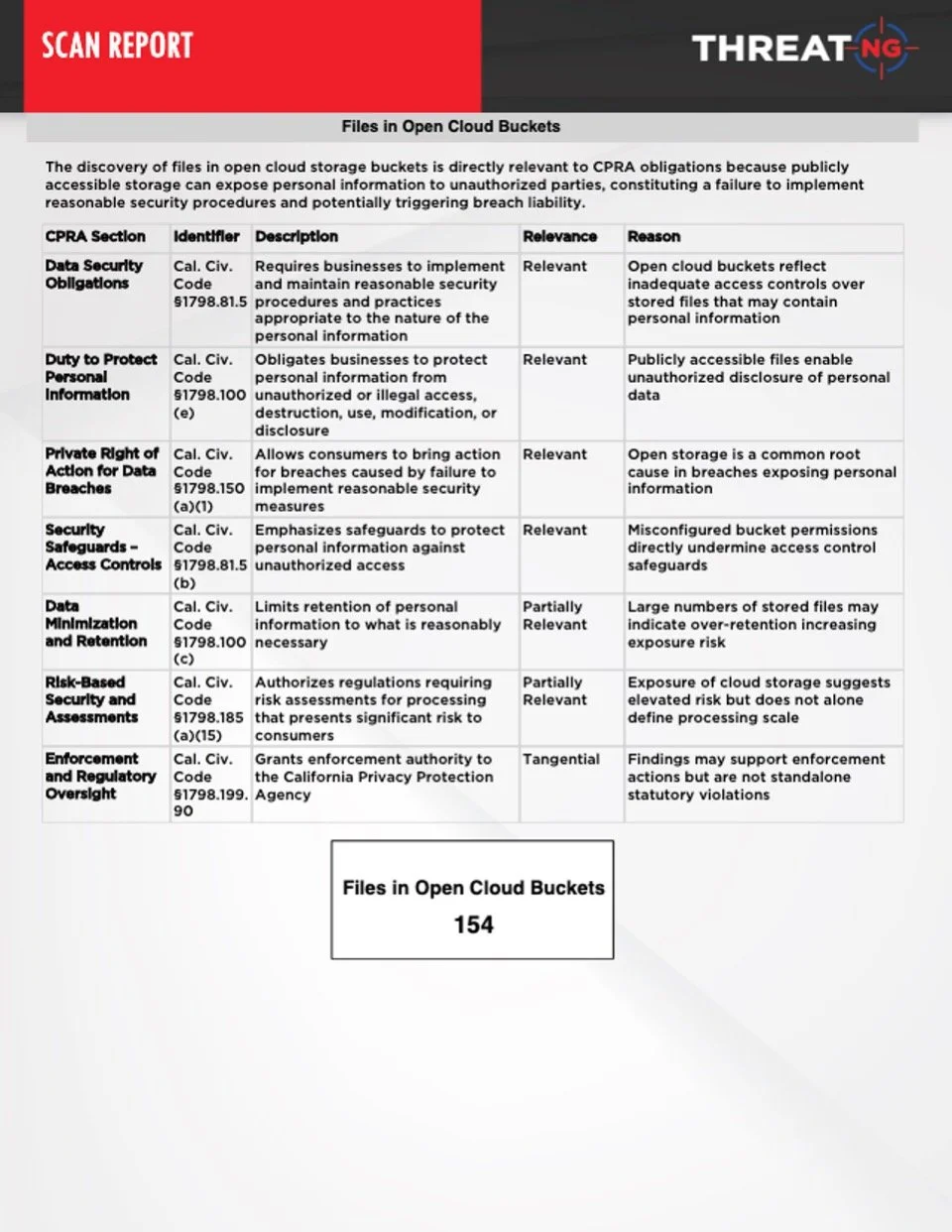
The External Discovery: Files in Open Cloud Buckets.
The Reality: Publicly accessible storage environments allow automated bots to browse and download sensitive consumer records without authentication.
The CPRA Alignment: This directly violates reasonable security procedures under §1798.81.5 and triggers Private Right of Action liability under §1798.150(a)(1), requiring immediate revocation of public Access Control Lists and continuous Cloud Security Posture Management deployment.
The External Discovery: Code Secrets Found.
The Reality: Hardcoded API keys and database passwords in public repositories allow attackers to bypass all traditional perimeter defenses and achieve instant, privileged cloud authentication.
The CPRA Alignment: Leaking privileged backend keys represents an architectural breakdown in Security Safeguards under §1798.81.5(b), guiding the playbook to immediately revoke and rotate keys while analyzing cloud access logs.
Your CPRA Executive Action Plan
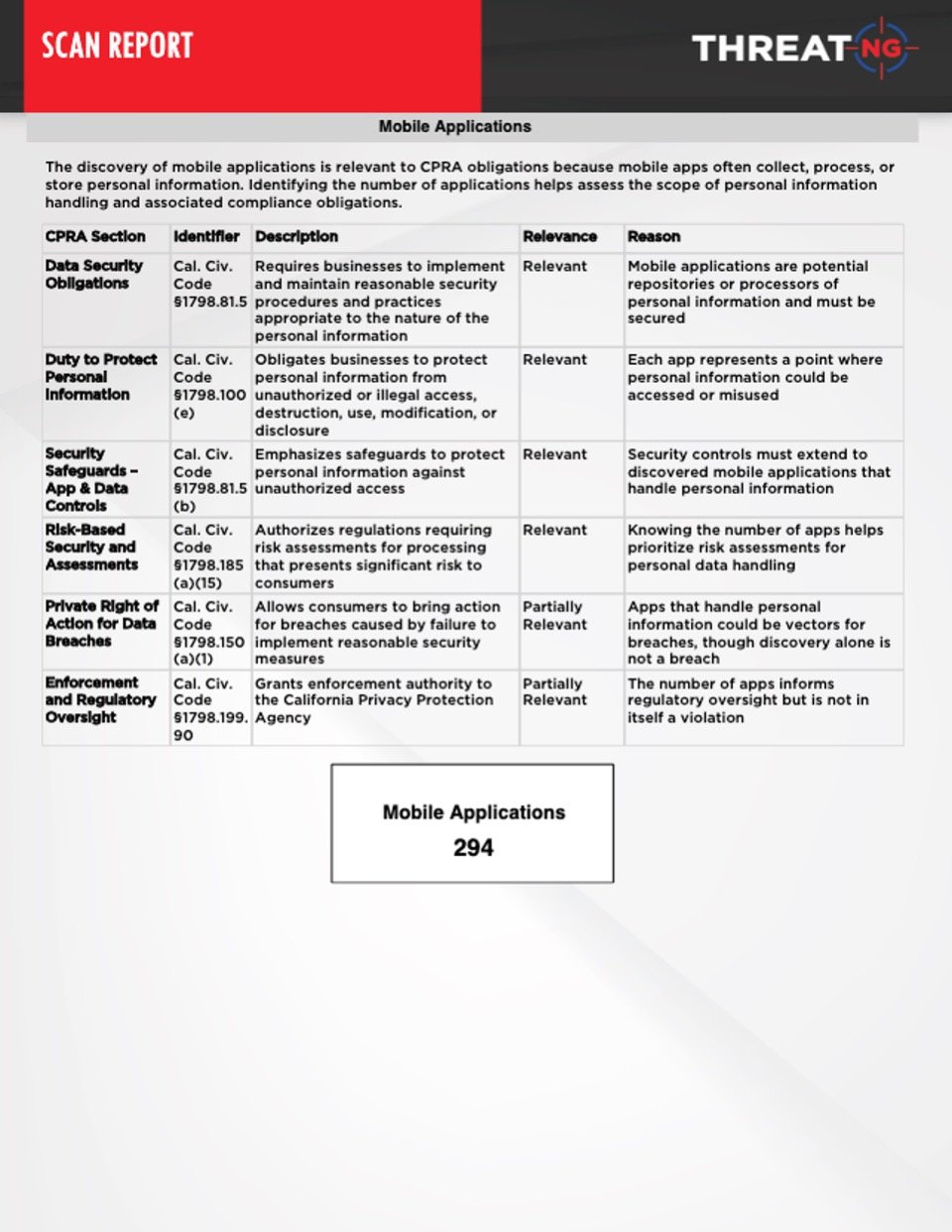
This is a sample deliverable of your Strategic Blueprint. It proves that ThreatNG does not just dump raw, overwhelming telemetry onto your team; it delivers structured, board-ready intelligence backed by Legal-Grade Attribution.
Aligning the SOC and the Boardroom on CPRA
A unified, resilient defense requires a unified language across the entire enterprise hierarchy.
For the CISO
ThreatNG empowers executive leadership with empirical, mathematically verified data for definitive board-level reporting and regulatory defense. By consolidating External Attack Surface Management (EASM), Digital Risk Protection (DRP), and Security Ratings into a single platform, you radically reduce overall software spend while optimizing the efficacy of existing security investments.
For SecOps
We eliminate the "Hidden Tax on the SOC" by transitioning your highly trained analysts from chaotic, manual alert triage to precise, prioritized remediation. For example, when ThreatNG discovers a Subdomain Missing a Content Security Policy, analysts aren't just given a CVE; they are shown the exact remediation playbook to prevent XSS data exfiltration and avoid statutory liability under §1798.150(a)(1).
For Compliance & Risk Teams
Maintain continuous audit readiness with an automated, evidence-based reporting engine that replaces point-in-time spreadsheet exercises. When an 8-K Security Incident Filing is detected, your team immediately understands the need for risk assessments and incident response documentation to satisfy CPPA oversight.
Dominate Your Perimeter Before the Strike
Stop reacting to breaches and start dictating the rules of engagement. Uncover the shadow infrastructure and leaked credentials adversaries use to compromise your organization.

Frequently Asked Questions: CPRA Compliance & External Attack Surface Intelligence
-
Under California Civil Code §1798.81.5, "reasonable security" requires an affirmative, continuous defense of personal information. You cannot defend a strike you cannot see. Traditional security focuses inward, but adversaries attack from the outside. If your organization has shadow IT, dangling DNS records, or open cloud buckets that you are blind to, you are fundamentally failing this mandate. ThreatNG maps the internet-facing perimeter from the adversary's perspective, proving you have the visibility and control required to meet the CPRA’s strict legal standard.
-
SecOps teams are currently suffocating under the "Hidden Tax on the SOC"—wasting hours manually investigating thousands of contextless alerts dumped by legacy scanners. Discovering a vulnerability is meaningless if you have to guess its business impact. ThreatNG cures this by acting as a Cognitive Exoskeleton. When we find an exposed administrative port, we don't just log a CVE; we automatically map it to a failure of §1798.81.5(b) safeguards , dictating the exact remediation playbook. This allows your Tier 1 analysts to dominate the grip fight, neutralizing threats before the adversary even initiates an attack.
-
No. The California Privacy Protection Agency (CPPA) is shifting enforcement to mandate continuous, independent cybersecurity audits that evaluate 18 specific security components. A point-in-time penetration test is obsolete the moment it is finalized. ThreatNG provides an automated, evidence-based reporting engine. By continuously monitoring your external footprint and mapping technical telemetry directly to the CPRA framework, you generate a defensible, board-ready audit trail of due diligence that proves constant oversight.
-
Relying on external Large Language Model (LLM) APIs to analyze live infrastructure vulnerabilities creates the "API Privacy Trap". Transmitting this sensitive telemetry outside your environment violates strict data sovereignty mandates and fractures your audit trail. ThreatNG solves this through Bounded Autonomy. The platform synthesizes Attack Path Intelligence natively within a closed ecosystem, allowing security teams to securely use AI via an Air-Gapped Handoff without ever leaking their investigative footprint.
-
The CPRA removed the previous 30-day "cure period" and permits statutory damages of $100 to $750 per consumer per incident for data breaches resulting from unreasonable security. If an adversary exploits a missing Content Security Policy (CSP) on an orphaned marketing subdomain to exfiltrate consumer data, plaintiffs' counsel will cite that technical flaw as undeniable evidence of negligence. ThreatNG identifies and translates these exact structural vulnerabilities into executive-level risk, allowing you to preemptively close the gaps and shield the organization—and the CISO—from catastrophic financial and legal liability.
-
No. ThreatNG operates as the "Invisible Engine". It uses zero-connector, unauthenticated reconnaissance to discover your digital footprint exactly as a threat actor perceives it. It requires no internal API connectors, software agents, or administrative credentials. By analyzing the attack surface entirely from the outside in, we uncover "Unknown Unknowns" without adding operational friction or triggering internal SIEM alerts.