


Customizable Risk Scoring and Configuration
Master Your Digital Risk: The Architect of Defensibility
In today's complex cybersecurity landscape, the primary threat is no longer just missing patches; it is the "Crisis of Context" and the operational paralysis alert fatigue causes. For decades, the industry has relied on static, generic severity models like CVSS, flooding security teams with thousands of theoretical alerts while masking true, weaponized threats.
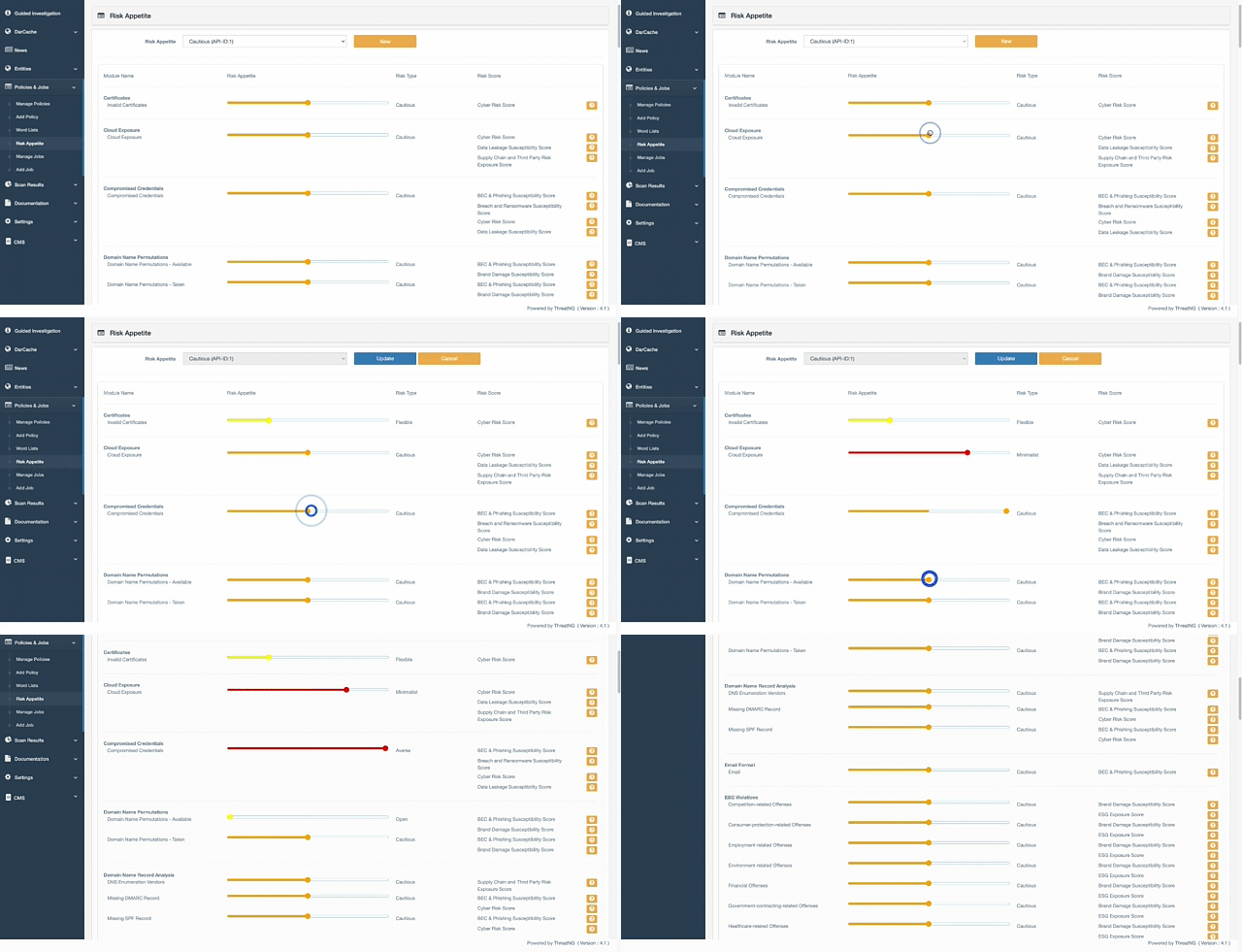
ThreatNG provides the technological remedy, facilitating a fundamental shift from reactive, volume-based patching to a proactive Continuous Threat Exposure Management (CTEM) and Threat-Informed Vulnerability Management (TIVM) framework. By letting you tailor your risk parameters (Averse, Minimalist, Cautious, Flexible, or Open), ThreatNG turns generic technical severity scores into board-ready, context-aligned risk metrics. This unique capability ensures External Threat Alignment, allowing C-suite executives and CISOs to mathematically verify reductions in their external attack surface and become architects of their own defensibility.
Transform Your Security Ratings: The 4 Dimensions of Contextual Risk
Rather than relying solely on scores in a vacuum, ThreatNG dynamically evaluates raw technical flaws against four critical dimensions of risk to generate highly accurate X Susceptibility and eXposure ratings:
Asset Criticality and Business Value: The system algorithmically contextualizes the affected asset's inherent value, prioritizing vulnerabilities on mission-critical production systems over identical flaws in isolated test environments.
Environmental Exposure: Using purely agentless, connectorless external discovery, ThreatNG actively validates whether an asset is publicly reachable by an adversary, hunting for unmanaged shadow IT, exposed vector databases, and missing security headers.
Active Threat Landscape Analytics: The scoring matrix integrates real-time, empirical intelligence from DarCache Vulnerability and triangulates risk through a unique 4-Dimensional Data Model. It cross-references external findings by fusing foundational technical severity from the National Vulnerability Database (NVD) with predictive foresight via the Exploit Prediction Scoring System (EPSS). It then confirms active weaponization in the wild by checking findings against real-time urgency from the CISA Known Exploited Vulnerabilities (KEV) catalog and mathematically verified pointers to active Proof-of-Concept (PoC) exploits (DarCache eXploit).
Compensating Controls: Through Contextual Vulnerability Analysis, the system evaluates whether existing security architectures mitigate the risk, effectively downgrading the severity of theoretical flaws hidden behind properly configured controls.
The ThreatNG Advantage: Context Over Volume
From the "Pile of Bricks" to the "Blueprint"
Legacy vulnerability scanners and traditional External Attack Surface Management (EASM) tools dump a massive "pile of bricks" (uncontextualized data) on your Security Operations Center (SOC). ThreatNG’s DarChain Attack Path intelligence engine connects the dots, taking isolated technical findings and mapping them into visual, multi-step exploit narratives. We provide the blueprint, showing you exactly how a minor missing header can chain into a catastrophic ransomware event, so you can focus finite resources exclusively on structural choke points.
Your Cyber "Credit Repair Lawyer"
Traditional security rating agencies function as arbitrary credit bureaus, often penalizing organizations with generic scores based on misattributed "ghost assets". ThreatNG serves as your "Credit Repair Lawyer.” By providing legal-grade attribution and irrefutable proof of your actual external exposure, ThreatNG empowers you to dispute inaccurate third-party scores, control your corporate security narrative, and directly drive down your cyber insurance premiums.
Defeating the "Disclosure Disconnect"
As international data protection laws shift and U.S. SEC cybersecurity disclosure rules evolve, organizations face severe penalties if their public risk disclosures don't match their actual technical attack surface. ThreatNG’s contextual risk scoring ensures your deployed risk controls align mathematically with your organization's risk appetite, preventing regulatory catastrophe and providing quantifiable proof for Governance, Risk, and Compliance (GRC) leaders.
Key Benefits by Operational Area
Security Operations & Threat Intelligence (SOC)
Eradicate Alert Fatigue: By filtering raw internet noise against CISA KEV and EPSS intelligence, ThreatNG algorithmically filters out theoretical noise. This terminates alert fatigue, reduces acute analyst burnout, and recovers stolen operational hours for proactive threat hunting.
Automated Exception Management: Streamline policy deviations by whitelisting legitimate operational activities to prevent low-risk alerts, reducing systemic friction between security teams and DevOps units.
Brand Protection & Digital Risk
Pre-Emptive Intelligence: Move beyond reactive takedown services that play "Whac-A-Mole" with fake domains. By customizing scoring to emphasize Domain Intelligence and Brand Damage Susceptibility, ThreatNG detects the infrastructure behind lookalike domains and phishing campaigns before an attack launches.
Spotter and Sniper Precision: ThreatNG acts as the intelligence "Spotter," identifying high-value targets and calculating context so your expensive legal or managed takedown services (the "Sniper") know exactly where to aim, saving resources and increasing efficacy.
Third-Party Risk & Due Diligence
Expedited, Evidence-Based Vendor Risk: Move away from trust-based questionnaires to independent, continuous external audits. By integrating findings from actively exploited vulnerabilities and compromised credentials, customized vendor risk scores immediately highlight supply chain vulnerabilities based on your specific Averse or Cautious risk appetites.
M&A Defensibility: During due diligence, apply strict risk configurations to a target company's external footprint to uncover hidden cybersecurity debt, helping acquirers make informed financial decisions without relying on generic audits.

Frequently Asked Questions
-
ThreatNG's "Customizable Risk Configuration and Scoring" capability enables organizations to precisely tailor the assessment and prioritization of their external digital risk, going beyond generic security scores. Users can define and gauge their security ratings based on their specific risk appetite (e.g., Averse, Minimalist, Cautious, Flexible, Open). This process involves selecting and configuring the externally visible settings and configurations that pertain to their digital environment, third parties, and supply chain, ultimately shaping their overall security posture. The result is security scores that accurately represent an organization's distinct priorities and the external threat landscape it confronts.
-
This capability is vital because it ensures that your cybersecurity efforts align precisely with your unique business objectives and risk tolerance. It provides Contextual Risk Scoring, dynamically adjusting the weighting and severity of identified vulnerabilities and exposures based on your specific operational environment, strategic goals, and defined risk appetite. This means your organization can focus on the risks that matter most to your business rather than being overwhelmed by generic alerts. Translating technical findings into business-relevant risk terms enhances organizational communication and decision-making.
-
ThreatNG introduces a paradigm shift compared to other security ratings platforms, bolstered by its comprehensive capabilities:
Tailored and Relevant Prioritization: While most platforms provide general numerical scores or letter grades that may not reflect your unique context, ThreatNG allows for detailed customization based on your specific risk appetite levels (Averse, Minimalist, Cautious, Flexible, Open). This enables Contextual Risk Scoring, where the severity of a vulnerability is reassessed as ThreatNG's External Assessment capabilities correlate with these established risk appetite levels. This correlation ensures that specific assessments like Web Application Hijack Susceptibility, Data Leak Susceptibility, and Cyber Risk Exposure directly inform and adjust tailored scores based on their impact on your critical assets and business objectives, ensuring that remediation efforts focus on your most significant risks.
Dynamic Alignment & Enablement: ThreatNG's capability facilitates Risk Appetite Orchestration and External Threat Alignment, allowing your organization to continuously adapt its security ratings to changes in business initiatives and the real-world external threat landscape. Unlike the static snapshots provided by other solutions, ThreatNG's Continuous Monitoring delivers the real-time data necessary to calibrate and customize risk appetite. This positions security ratings as an enabler for the business:
Example 1 (Innovation): An organization with an "Open" risk appetite for pioneering new cloud services can configure ThreatNG to accept a higher risk for non-critical exposures in these experimental environments. However, should ThreatNG's Cloud and SaaS Exposure assessment or Sensitive Code Exposure module identify a critical data leak or exposed API key in that new service, ThreatNG's continuous monitoring would provide the information needed to re-calibrate the customized scoring, allowing for immediate attention to safeguard sensitive data while allowing innovation to continue where risk is within appetite.
Example 2 (Market Expansion): A "Flexible" risk appetite for new digital campaigns can be set when rapidly entering new markets. ThreatNG's Domain Intelligence (including Domain Name Permutations) and BEC & Phishing Susceptibility assessments will continuously monitor for specific external threats like brand impersonation or phishing campaigns targeting these new market ventures. If a significant threat emerges, ThreatNG's continuous monitoring provides the necessary data, allowing customized scoring to highlight it immediately and enable quick, targeted mitigation to protect the brand's reputation without hindering market entry.
Comprehensive, Actionable, Outside-In Visibility Bolstered by Intelligence: ThreatNG's purely External Discovery combined with its extensive External Assessment capabilities (like Supply Chain & Third Party Exposure and Mobile App Exposure) provides an unparalleled "attacker's view" of your digital footprint. This is further bolstered by rich Intelligence Repositories (DarCache). For instance, DarCache KEV identifies actively exploited vulnerabilities, and DarCache Rupture tracks compromised credentials. These data points directly correlate with the customized scoring, providing precise, real-world exploitability and threat context. This allows for a deeper, more actionable understanding of risks based on actual external exposures and enables a shift from general awareness to precise, data-driven remediation efforts.
-
This capability is crucial for a broad range of stakeholders:
CISOs and Security Leadership: It empowers them to clearly define, operationalize, and consistently apply the organization's cybersecurity risk appetite across all external exposures. This ensures security investments and efforts align directly with strategic business goals and provides evidence of effective risk governance.
Business Unit Leaders & Project Managers: They gain a transparent understanding of the cyber risks associated with their specific initiatives, tailored to their project's objectives and the organization's risk appetite. This enables them to confidently make informed, agile decisions about pursuing new opportunities, knowing associated risks are understood and managed.
Risk Management Teams: This capability provides a sophisticated, data-driven approach to understanding and prioritizing risks based on the organization's unique context. It enhances their ability to accurately assess, manage, and report on cybersecurity risks, integrating seamlessly with their existing risk frameworks.
Security Operations Center (SOC) Analysts & Incident Responders: By receiving highly contextualized and prioritized reports from ThreatNG's point-in-time discoveries and assessments, reflecting the genuine risk appetite, they can focus on the most critical external threats. This reduces alert fatigue and ensures their response efforts are directed where they will have the most significant impact.
Third-Party Risk Management Teams: They can conduct more precise due diligence and continuously monitor vendors' external security postures, ensuring that supply chain risks are assessed and managed in alignment with the organization's specific appetite for third-party exposure.
-
ThreatNG's Customizable Risk Configuration and Scoring serves as a powerful enabler for M&A by enabling organizations to assess and contextualize the external cybersecurity risk of potential acquisition targets immediately. For example, during due diligence, the acquiring company can apply a "Cautious" or even "Averse" risk appetite to the target's external posture. ThreatNG's External Discovery and Assessment can quickly identify critical vulnerabilities, exposed sensitive data, or high Breach & Ransomware Susceptibility specific to the target's external footprint. This allows the acquiring company to gain a rapid, tailored understanding of the cybersecurity debt or immediate risks before integration. It empowers them to make informed decisions about the acquisition terms or develop a precise post-merger security integration plan, which accelerates the M&A process while controlling risk.
-
Absolutely. ThreatNG's Customizable Risk Configuration and Scoring assist development teams by aligning security priorities with development velocity. For instance, teams can define a "Flexible" risk appetite for new product development environments, which allows for rapid iteration without excessive security bottlenecks. ThreatNG's Sensitive Code Exposure and Cloud and SaaS Exposure assessments continuously monitor these environments for critical exposures like leaked API keys or open cloud buckets. If a significant risk is detected that violates even a flexible appetite, the customized scoring will immediately highlight it. This enables development teams to address critical security flaws quickly and efficiently, rather than being bogged down by generic findings, ultimately facilitating faster and more secure product releases by focusing on what truly impacts the business's acceptable risk.
-
Legacy scanners dump a massive "pile of bricks"—thousands of uncontextualized alerts—onto your Security Operations Center (SOC). ThreatNG dismantles this noise using a proprietary 4-Dimensional Data Model that acts as the ultimate filter:
Foundational Severity: National Vulnerability Database (NVD) baseline metrics.
Predictive Foresight: Exploit Prediction Scoring System (EPSS) probabilities to forecast likelihood.
Active Threat Confirmation: Real-time urgency checks against the CISA Known Exploited Vulnerabilities (KEV) catalog.
Mathematical Verification: Direct pointers to active Proof-of-Concept (PoC) exploits via DarCache eXploit.
The Operational Value: Analysts stop chasing phantom IT noise and recover stolen operational hours by focusing exclusively on validated, weaponized attack paths.
-
Yes. Traditional security rating agencies (like BitSight or SecurityScorecard) function as arbitrary credit bureaus, often penalizing organizations with generic scores based on misattributed "ghost assets".
Your Cyber "Credit Repair Lawyer": ThreatNG provides Legal-Grade Attribution—irrefutable cryptographic and DNS proof of your actual external exposure.
The Financial Value: By handing this deterministic evidence to auditors, CISOs can force rating agencies to correct inaccurate scores overnight, directly protecting corporate procurement contracts and driving down cyber insurance premiums.
-
With the enforcement of stringent regulations like the U.S. SEC cybersecurity disclosure rules, a discrepancy between public risk disclosures and actual technical attack surfaces can result in severe financial and legal penalties (the "Disclosure Disconnect").
Evidence-Based Alignment: ThreatNG automatically ingests public regulatory text (e.g., Form 8-K) and correlates it against continuous external telemetry.
The Executive Value: It arms the CISO with mathematically verifiable evidence of risk mitigation—proving that deployed controls align with corporate financial tolerances—making security strategies inherently defensible to non-technical oversight committees.
-
Item descriptionTraditional External Attack Surface Management (EASM) provides a "Phone Book" (a massive list of known assets), while Threat Intelligence feeds provide the "Weather Channel" (global noise about threat actors).
The Blueprint Approach: ThreatNG provides the "Blueprint." Through its DarChain correlation engine, it takes an isolated external finding (like a missing security header) and links it to dark web chatter and identity exposure to map a complete, multi-step exploit narrative.
The Strategic Value: We don't just tell you a storm is coming; we tell you exactly which unmanaged side door the adversary will use to get in.
-
No. ThreatNG operates entirely through 100% connectorless and unauthenticated (outside-in) discovery.
The Visibility Advantage: Internal Cyber Asset Attack Surface Management (CAASM) tools are blind to infrastructure they do not actively manage. ThreatNG finds the "Unknown Unknowns"—rogue cloud buckets, forgotten subsidiary assets, and shadow AI—exactly as an adversary sees them, requiring zero setup friction, zero internal credentials, and zero API integrations.