




DarCache Infostealer Intelligence
Eradicate the Contextual Certainty Deficit and Stop Initial Access Brokers from Bypassing Your MFA
We know your organization has invested millions in Identity and Access Management (IAM), Single Sign-On (SSO), and Multi-Factor Authentication (MFA) to secure your perimeter. You have done exactly what the industry advised. Yet, the industrialized machinery of modern cybercrime has evolved to bypass these exact defenses. Today, Initial Access Brokers (IABs) use highly evasive Information Stealer (infostealer) malware to silently harvest session cookies and Primary Refresh Tokens (PRTs) directly from the unmanaged personal devices (BYOD) of your employees. Because these stolen session tokens act as a modern "Golden Ticket," attackers can completely bypass your MFA prompts and seamlessly hijack active cloud sessions without triggering any internal alarms. ThreatNG’s DarCache Infostealer acts as your definitive "Outside-In Identity Protection" layer. By continuously parsing and sanitizing dark web marketplaces, DarCache provides the unauthenticated external visibility needed to detect and neutralize compromised digital identities before they are weaponized, eradicating your blind spots and securing the infrastructure you've worked so hard to build.
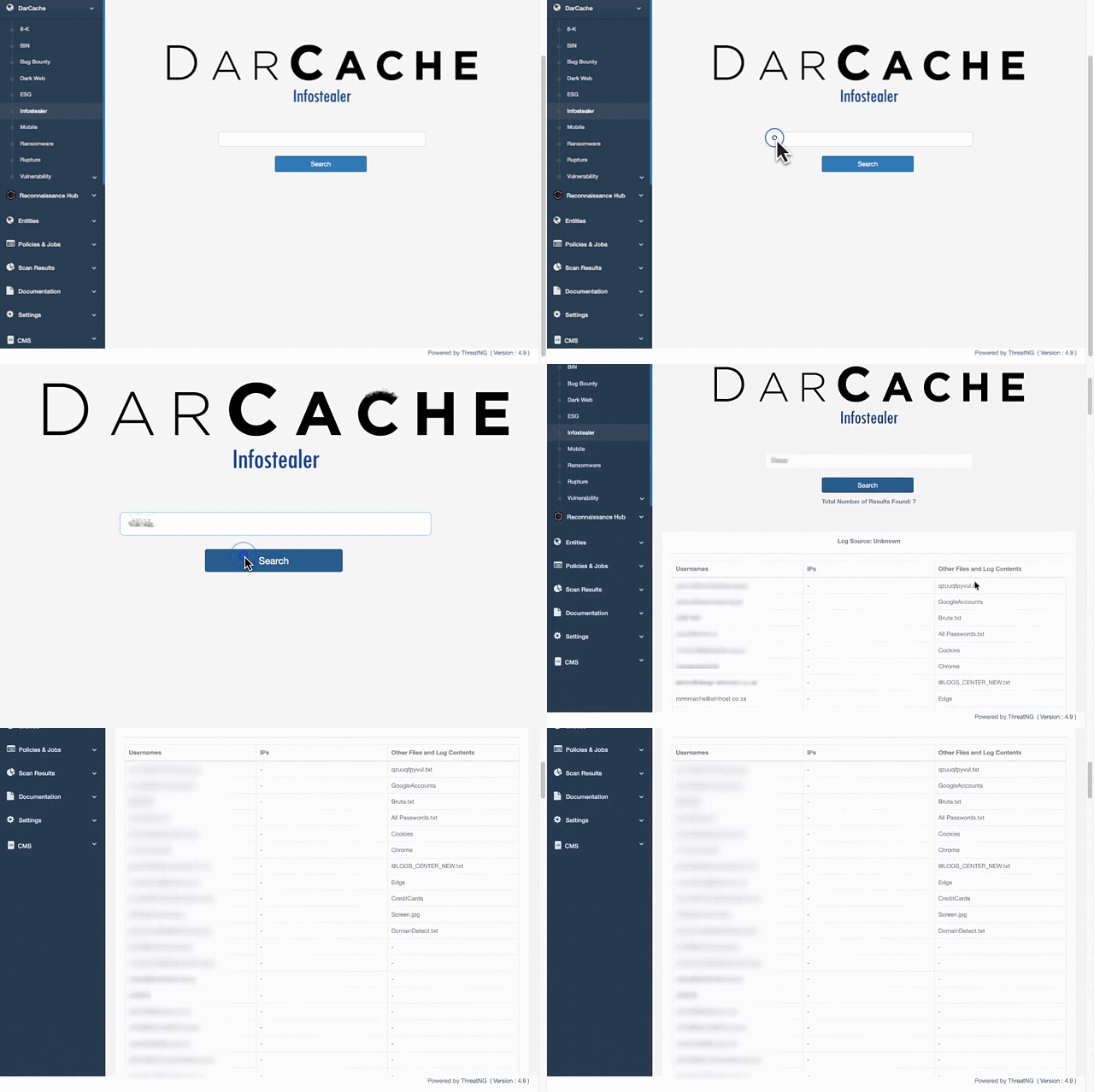
ThreatNG DarCache Infostealer Secures Your Identity Investments and Transforms Your SOC into a Proactive Sniper

Achieve Boardroom Authority with Legal-Grade Attribution
The financial stakes of an undetected breach have never been more severe; the global average cost of a data breach is currently $4.44 million, but for U.S. organizations, that figure has surged to an unprecedented $10.22 million. You cannot afford to guess which alerts matter, and relying on generic Threat Intelligence feeds is like watching "The Weather Channel". It tells you a ransomware storm is hitting your sector, but it cannot tell you if the window in your specific house is open.
DarCache Infostealer eliminates the anxiety of the "Contextual Certainty Deficit." Using our patent-backed Context Engine™, the platform moves beyond flat lists of stolen passwords to deliver Legal-Grade Attribution. We act as the moisture sensor in your basement, proving beyond a doubt that a compromised session token belongs to your organization. This shifts you from a reactive posture to an absolute state of executive confidence, empowering you to authoritatively answer the Board of Directors with mathematically backed certainty about your exact risk exposure.
Eradicate the "Hidden Tax on the SOC" and Master Your Attack Surface
Standard External Attack Surface Management (EASM) tools are notorious for "Asset Hoarding," which results in a "pile of bricks" consisting of thousands of uncontextualized IPs and domains being dumped onto your desk. This leaves your team to figure out whether it is a wall or a walkway. This endless cycle of investigating false positives creates a devastating "Hidden Tax on the SOC," leading to severe analyst burnout and an inability to execute Continuous Threat Exposure Management (CTEM).
In the war against cybercrime, your Security Operations Center is the elite sniper, but a sniper looking through a narrow scope cannot see the entire battlefield. ThreatNG acts as your dedicated spotter. By leveraging DarChain (External Contextual Attack Path Intelligence), we transform chaotic dark web infostealer logs into a precise architectural Blueprint. We provide your analysts with precise exploit chains that target your network. By correlating a specific stolen credential with an exposed API, we restore their operational autonomy and enable them to perform surgical remediations rather than being overwhelmed by dashboard noise.
Regain Absolute Control Over Shadow IT and Prevent MFA Obsolescence
The rapid acceleration of remote work has pushed your network perimeter into your employees' living rooms. Internal tools like CAASM (Cyber Asset Attack Surface Management) only protect what they have permission to see, meaning they are entirely blind when an employee unknowingly downloads a disguised infostealer payload onto a personal computer via SEO poisoning.
Without external visibility, your massive ROI in identity infrastructure is effectively expired the moment a token is stolen. DarCache restores your power and control. By providing automated discovery of compromised PRTs and session tokens actively traded by Initial Access Brokers on the dark web, we give IT Directors the actionable truth they need to immediately invalidate active cloud sessions, isolate infected devices, and force global password resets. Protect your identity investments and lock the master key before the adversary even realizes they have it.

Frequently Asked Questions (FAQ): Defending Against the Infostealer Epidemic
-
A password breach exposes user login credentials, which can often be blocked by Multi-Factor Authentication (MFA) protocols. Session token theft involves stealing active browser cookies or Primary Refresh Tokens (PRTs), which act as a "Golden Ticket" that allows attackers to completely bypass MFA and maintain persistent access.
The Detail: Modern infostealer malware is specifically designed to covertly harvest these session cookies directly from an infected device's memory or browser storage.
The Example: If an employee downloads disguised software on a personal BYOD device, an infostealer can instantly steal their active Microsoft Entra ID token, granting an attacker immediate corporate cloud access without ever triggering an MFA prompt.
-
Attackers bypass MFA using a technique called session hijacking. By using infostealer malware to exfiltrate valid session cookies from a victim's device, adversaries can inject those cookies into their own anti-detect browsers, tricking the target system into believing they are already authenticated.
The Detail: This nullifies the preceding MFA steps because the system assumes multi-factor verification has already occurred during the legitimate session establishment.
The Example: Attackers frequently bypass expensive corporate identity infrastructure by purchasing stolen session cookies on dark web marketplaces and replaying them to access Microsoft 365 applications like Outlook and Teams.
-
Initial Access Brokers (IABs) primarily gain network access by harvesting compromised credentials and session tokens via infostealer logs. They industrialize the first phase of an intrusion, validating this stolen access before auctioning it as a tradable commodity to ransomware syndicates and nation-state actors.
The Detail: IABs act as wholesale distributors of cybercrime, actively seeking high-privilege access such as VPN accounts, Single Sign-On (SSO) credentials, and SaaS administrator sessions.
The Example: An IAB might buy a bundle of stolen session tokens for a few dollars, validate the access, and resell verified domain administrative privileges to a Ransomware-as-a-Service (RaaS) affiliate for tens of thousands of dollars.
-
In 2025, the global average cost of a data breach is $4.44 million, but for U.S. organizations, it has reached an unprecedented all-time high of $10.22 million. Breaches originating from stolen credentials are the single largest initial access vector, accounting for 22% of all breaches.
The Detail: Organizations also suffer a massive "dwell time penalty." Breaches that take longer than 200 days to identify and contain cost an average of $5.01 million—nearly $1.4 million more than those caught quickly.
The Example: A healthcare organization suffering an undetected infostealer breach could face average costs exceeding $7.42 million due to severe regulatory fines and catastrophic system downtime.
-
Traditional External Attack Surface Management (EASM) tools cause alert fatigue by generating massive, uncontextualized lists of unknown assets. They provide a flat directory of potential vulnerabilities without definitive proof of ownership or correlation to active, business-impacting threats.
The Detail: This creates a "Hidden Tax on the SOC," forcing highly trained security analysts to manually investigate thousands of false positives rather than neutralizing actual risks.
The Example: Legacy tools might flag 5,000 open IP addresses, acting like a generic phone book. A modern intelligence platform cross-references those IPs with dark web criminal records to provide analysts with the three specific endpoints currently under attack.
-
ThreatNG DarCache detects compromised tokens by performing continuous, agentless passive reconnaissance of dark web marketplaces. It automatically parses, normalizes, and sanitizes analyzed infostealer logs to identify corporate email addresses and associated session tokens before Initial Access Brokers can weaponize them.
The Detail: It uses a patent-backed Context Engine™ to deliver "Legal-Grade Attribution." This multi-source data fusion proves definitively that the stolen asset belongs to your organization, eliminating guesswork.
The Example: When a financial controller's PRT is leaked via a personal device infected with malware, DarCache instantly alerts your team with irrefutable contextual evidence, empowering you to isolate the device and invalidate the session before extortion occurs.
-
MSSPs can reduce customer abandonment by shifting from providing generic threat feeds to delivering proactive, client-specific intelligence via a CTEM program. By using automated tools to detect infostealer activity in real time, MSSPs generate continuous value without overextending their SOC analysts.
The Detail: Resolving the "Contextual Certainty Deficit" elevates the MSSP from a reactive alerting service to an indispensable strategic partner capable of neutralizing threats at the reconnaissance phase.
The Example: Instead of forwarding a generic alert about global ransomware trends, an MSSP can use ThreatNG's DarChain to map a specific stolen client credential directly to an exposed API, executing a targeted password reset that saves the client millions.

DarCache Dark Web: Scans underground for threats to your brand, VIPs, and assets.

DarCache ESG: Tracks Environmental, Social, and Governance violations that signal broader risk culture issues.

DarCache Ransomware: Tracks active gangs and their specific TTPs to move defense from reactive to proactive.

DarCache Rupture: Monitors for compromised credentials and data leaks that lead to initial access.

DarCache Breach eXposure: Evaluates exposure by isolating specific named breach events to identify which organizational accounts are in the blast radius.

DarCache Vulnerability: Fuses NVD, EPSS, KEV, and PoC Exploit data to prioritize patching based on active exploitation.

DarCache Mobile: Detects hardcoded secrets, API keys, and platform identifiers in mobile applications.

DarCache Bug Bounty: Aggregates data on assets under active scrutiny by the researcher community.

DarCache 8-K. Correlates cyber risk with SEC filings to provide the decisive financial context boards require.

DarCacvhe BIN: Monitors Bank Identification Numbers to detect and prevent payment fraud.