

DNS Enumeration
In cybersecurity, DNS enumeration is the process of locating, mapping, and listing all public Domain Name System (DNS) records associated with a target organization's network infrastructure. The Domain Name System functions as the Internet's phone book, translating human-readable domain names into machine-readable IP addresses.
During the reconnaissance phase of an assessment or an attack, DNS enumeration allows security professionals and threat actors to outline the external attack surface. By systematically querying DNS servers, an investigator can discover valid hostnames, subdomains, IP addresses, mail servers, and administrative configurations linked to an enterprise. This foundational visibility helps identify exposed or unmanaged assets before they can be exploited.
Common DNS Record Types Targeted in Enumeration
An effective DNS enumeration process focuses on gathering specific types of DNS records, each revealing different architectural details about the target network.
A and AAAA Records: Address records map a hostname directly to its IPv4 (A) or IPv6 (AAAA) address, revealing the physical or cloud-hosted location of web servers and portals.
MX Records: Mail Exchanger records specify the mail servers responsible for receiving email for the domain. Identifying these servers highlights email gateways and third-party security filtering solutions.
NS Records: Name Server records identify the authoritative DNS servers for the domain, showing who manages the routing infrastructure and hosting services.
CNAME Records: Canonical Name records map aliases to the corresponding domain names, often indicating the use of third-party SaaS applications, content delivery networks (CDNs), or cloud service providers.
TXT Records: Text records hold human and machine-readable notes. They frequently contain critical configuration data for email security framework protocols such as SPF, DKIM, and DMARC, or site verification tokens that expose third-party business services.
SOA Records: Start of Authority records provide administrative details about the DNS zone, including the primary name server, the administrator's email, and zone transfer parameters like refresh and retry intervals.
Key Techniques Used in DNS Enumeration
Security analysts use several automated and manual techniques to query nameservers and extract comprehensive domain maps.
DNS Zone Transfers (AXFR): A zone transfer is a legitimate mechanism for replicating DNS databases across secondary name servers. If a primary nameserver is misconfigured to allow anonymous AXFR requests from unauthorized hosts, an investigator can copy the entire DNS zone file in a single query, immediately exposing every recorded host and IP address.
Subdomain Brute Forcing and Dictionary Attacks: When zone transfers are disabled, automated tools attempt to guess valid hostnames by appending a large word list (such as admin, staging, mail, or dev) to the root domain. The tool records every attempt that returns a valid response.
Reverse DNS Lookups: Instead of resolving a name to an IP address, investigators perform pointer (PTR) record queries against known IP address blocks. This reverse lookup approach identifies hostnames associated with the Active Server Infrastructure.
DNS Cache Snooping: This technique involves querying a recursive DNS server to check whether specific domain records are present in its active cache. If the server responds instantly rather than fetching the record from an authoritative server, it indicates that a user on that local network recently visited the domain.
Why DNS Enumeration is Critical for Cyber Defense
Maintaining an accurate inventory of external DNS records is essential to protecting modern, cloud-reliant enterprise architectures.
Shadow IT Elimination: Development teams frequently deploy temporary testing sites or marketing landing pages that do not undergo central security reviews. DNS enumeration finds these forgotten records, allowing teams to secure or decommission them.
Phishing and Brand Protection: Attackers often set up lookalike domains (typosquatting) to execute social engineering campaigns. Automated enumeration identifies newly registered domains that mimic corporate branding.
Configuration Auditing: Continuous auditing of TXT and MX records ensures that security frameworks like SPF and DMARC remain strictly configured, preventing threat actors from spoofing corporate email addresses.
Frequently Asked Questions (FAQs)
What is the primary objective of DNS enumeration?
The primary objective of DNS enumeration is to gather a complete and detailed map of an organization's public-facing network infrastructure. By listing all subdomains, IP blocks, and server records, security teams can pinpoint exposed systems and understand exactly what an attacker can see from the outside in.
Is DNS enumeration legal?
Yes. DNS enumeration is entirely legal because it relies on standard queries sent to publicly accessible nameservers designed to respond to internet requests. It does not involve bypassing authentication barriers, exploiting software vulnerabilities, or penetrating internal networks.
How do organizations prevent unauthorized DNS enumeration?
Organizations restrict DNS enumeration by disabling zone transfers (AXFR) to unapproved IP addresses, implementing rate-limiting on DNS gateways, removing wildcard DNS entries, and hiding internal or development subdomains behind private split-horizon DNS architectures rather than publishing them to public registries.
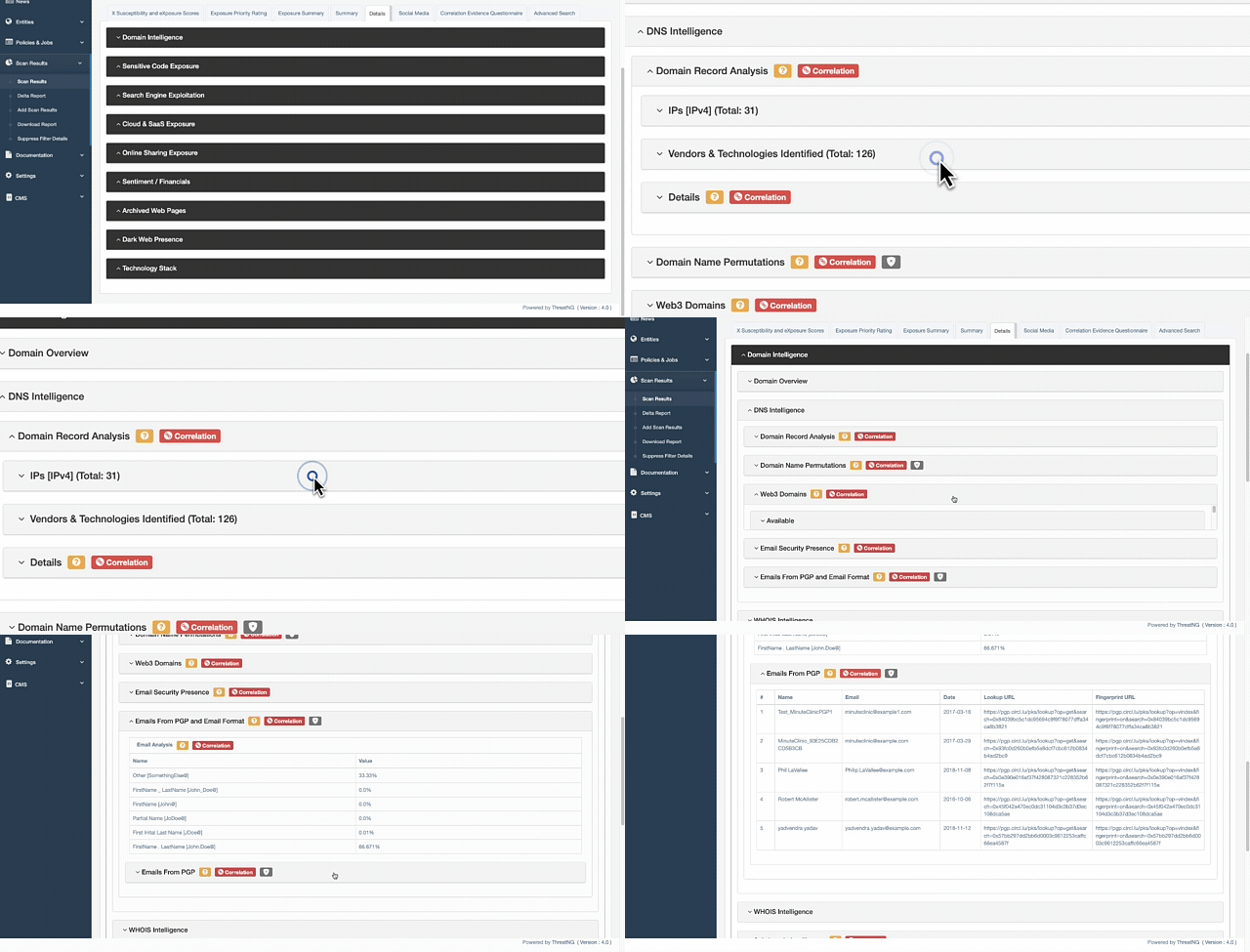
Threat Modeling DNS Enumeration Using ThreatNG
Securing an organization's public infrastructure requires a comprehensive and dynamic map of its Domain Name System (DNS) architecture. Because threat actors use DNS enumeration as a foundational reconnaissance technique to find valid hostnames, subdomains, and exposed IP addresses, security teams must see their public presence exactly as an attacker does. Identifying misconfigured zone transfers, orphaned staging subdomains, or weak email security records before they are weaponized is critical to perimeter defense.
ThreatNG operates as an advanced, connectorless, agentless Integrated External Risk Management Platform. By providing an unauthenticated, outside-in attacker's perspective without performing intrusive penetration testing, ThreatNG systematically uncovers, categorizes, and audits an organization's global DNS footprint. This continuous visibility allows security operations teams to discover hidden network structures and neutralize exposures across the external attack surface.
Agentless External Discovery to Map the DNS Attack Surface
Adversaries begin their initial reconnaissance by running automated scripts to query public nameservers for any recorded subdomain linked to a target brand. Traditional internal security scanners struggle to identify these resources because they operate within the internal corporate directory and remain completely blind to unauthorized or forgotten external setups.
ThreatNG addresses this lack of visibility by executing continuous, agentless external discovery. Operating entirely from the outside-in without requiring internal software agents, credentialed access, or network connectors, the platform interrogates public registries, domain servers, and cryptographic certificate transparency logs. This discovery engine recursively identifies registered domains, active subdomains, and public IP address blocks associated with the enterprise. By automatically mapping shadow IT, hidden development portals, and temporary marketing pages, ThreatNG gives defenders a complete inventory of their visible internet presence.
Deep External Assessment to Audit DNS Configurations
Once ThreatNG maps the public-domain footprint, it performs non-intrusive external technical assessments to evaluate active configuration settings, verify structural security, and translate technical vulnerabilities into clear, letter-graded Security Ratings.
Detailed Assessment Example: Exposed Subdomains and Staging Environments
During a routine external discovery sequence, ThreatNG identifies an unindexed staging subdomain (such as dev-payment-gateway.company.com) that has omitted corporate security controls. The assessment engine analyzes the host's DNS records and detects that it points directly to an active cloud server hosting an unauthenticated database management interface. ThreatNG flags this configuration error as a high-severity exposure, providing the exact host IP address, A record metadata, and open port details. This intelligence allows the security team to restrict or decommission the endpoint before an adversary locates it via brute-force dictionary attacks.
Detailed Assessment Example: Open DNS Zone Transfers (AXFR)
ThreatNG directly tests discovered authoritative nameservers to determine if they are vulnerable to unauthorized zone transfers. If an assessment reveals that a secondary nameserver is misconfigured to allow anonymous AXFR requests, ThreatNG records the exposure. The platform delivers the exact server response data, showing how an external attacker could download the entire DNS zone file in a single query, exposing the organization's internal topology and enabling infrastructure teams to disable the vulnerability immediately.
Deep-Dive Investigation Modules for Off-Perimeter DNS Hunting
Adversaries frequently look beyond core production servers to find leaked zone data, hardcoded infrastructure keys, and compromised corporate identities that can be used to hijack active domains. ThreatNG deploys highly specialized investigation modules to track down these peripheral threats across open and hidden web networks.
Detailed Investigation Example: Sensitive Code Exposure Module
Software engineers frequently use open-source platforms to collaborate on infrastructure-as-code scripts, but simple human errors can lead to public data leaks. ThreatNG's Sensitive Code Exposure module continuously scans public development environments, including GitHub, GitLab, and Bitbucket, for corporate markers. In a live scenario, the module might discover a public code repository containing an organization's complete internal DNS architecture map or cloud access tokens embedded inside a deployment script. ThreatNG isolates the exact repository URL and the exposed code snippet in real time, enabling the security team to revoke the credentials and remove the repository immediately.
Detailed Investigation Example: Dark Web and Infostealer Intelligence Module
Initial Access Brokers routinely deploy information-stealing malware to harvest corporate administrative credentials and session tokens from compromised personal devices. Driven by the DarCache Infostealer Intelligence Repository, ThreatNG’s Dark Web Presence module continuously scans and processes data from underground marketplaces, illicit forums, and public paste bins. If an attacker uploads an info-stealer log containing valid corporate credentials belonging to a DNS zone administrator, ThreatNG intercepts the breach. The module uses a patent-backed Context Engine™ to deliver precise attribution, enabling the organization to secure the account and enforce multi-factor authentication before an adversary alters routing tables or executes a domain-hijacking attack.
Continuous Monitoring to Eradicate Configuration Drift
Cloud-native enterprise perimeters are highly fluid; automated deployment pipelines spin up temporary infrastructure constantly, and network administrators modify routing records daily. A point-in-time vulnerability assessment or a quarterly compliance audit fails to track this rapid change, creating sudden windows of exposure in which unmanaged records can remain undetected.
ThreatNG counters this issue by delivering continuous monitoring across the entire external digital footprint and risk landscape. The moment an employee accidentally creates a wildcard DNS entry, adds a third-party service verification token to a public TXT record, or deploys an expired cryptographic certificate, ThreatNG identifies the shift immediately. This real-time tracking keeps the enterprise threat baseline completely accurate, allowing security operations centers to resolve configuration drift and eliminate exposures as soon as they appear online.
Intelligence Repositories for Strategic Security Context
To transform disparate domain records and technical findings into a cohesive defensive strategy, ThreatNG consolidates all discovered infrastructure logs, brand alerts, and technical exposures into DarCache, its centralized operational intelligence data store. DarCache organizes threat telemetry into dedicated sub-repositories—such as DarCache Vulnerability for active exploit tracking—giving defenders a single source of truth for their perimeter health.
Using the DarChain engine, ThreatNG performs contextual hyper-analysis of digital attack risk. DarChain models an attacker's real-world methodologies, demonstrating how a threat actor can chain together separate, lower-severity issues across different systems. For instance, it can illustrate how an adversary can target an unmanaged subdomain discovered by the platform, exploit an outdated software vulnerability, and use a credential leaked from an info-stealer log to orchestrate a major system breach. This predictive analysis helps organizations understand their true blast radius and conduct an External Open FAIR Assessment to prioritize remediation resources.
Standardized Reporting for Clear Perimeter Governance
To bridge the gap between technical operations and executive compliance, ThreatNG structures its continuous findings into the eXposure paradigm, automatically generating specialized Executive, Technical, and Prioritized reports. Executive Reports convert technical asset data into clear Security Ratings, allowing corporate leadership to monitor overall compliance and digital risk trends over time. At the same time, Technical and Prioritized Reports send actionable data directly to security engineers. These documents contain an embedded Knowledgebase packed with precise technical definitions, risk reasoning, and step-by-step remediation instructions, ensuring that infrastructure teams can quickly secure exposed records without conducting separate external research.
Strengthening DNS Security Through Cooperation with Complementary Solutions
ThreatNG functions as an automated external intelligence and discovery engine, focusing on seamless cooperation with complementary internal security solutions to accelerate defense actions and automate response workflows across the network perimeter.
Cooperation with Domain Name System (DNS) Security and Management Complementary Solutions: Internal DNS management complementary solutions track known corporate routing records, but often suffer from data gaps due to shadow IT. ThreatNG cooperates with these platforms by streaming its outside-in discovery data—including newly identified subdomains, wildcard records, and unmanaged IP blocks—directly into the central management interface. This cooperation ensures that the organization's internal authoritative record database remains complete, accurate, and up to date with real-time external telemetry.
Cooperation with Identity and Access Management (IAM) Complementary Solutions: When ThreatNG's investigation modules detect a compromised administrative account or exposed corporate credentials on public text bins or dark web marketplaces, it routes this technical intelligence straight to enterprise IAM complementary solutions. The IAM platform cooperates by instantly enforcing conditional access rules, locking the affected accounts, terminating active web sessions, and forcing a mandatory password change to completely block unauthorized login attempts to the domain registrar.
Cooperation with Security Orchestration, Automation, and Response (SOAR) Complementary Solutions: Upon identifying an urgent perimeter exposure—such as an open nameserver allowing unauthorized zone transfers—ThreatNG sends an immediate alert to enterprise SOAR complementary solutions. The SOAR platform cooperates by executing a preconfigured automated playbook, adjusting access control lists on the affected nameserver to block unauthorized queries, and creating an emergency ticket for the infrastructure team to apply the necessary permanent configuration fix.
Frequently Asked Questions (FAQs)
What is the primary benefit of an agentless approach to DNS discovery?
An agentless approach allows an organization to discover and assess its public-facing assets entirely from the outside-in, without requiring internal software installations or network access tokens. This replicates the exact reconnaissance techniques used by real-world adversaries, showing defenders precisely what an attacker can see across public nameservers and global internet registries.
How does ThreatNG complement traditional internal vulnerability scanners?
Internal vulnerability scanners excel at auditing known, managed systems within the internal enterprise directory, but remain blind to shadow IT. ThreatNG complements these tools by scanning the external internet to find undocumented subdomains, unmanaged cloud storage containers, and leaked credentials that traditional internal scanners cannot detect.
Why is continuous monitoring required for modern DNS asset management?
Because modern cloud infrastructure is highly dynamic, records are generated, modified, and removed daily to support fast-paced business operations. A point-in-time security audit leaves massive visibility gaps, making continuous monitoring essential to identify configuration errors or unmanaged records as soon as they appear online.
