


External ISO42001 Mapping
We Speak Attacker. We Translate to ISO 42001.
The impossibility of defending against invisible threats ends here. In an era where AI adoption outpaces security oversight, what remains unseen on the perimeter will inevitably escalate into an internal crisis. ISO/IEC 42001 (Artificial Intelligence Management System) is the definitive international standard, providing formal requirements for establishing, implementing, maintaining, and continually improving an AI governance framework. ThreatNG acts as the enterprise Cognitive Exoskeleton, establishing absolute positional dominance by translating the chaotic, unregulated noise of the external internet into a structured, disciplined defense. Discovering a vulnerability is only half the challenge; by autonomously uncovering exposures before exploitation, ThreatNG turns raw external data into an executive-ready roadmap for governance and technical resilience.
Curing the Chronic Blindness of AI Blindness
Organizations today suffer from chronic "Compliance Blindness": the dangerous, paralyzing friction between discovering a digital vulnerability and knowing exactly which ISO 42001 control it violates. Security leaders cannot rely on the passive Surveillance Fallacy; watching a perimeter is not the same as securing it. The anxiety generated by unknown exposures in the AI supply chain, exposed Application Programming Interfaces (APIs), and leaked training datasets creates a vacuum of order that threat actors eagerly exploit. ThreatNG fills this void by moving beyond passive observation, delivering active, framework-aligned intelligence that restores structural integrity to the enterprise.
Translating External Chaos to ISO 42001 Clarity
ThreatNG provides the strategic blueprint needed to address imminent threats. The platform doesn't just find isolated leaks; it delivers the structural mapping needed to satisfy external auditors and secure the entire AI lifecycle. Below are just a few high-impact examples demonstrating how external exposures map directly to ISO 42001 requirements:
The External Discovery: Code Secrets Found
The Reality: Sensitive credentials, API tokens, or proprietary logic discovered in public repositories can lead to a total compromise of AI models and backend data pipelines.
The ISO 42001 Alignment: Maps directly to Annex A (A.10.1) Information Security for AI Systems and Clause 8.3 AI Risk Treatment. ThreatNG identifies these external leaks to guide immediate secret rotation and repository cleanup, ensuring AI system integrity.
The External Discovery: Subdomains Missing Content Security Policy (CSP)
The Reality: Without a CSP, client-side injection attacks can compromise AI system inputs, execute malicious scripts, or exfiltrate user data directly from AI interfaces.
The ISO 42001 Alignment: Maps directly to Annex A (A.6.1) Data Security and Protection. ThreatNG identifies this technical gap as an unmitigated risk to data confidentiality, guiding the rapid implementation of browser-level controls.
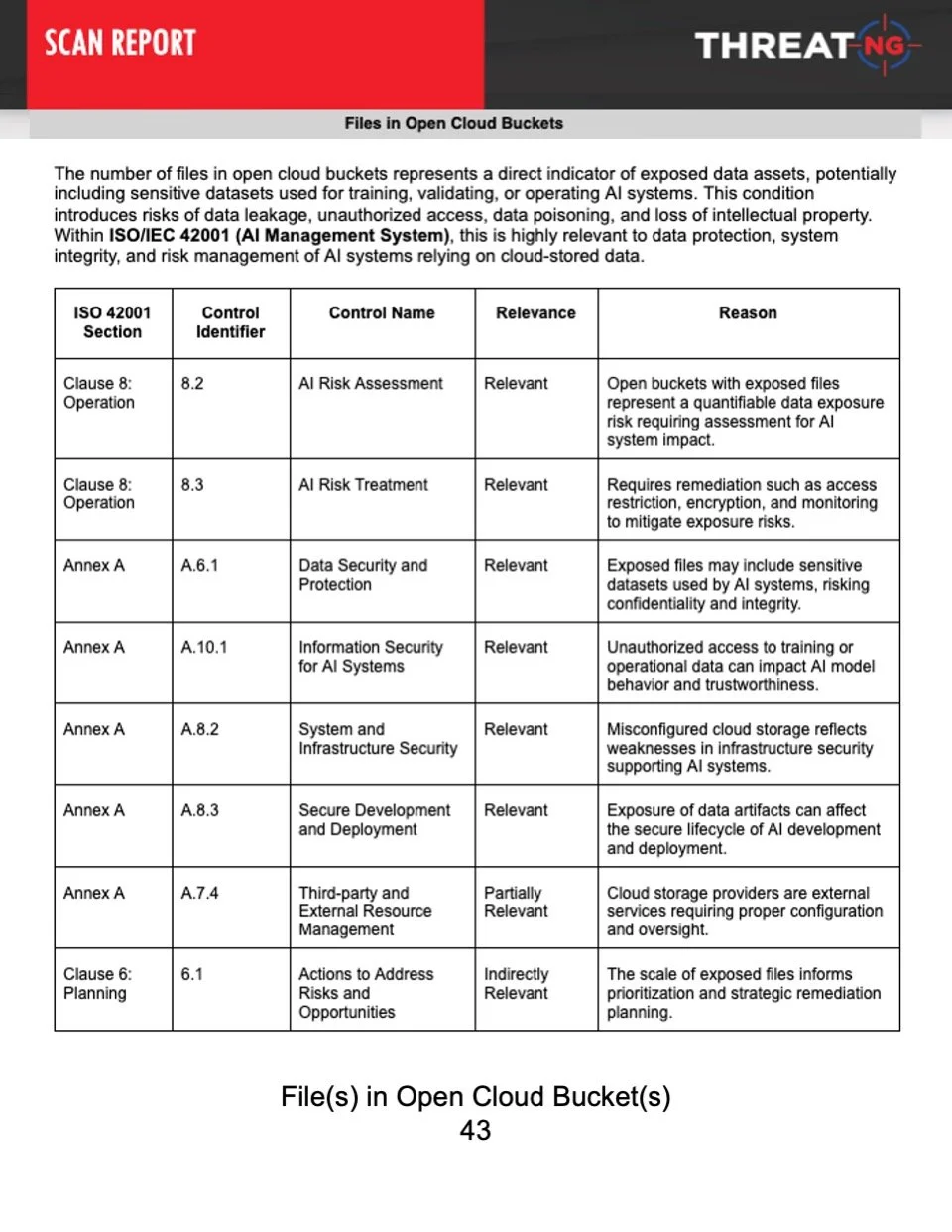
The External Discovery: Files in Open Cloud Buckets
The Reality: Unprotected cloud storage often contains the exact datasets used to train or validate AI models, creating severe risks of data poisoning, intellectual property theft, or privacy violations.
The ISO 42001 Alignment: Maps directly to Clause 8.2, AI Risk Assessment, and Annex A (A.8.3), Secure Development and Deployment. ThreatNG quantifies this exposure, providing the empirical evidence needed to enforce strict access restrictions and encryption standards.
Your ISO 42001 Executive Action Plan
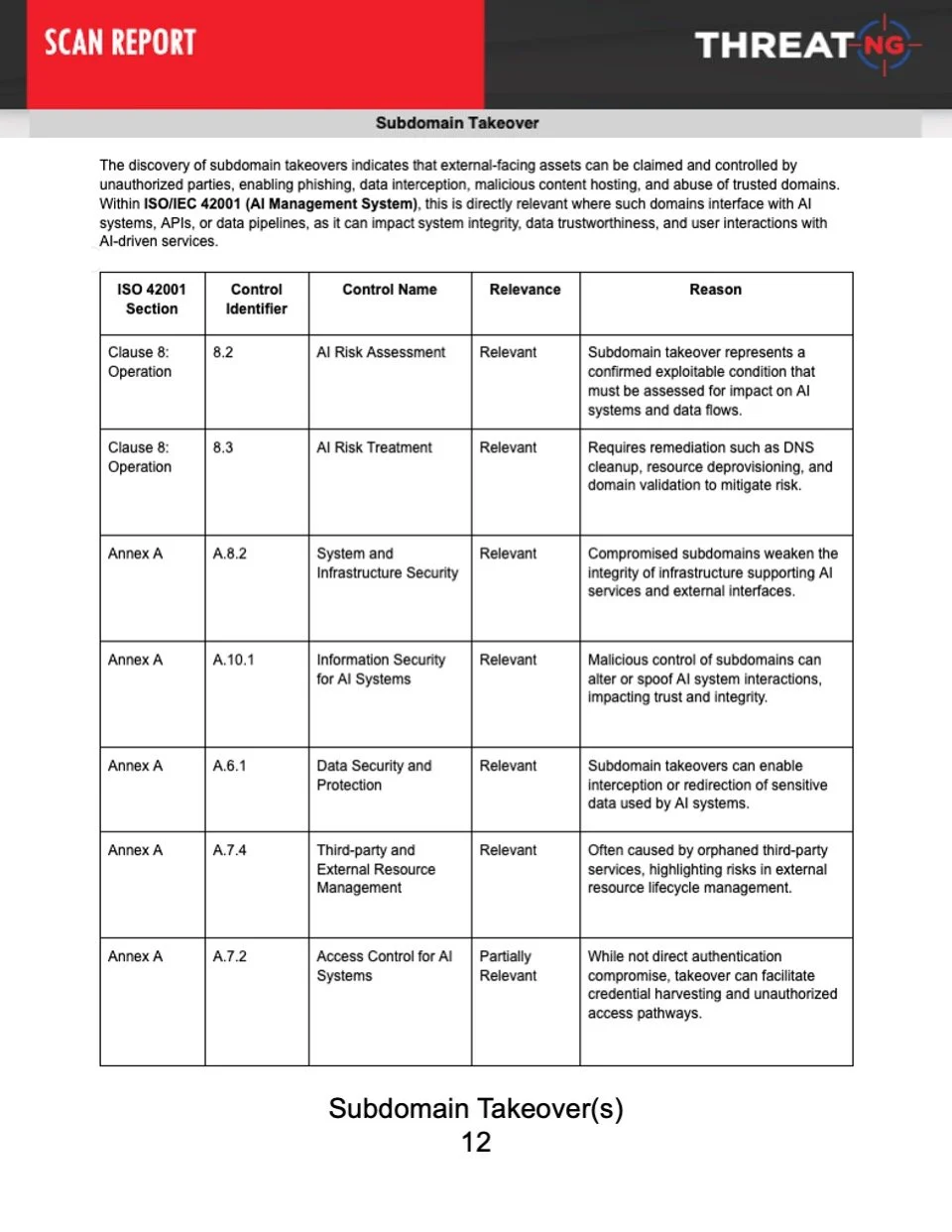
This deliverable is more than a disjointed list of software bugs; it is your definitive Executive Action Plan. ThreatNG delivers structured, board-ready intelligence that empirically proves the organization's security posture to executive stakeholders, auditors, and cyber insurance underwriters. It transforms an overwhelming deluge of raw external data into a clear, compelling narrative of "Risk vs. Resolution," providing the absolute certainty required to lead confidently in the rapidly evolving AI governance space.
Aligning the SOC and the Boardroom on ISO 42001
A unified, resilient defense requires a unified language. ThreatNG actively bridges the communication gap between technical execution and executive oversight, ensuring that every layer of the organization operates from a single source of truth.
For the CISO
Eliminate the friction and expense of managing disparate intelligence feeds. By replacing fragmented EASM, Digital Risk Protection (DRP), and threat intelligence tools with one unified platform, organizations achieve massive ROI from tool consolidation. This single source of truth justifies cybersecurity budgets with absolute certainty and streamlines board-level reporting.
For SecOps
Analysts are liberated from the exhaustion of endless, contextless alerts. The platform drives prioritized, confident remediation with specific attack-path intelligence. For example, when ThreatNG identifies Exposed Admin Pages, the security operations team knows instantly which Annex A (A.7.2) Access Controls require immediate hardening, drastically reducing mean time to remediation (MTTR).
For Compliance & Risk Teams
Maintain continuous, 24/7 audit readiness. Instead of suffering through a chaotic once-a-year scramble to gather evidence, teams use continuous monitoring to track Invalid Certificates or DNSSEC gaps (Annex A, A.8.2) in real time, permanently transforming compliance anxiety into verifiable peace of mind.
Reclaim Your Perimeter Today
The internet remains inherently chaotic, but enterprise AI governance must be absolute. Guesswork regarding external exposures is no longer an acceptable strategy. Stop accepting compliance blindness. Disciplined visibility is the only path forward.

Frequently Asked Questions: Mastering EASM and ISO 42001
-
Organizations map these risks by using continuous external discovery telemetry to automatically correlate technical vulnerabilities with specific governance requirements. For example, ThreatNG translates a discovered unencrypted cloud bucket into a direct violation of ISO 42001 Data Security controls, providing the verifiable evidence auditors demand for Stage 2 certification. This automated alignment cures "compliance blindness" and transforms static policies into continuously monitored, audit-ready operational evidence.
-
Yes, by autonomously discovering open cloud storage buckets and leaked secrets in public code repositories, ThreatNG identifies exposures that directly impact the Data Security and Protection requirements of ISO 42001. The platform provides the continuous, outside-in visibility needed to prevent data poisoning, intellectual property theft, and unauthorized access to proprietary AI datasets.
-
ThreatNG actively monitors for external organizational signals such as Environmental, Social, and Governance (ESG) violations, negative news, and legal filings that indicate a breakdown in the AI Governance Framework (Annex A, A.2.1). These critical, non-technical findings help executive leadership address systemic oversight gaps and third-party vendor instability long before they result in material regulatory penalties or catastrophic reputational damage.
-
Accurately determining materiality requires legal-grade attribution of external assets and verified threat context, rather than sifting through thousands of disjointed alerts. Because the four-day SEC disclosure clock begins with the materiality determination itself, executives urgently need unified attack-path intelligence that immediately quantifies the financial and operational impact of an exposure. ThreatNG provides this definitive ground truth by correlating technical risks with historical Form 8-K data and public lawsuits, protecting leaders from personal liability and preventing misleading disclosures.
-
Legacy port scanning operates as a manual, point-in-time exercise that requires internal network credentials, complex connectors, and known seed lists, leaving organizations fundamentally blind to Shadow IT. In contrast, unauthenticated recursive discovery uses a self-expanding loop to interrogate global internet registries and routing databases using only a primary domain. This patented method dynamically maps the true digital footprint, including forgotten subdomains and unsanctioned cloud environments exactly as an adversary sees it, creating absolute visibility with zero operational friction.
-
Compromised non-human identities, such as API keys, OAuth tokens, or AI agent credentials, authenticate at machine speed directly from infrastructure, bypassing multi-factor authentication (MFA) prompts designed for humans. Because these credentials often leak into public code repositories or third-party vendor systems, attackers can use them to execute bulk access that perfectly mimics authorized automated behavior. Continuous external scanning of deep web marketplaces and external repositories is required to detect and revoke these leaked machine identities before they become the primary entry point for an intrusion.