


Lawsuits
The Litigation Risk Horizon: Eradicate Your External GRC Blind Spot and Defend Your Executive Legacy
In structural engineering, a skyscraper's flawless visible architecture means nothing if the subterranean bedrock is fracturing under seismic pressure. You have built a flawless internal Governance, Risk, and Compliance (GRC) architecture; your perimeters are secured, and your vendors consistently pass exhaustive onboarding questionnaires. However, legacy security tools rely on static, point-in-time assessments, leaving you entirely blind to external financial and legal stress. This traps you in the External GRC Blind Spot.
What happens when your most trusted cloud provider is suddenly engulfed in a federal class-action lawsuit for consumer fraud or severe labor violations? As they bleed capital to defend themselves, they quietly defund their internal IT security, miss critical patch cycles, and become a highly vulnerable soft target for ransomware. In an era of aggressive regulatory enforcement, where the legal perimeter extends to wherever your data resides, ignoring discoverable external liabilities is increasingly prosecuted as gross negligence.
Operating under the philosophy of "Security Centric, Not Security Exclusive," the Lawsuits module empowers CISOs, Risk Officers, and General Counsel to reclaim the perimeter and defend their executive legacy. By cutting through the noise, the module transforms chaotic public lawsuits, ESG violations, and negative news into a proactive, mathematically verified defense.
The ThreatNG Arsenal: Eliminate Operational Friction, Predict Attack Paths, and Stop Accepting the Burden of Proof

The External Scout: Break the "Connector Trap" with Zero-Connector Structural Diagnostics
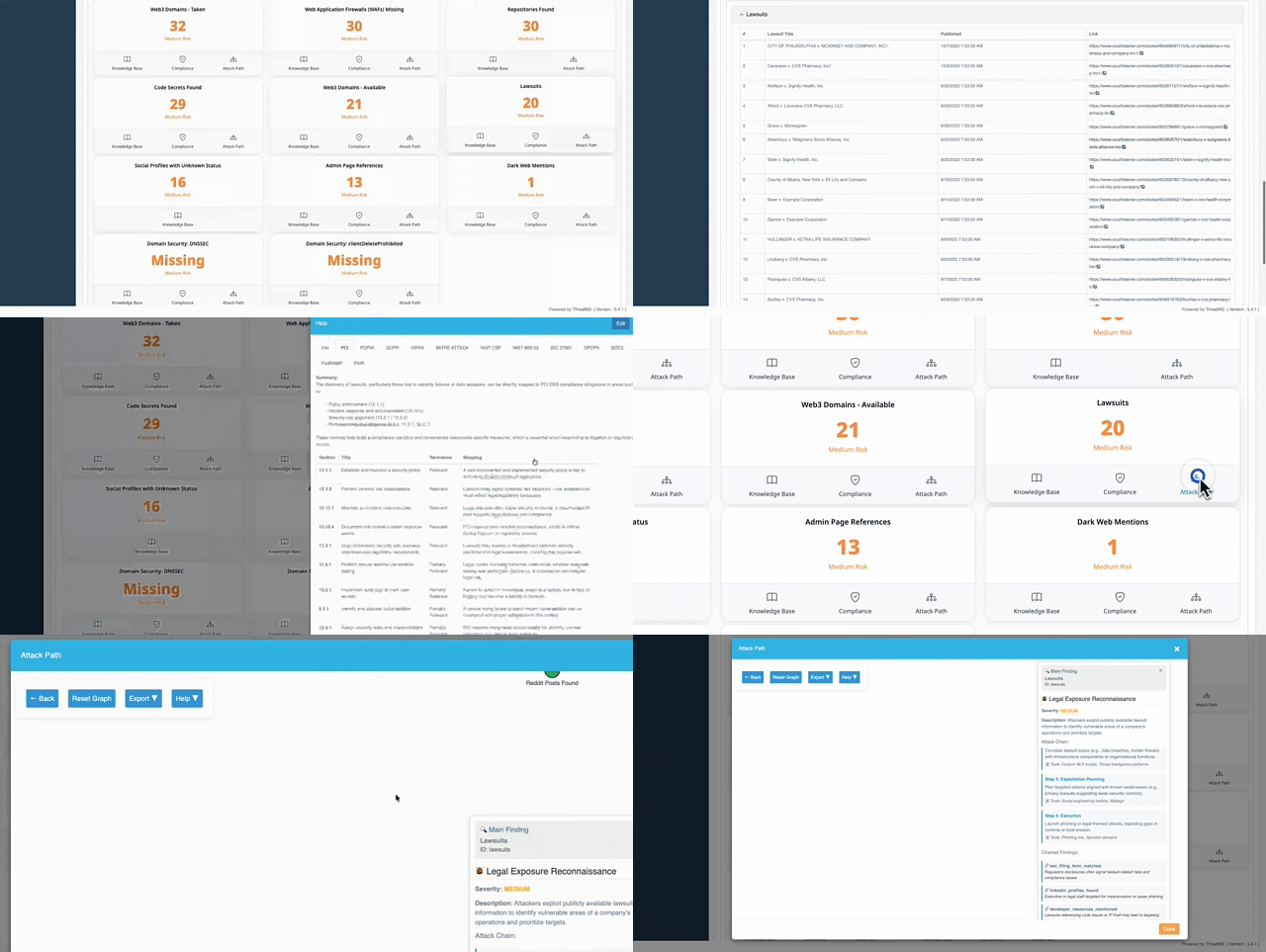
Legacy External Attack Surface Management (EASM) platforms are often merely sophisticated port scanners that hold you hostage to endless API integrations. They demand manual seed data and internal credentials while leaving you blind to shadow IT. We stand with you against this operational friction. ThreatNG uses patented, unauthenticated recursive discovery (US Patent No. 11,962,612 B2) to dynamically map your true digital footprint exactly as the adversary sees it. This frictionless approach requires zero API keys or manual inputs, eradicating your seed data blind spots and reclaiming your security team's valuable time. Operating as your unauthenticated external Scout, ThreatNG continuously uncovers publicly disclosed lawsuits across your digital supply chain, uncovering the 'unknown unknowns' before they can be exploited.
Contextual Certainty: Shield Yourself from Personal Liability with Legal-Grade Attribution
Under evolving regulatory reporting rules, agencies like the SEC no longer accept "we didn't know" as a defense when a vendor's publicly discoverable legal distress leads to a data breach. To replace probabilistic guesswork with certainty, ThreatNG automatically extracts the cause of action, plaintiff, and defendant. By delivering irrefutable Legal-Grade Attribution, we arm you with the exact evidence required to sever toxic vendor relationships. With these Forensic Evidence Packages, you are empowered to act before a vendor's negligence forces a panicked Form 8-K disclosure, ensuring your personal career and board of directors remain fully protected.
The DarChain Attack Path Intelligence Methodology: Predict Attack Choke Points
Sophisticated adversaries do not send compliance questionnaires; they weaponize public financial stress. ThreatNG’s DarChain engine acts as your architectural blueprint, iteratively correlating a vendor's legal instability directly to unmanaged technical vulnerabilities. By identifying these exact Attack Choke Points, you can dismantle an adversary's exploit chain before a threat escalates into a crisis. We then translate these chaotic external risks into a board-ready Brand Damage Susceptibility Rating (A-F). This single metric empowers you to command the boardroom, quantify the Cost of Inaction (COI), and protect your organization from the devastating effects of Long-Term Market Value Suppression.
Interoperability: Powering the Intelligence Engine
The Lawsuits module seamlessly empowers ThreatNG’s overarching enterprise use cases, ensuring your structural integrity is preserved across every front:
Brand Protection
Protects your organization from the devastating effects of Long-Term Market Value Suppression.
Cloud & SaaS Exposure Management
Identifies when your trusted cloud provider is bleeding capital and missing patch cycles, all without requiring any API integrations.

Due Diligence
Iteratively correlates a target company's legal instability directly to unmanaged technical vulnerabilities, giving you the power to predict attack paths before finalizing an acquisition.
Third-Party Risk Management
Replaces the reliance on point-in-time questionnaires by continuously uncovering publicly disclosed lawsuits across your digital supply chain.

External Attack Surface Management (EASM)
Maps your true digital footprint dynamically and without operational friction, eliminating blind spots.

Digital Risk Protection (DRP)
Shields you from personal liability by tracking ESG violations and negative news that adversaries could weaponize.

Security Ratings
Iteratively correlates a target company's legal instability directly to unmanaged technical vulnerabilities, giving you the power to predict attack paths before finalizing an acquisition.

Frequently Asked Questions: Mastering External Legal & Cyber Risk
-
The External GRC Blind Spot is a critical vulnerability where internal Governance, Risk, and Compliance (GRC) and Enterprise Risk Management (ERM) programs fail to proactively flag public disclosures originating outside the organization's perimeter. While your internal telemetry might be flawless, you remain blind to third-party vendor lawsuits, regulatory filings, or negative news. Because modern cyberattacks frequently exploit the degraded security posture of financially or legally stressed vendors, this blind spot leaves your organization exposed to severe supply chain breaches and downstream legal liability.
-
Lawsuits, negative news, and Environmental, Social, and Governance (ESG) violations create continuous, long-term liabilities that signal a failure to maintain operational controls. These non-financial threats directly contribute to investor hesitation, heighten perceptions of corporate mismanagement, and result in a sustained financial drag from legal fees and compliance costs. Ultimately, this leads the market to expect lower future cash flows, resulting in a lower stock price multiple and a permanently suppressed market capitalization relative to more resilient peers.
-
Operating natively within the Sentiment and Financials module, the "Lawsuits" capability dives into the legal landscape of your digital ecosystem to uncover and continuously monitor publicly disclosed lawsuits relevant to your organization and its vendors. It automatically extracts crucial, actionable information, including the lawsuit's title, cause of action, publication date, plaintiff, and defendant. This allows security and legal teams to proactively assess legal resilience and sever toxic vendor relationships before financial distress leads to a data breach.
-
ThreatNG translates non-technical external risks into the Brand Damage Susceptibility Rating, an executive-level security metric graded from A to F. This score quantifies total external liability by evaluating the Digital Presence Triad: Feasibility, Believability, and Impact. By mathematically aggregating lawsuits, negative news, SEC filings, and ESG violations into a single, objective score, CISOs can clearly communicate the Cost of Inaction (COI) to the board and justify strategic investments in digital resilience.
-
DarChain (Digital Attack Risk Contextual Hyper-Analysis Insights Narrative) is ThreatNG's proprietary External Contextual Attack Path Intelligence engine. Instead of handing security teams a disorganized "pile of bricks" composed of low-level alerts, DarChain acts as an architectural blueprint. It iteratively correlates isolated social, regulatory, and technical exposures—such as mapping a vendor's public lawsuit directly to an unmanaged, highly vulnerable staging server—to identify exact "Attack Choke Points". This allows your team to intervene and disrupt the adversary's exploit chain before an incident escalates into a crisis.
-
No. ThreatNG permanently breaks the "Connector Trap". Legacy External Attack Surface Management (EASM) tools often act as sophisticated port scanners that require manual seed data, internal credentials, or complex API keys. ThreatNG utilizes patented, unauthenticated recursive discovery (US Patent No. 11,962,612 B2) to dynamically map your true digital footprint exactly as an adversary sees it, requiring zero input, zero manual seeds, and no internal agents to operate.
-
Under evolving SEC reporting rules, ignoring discoverable external assets is increasingly prosecuted as gross negligence. ThreatNG automates analysis of SEC filings and includes the DarCache 8-K intelligence repository, which correlates your active threat data with the real-world historical SEC Form 8-K filings of publicly traded peers. By delivering Legal-Grade Attribution—mathematically verified evidence of asset ownership—ThreatNG arms executives with the irrefutable proof required to manage incident materiality, accurately file disclosures, and protect executive leaders from personal liability.