


External MITRE ATLAS Mapping
We Speak Attacker. We Translate to MITRE ATLAS.
Stop defending against what you cannot see. In an era where Artificial Intelligence and Machine Learning define the new competitive frontier, external blind spots are the primary catalysts for systemic internal catastrophes. ThreatNG brings immediate, uncompromising clarity to the external attack surface, neutralizing threats before they mutate into executive crises.
The MITRE ATLAS (Adversarial Threat Landscape for Artificial-Intelligence Systems) framework is the globally recognized, definitive knowledge base of adversary tactics and techniques deployed against AI-enabled systems. Establishing true "positional dominance" requires recognizing that discovering a vulnerability represents only half the operational challenge; raw data without context is merely noise. ThreatNG operates as the ultimate "Cognitive Exoskeleton," translating the chaotic signals of the external internet perimeter into a structured, disciplined, and framework-aligned defense mechanism.
Curing MITRE ATLAS Compliance Blindness
The most dangerous vulnerability in modern cybersecurity is not a zero-day exploit; it is "Compliance Blindness." This is the high-friction, anxiety-inducing gap between the exact moment an external vulnerability is discovered and the delayed realization of which specific regulatory compliance control it violates. You cannot protect what you do not manage, and you cannot manage what remains invisible.
Organizations can no longer rely on the passive "Surveillance Fallacy", the dangerous assumption that simply watching the perimeter and waiting for an alert is sufficient to deter adversaries. Threat actors operate entirely outside internal visibility, exploiting forgotten subdomains, open ports, and leaked credentials to poison training data and manipulate ML pipelines long before an internal alarm triggers. ThreatNG completely eradicates this anxiety. By replacing the guesswork of manual triage with the certainty of direct framework mapping, the platform ensures every external discovery is immediately contextualized against the MITRE ATLAS matrix.
Translating External Chaos to MITRE ATLAS Clarity
ThreatNG provides the exact strategic blueprint required to resolve complex external threats, moving beyond raw discovery to deliver actionable, prioritized context. The platform automatically correlates technical findings with external verification points, providing high-confidence attribution. Below are just a few examples of how ThreatNG maps external exposures directly to the MITRE ATLAS framework to aggressively guide remediation:
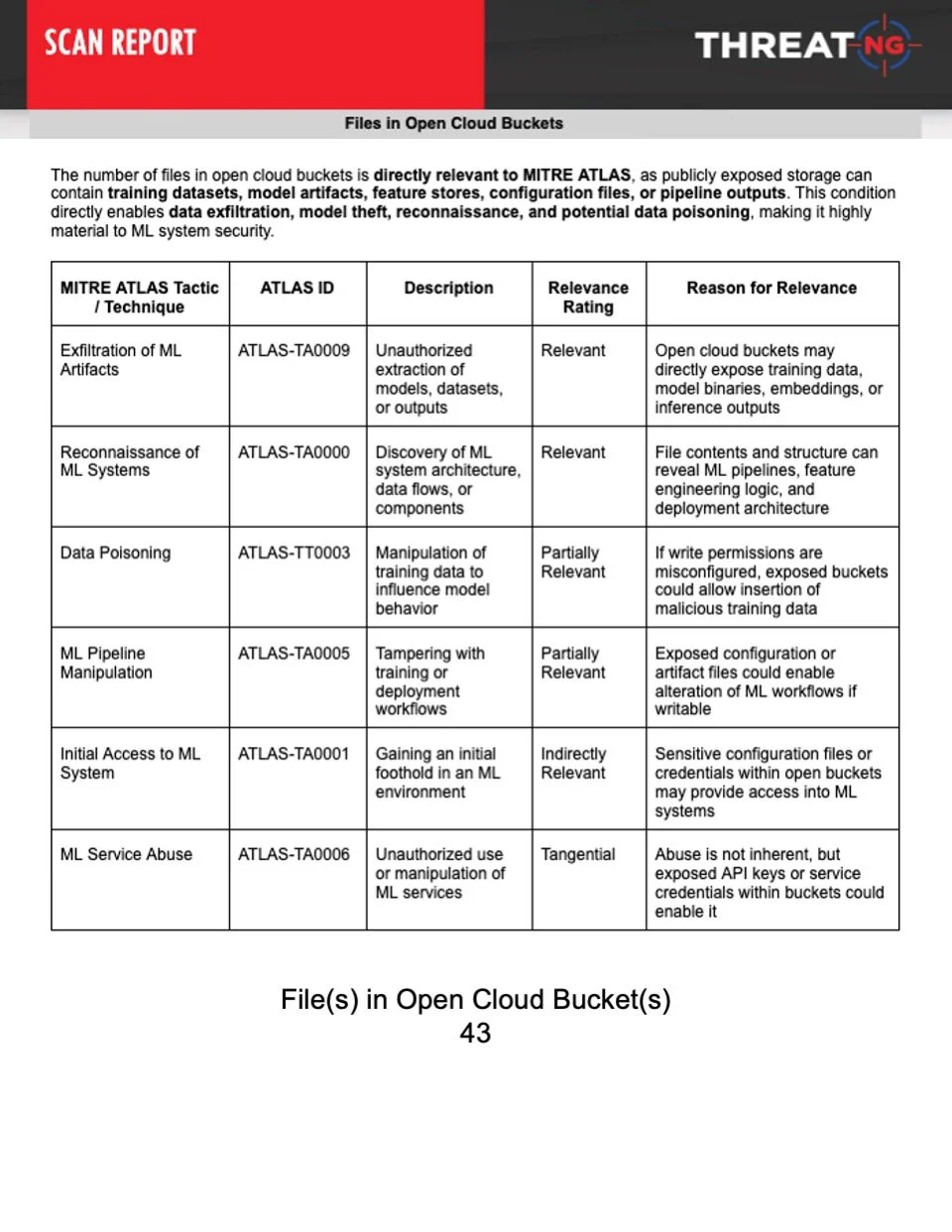
The External Discovery: Files in Open Cloud Buckets
The Reality: Publicly exposed storage infrastructure frequently contains proprietary training datasets, model binaries, or sensitive configuration files critical to AI integrity.
The MITRE ATLAS Alignment: Maps to Exfiltration of ML Artifacts (ATLAS-TA0009) and Data Poisoning (ATLAS-TT0003), providing a direct, framework-aligned guide to securing training data and model weights against adversarial extraction.
The External Discovery: Compromised Emails
The Reality: Stolen credentials enable threat actors to effortlessly bypass perimeter authentication and gain unhindered entry to machine learning dashboards and external APIs.
The MITRE ATLAS Alignment: Maps to Initial Access to ML System (ATLAS-TA0001) and Credential Harvesting (ATLAS-TT0010) to instantly prioritize identity and access management defenses.
The External Discovery: Exposed Developer Resources
The Reality: Development environments and code repositories frequently leak source code, API keys, and continuous integration/continuous deployment (CI/CD) configurations for ML models.
The MITRE ATLAS Alignment: Maps to ML Pipeline Manipulation (ATLAS-TA0005), guiding the protection of training, validation, and deployment workflows against adversarial tampering.
Your MITRE ATLAS Executive Action Plan
This Strategic Blueprint is more than a list of technical findings; it is fully contextualized, board-ready intelligence. ThreatNG distills millions of external data points into a cohesive, prioritized narrative that bridges the communication gap between technical reality and boardroom governance. By delivering categorized, framework-aligned remediation steps, this deliverable shows your organization has the structured roadmap needed to preemptively manage cyber risk and meet the most stringent regulatory oversight.
Aligning the SOC and the Boardroom on MITRE ATLAS
A unified, resilient enterprise defense requires a unified language. ThreatNG serves as the translation layer between tactical execution and strategic oversight, ensuring every stakeholder operates with absolute contextual certainty.
For the CISO
Prove definitive alignment with emerging AI security standards and justify security budgets with absolute certainty. Use ThreatNG to aggressively consolidate your security stack, replacing disparate external attack surface management (EASM) point products, dark web monitors, and disconnected threat intelligence feeds with a unified platform. This consolidation delivers clear Return on Investment (ROI), reduces operational overhead, and dramatically simplifies board reporting for SEC and regulatory disclosures.
For SecOps
Move operations from the exhaustion of overwhelming data discovery to the confidence of prioritized, targeted remediation. By automating the correlation of external signals, ThreatNG reduces Mean Time to Remediate (MTTR). For instance, when the platform identifies Default Port Scans on external infrastructure, your security operations team knows exactly how this maps to Reconnaissance of ML Systems (ATLAS-TA0000), empowering analysts to close critical entry points before adversarial exploitation occurs.
For Compliance & Risk Teams
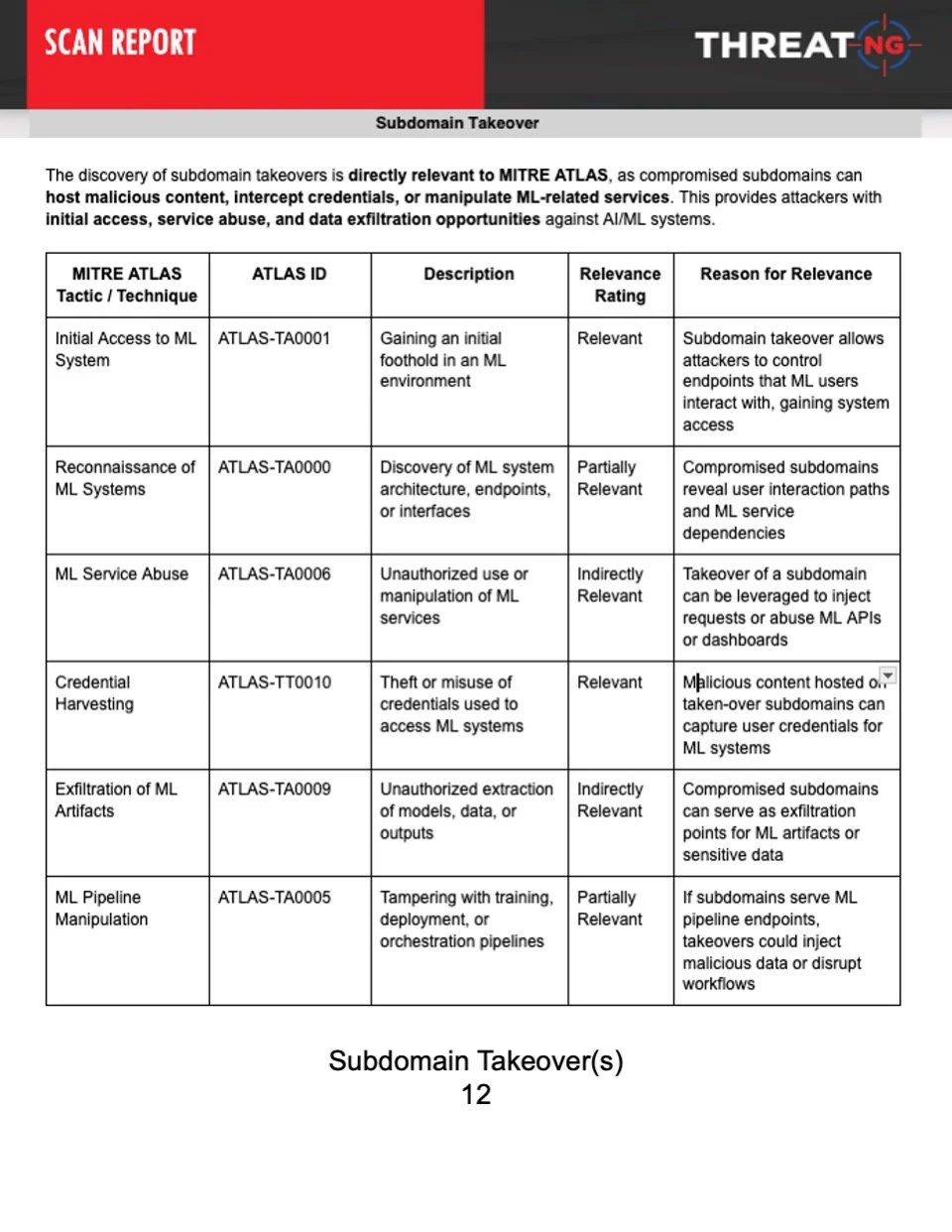
Maintain continuous audit readiness and operational peace of mind. By proactively identifying governance risks such as Subdomains Missing Content Security Policy (CSP), ThreatNG automatically highlights vulnerabilities associated with ML Service Abuse (ATLAS-TA0006). This continuous validation ensures your AI governance frameworks remain intact, auditable, and compliant across the entire enterprise ecosystem.
Command the Perimeter: Neutralize Your MITRE ATLAS Exposures Today
The modern digital perimeter is chaotic, but your enterprise defense strategy demands absolute order. Stop hoping your AI infrastructure is secure. Take immediate, uncompromising control of your external attack surface and align organizational risks directly with the definitive AI security framework today.

Frequently Asked Questions: Mastering AI Risk, Compliance, and the External Attack Surface
-
ThreatNG automates the correlation of external discoveries such as exposed developer resources, compromised credentials, or open cloud buckets directly to specific adversarial tactics within the framework. This contextualization turns raw perimeter noise into framework-aligned intelligence, helping security teams see exactly how an attacker might use an external exposure to achieve "Initial Access" or "ML Pipeline Manipulation" against internal AI systems.
-
CISOs can overcome the boardroom "Translation Problem" by using ThreatNG to generate structured Strategic Blueprints that convert technical exposures into business-level risk narratives. By automatically mapping vulnerabilities to specific compliance frameworks, the platform delivers the board-ready intelligence needed to satisfy stringent SEC cybersecurity disclosure rules that require documented oversight of material cyber risks.
-
Traditional External Attack Surface Management (EASM) predominantly scans for legacy IT misconfigurations and standard software flaws (CVEs). Conversely, AI-SPM focuses on the unique, data-driven attack surface of artificial intelligence, including deployed LLMs, datasets, shadow AI systems, and specialized endpoints. ThreatNG bridges these domains by applying advanced EASM discovery to find external blind spots that leave AI-SPM frameworks vulnerable to adversarial exploitation.
-
Replacing disparate point products (such as separate dark web monitors, threat intelligence feeds, and basic EASM scanners) with a single unified platform eliminates the financial drain of tool sprawl. By converging these capabilities into one risk-reasoning engine, security operations teams eliminate triage bottlenecks, streamline response workflows, and dramatically reduce Mean Time to Remediate (MTTR) by eliminating the need to jump between disconnected dashboards.
-
ThreatNG uses connectorless external discovery to continuously map the internet for unauthorized or unmanaged AI implementations deployed outside of standard IT visibility. By actively discovering forgotten subdomains, open APIs, and dangling infrastructure used by rogue departments, the platform cures "Compliance Blindness" and brings Shadow AI back under strict, auditable enterprise governance.
-
Relying strictly on base severity scores forces security teams into a "pile of bricks" scenario, causing alert fatigue as they chase high-scoring vulnerabilities that may not be exploitable in their specific environment. Risk-based prioritization combines active threat intelligence, asset criticality, and attack-path context to ensure teams focus their limited time on remediating the vulnerabilities that represent genuine, immediate business risks.
-
The platform automatically uses the framework to categorize external discoveries into specific AI-related tactics, such as Initial Access, Pipeline Manipulation, or ML Artifact Exfiltration. This allows security operations teams to use the severity of the potential impact on critical AI systems to sequence and prioritize remediation efforts effectively.
-
Yes, by continuously discovering exposed developer resources, API keys, and open cloud buckets, ThreatNG identifies the exact external vectors that lead to the manipulation of your training and deployment workflows. The platform then maps these exposures directly to specific ATLAS techniques for pipeline manipulation, providing an evidence-based guide for your defensive response.
-
ThreatNG is engineered to complement internal security tools by providing the critical external context they inherently lack, perfectly bridging the gap between perimeter security and internal AI governance. It identifies the precise methods and locations an external attacker might use to first gain the access necessary to target your internal machine learning environments.