

Email Harvesting
In cybersecurity, email harvesting is the automated or manual process of collecting a massive volume of email addresses from various public and private digital sources. Threat actors use this gathered data to build extensive target lists for malicious campaigns, such as mass spam distribution, targeted phishing attacks, and credential stuffing.
Instead of targeting a single individual, email harvesting allows cybercriminals to cast a wide net, increasing the likelihood that their automated attacks reach a vulnerable user.
How Cybercriminals Harvest Email Addresses
Attackers rely on a combination of automated technology and underground intelligence to build their email databases.
Web Scraping Bots: Attackers deploy automated scripts, often called spambots or spiders, to crawl web pages, public forums, and social media platforms. These bots are programmed to scan the underlying HTML and extract any text formatted with the "@" symbol followed by a domain extension.
Directory Harvest Attacks (DHA): Cybercriminals use brute-force techniques to guess valid email addresses at a specific target organization. They send thousands of emails to common name variations (e.g., admin@company.com, j.smith@company.com) and monitor the mail server's response. If the server does not return a "bounce" message, the attacker knows the guessed address is valid.
Data Breaches and Dark Web Purchases: When organizations suffer data breaches, customer and employee email databases are often dumped on underground forums. Attackers can simply purchase or download these massive repositories to instantly acquire millions of verified addresses.
Social Engineering and Fake Portals: Threat actors frequently create fake contests, newsletters, or gated content to trick users into voluntarily submitting their email addresses, completely unaware that they are handing their contact information directly to scammers.
The Cybersecurity Risks of Email Harvesting
The act of harvesting an email is just the reconnaissance phase. The true danger lies in how cybercriminals weaponize those lists.
Spear-Phishing and Social Engineering: Harvested corporate emails give attackers the exact targets they need to launch highly convincing spear-phishing and Business Email Compromise (BEC) campaigns against specific departments, such as finance or human resources.
Credential Stuffing: Because people frequently use their email address as a login username across multiple web services, attackers pair-harvest emails with previously leaked passwords. They use automated tools to test these combinations across banking, retail, and corporate portals to execute account takeovers.
Malware Distribution: Harvested lists provide a massive delivery network for threat actors to distribute ransomware, spyware, and trojans via malicious email attachments or deceptive links.
How to Defend Against Email Harvesting
Organizations and individuals must adopt proactive defensive measures to obscure their digital footprint and block automated reconnaissance tools.
Address Obfuscation: Instead of displaying emails in plain text on public websites, organizations should format them defensively (e.g., replacing the "@" symbol with "[at]" and the dot with "[dot]"). Alternatively, companies should use web-based contact forms rather than direct "mailto:" links.
Bot Management and Rate Limiting: Implement web application firewalls (WAFs) and CAPTCHA to detect and block the automated scraping bots attempting to crawl public-facing websites and directories.
Mail Server Hardening: Configure email servers to silently drop incoming messages addressed to invalid users. By refusing to send a "bounce" or "user unknown" receipt back to the sender, organizations prevent Directory Harvest Attacks from successfully verifying which addresses are real.
Frequently Asked Questions (FAQs)
Is email harvesting illegal?
While manually copying public email addresses is not inherently a crime, using automated bots to scrape them often violates a website's Terms of Service. Furthermore, using those harvested emails to send spam or launch cyberattacks explicitly violates regulations such as the CAN-SPAM Act in the United States and the General Data Protection Regulation (GDPR) in Europe.
What is the difference between email harvesting and lead generation?
Lead generation relies on explicit consent. Users willingly provide their contact information in exchange for value, such as a whitepaper or a newsletter subscription. Email harvesting is entirely non-consensual and covert, extracting addresses without the owner's knowledge or permission.
How can I tell if my email address has been harvested?
If you suddenly receive a massive influx of unsolicited spam, phishing attempts, or subscription confirmations for newsletters you never signed up for, it is highly likely that your email address has been scraped or exposed in a data breach and added to a threat actor's distribution list.
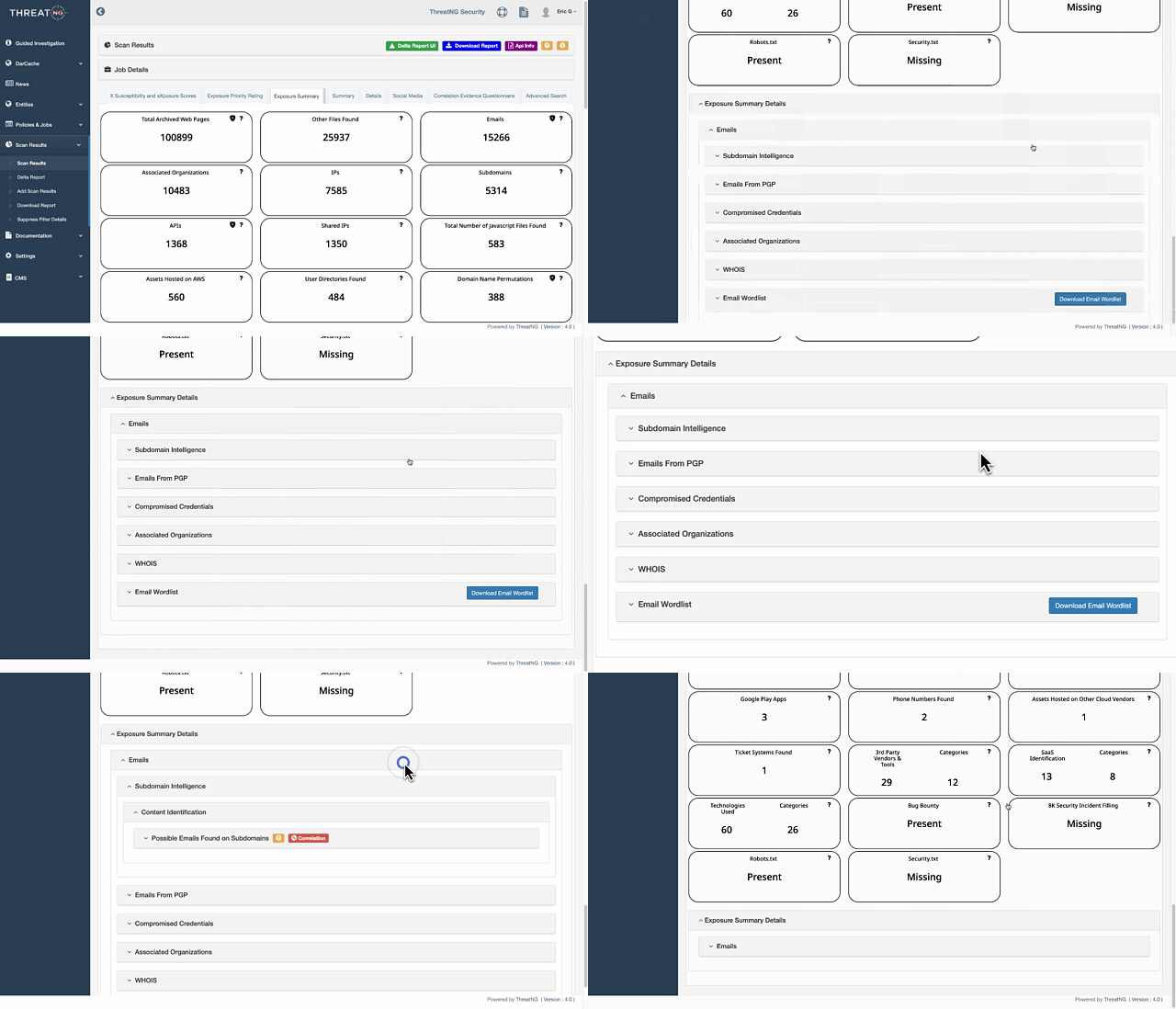
Defending Against Email Harvesting Using ThreatNG
Email harvesting exposes an organization to severe downstream cyberattacks, providing adversaries with the verified target lists needed to launch spear-phishing campaigns and execute credential stuffing. Because attackers compile these lists using automated scraping and dark web purchases, security teams require an external perspective to see exactly what email addresses are exposed.
ThreatNG operates as a comprehensive, agentless External Attack Surface Management (EASM) and Digital Risk Protection (DRP) platform. By combining continuous external discovery, targeted assessments, and deep web investigations, ThreatNG empowers organizations to uncover exposed email addresses, understand their dark web footprint, and proactively defend against the social engineering attacks that follow harvesting.
Agentless External Discovery to Uncover the Target List
To defend against email harvesting, an organization must understand what an attacker already knows.
ThreatNG executes connectorless, agentless external discovery to map the digital footprint. It uses multi-faceted discovery to identify exposed email addresses by actively scouring search engines, social media platforms, and public internet archives. This process provides a comprehensive, mathematically verified view of all corporate email addresses that are readily available to automated scraping bots, ensuring the security team sees the exact target list the adversary is building.
Deep External Assessment to Quantify the Risk of Exposure
Once exposed emails are discovered, ThreatNG conducts deep external assessments to measure how susceptible the organization is to attacks leveraging those harvested addresses.
Detailed Assessment Example: Phishing Susceptibility
ThreatNG directly assesses the risk posed by harvested emails through its Phishing Susceptibility evaluations. For example, if ThreatNG discovers the CEO's email address exposed on a public industry forum, it assesses this high-value exposure against the domain's email authentication records (like SPF and DMARC). If the assessment reveals that the organization lacks strict DMARC enforcement, it flags this as a critical vulnerability, proving that an attacker could easily spoof the harvested CEO’s email to launch highly convincing Business Email Compromise (BEC) attacks against the finance department.
Detailed Assessment Example: Credential Stuffing Susceptibility
Harvested emails are frequently used as the primary identifier in credential stuffing attacks. ThreatNG assesses external login portals, such as a corporate VPN gateway or customer portal, for the presence of rate limiting and CAPTCHA implementation. If an assessment reveals a login endpoint that allows unlimited login attempts, ThreatNG combines this finding with the known volume of harvested corporate emails to demonstrate a severe risk of automated account takeovers.
Deep-Dive Investigation Modules for Forensic Intelligence
To understand the full context of how harvested emails are being weaponized, ThreatNG deploys highly specialized investigation modules across the open, deep, and dark web.
Detailed Investigation Example: Dark Web Presence Module
Attackers frequently purchase massive lists of harvested emails that have been enriched with passwords from previous data breaches. ThreatNG’s Dark Web Presence module utilizes specialized crawlers to actively index hidden hacker forums, ransomware leak sites, and underground marketplaces. If the module detects that a database containing thousands of the organization's harvested employee emails and passwords is being auctioned or traded, ThreatNG captures this definitive proof of compromise. This intelligence allows the organization to initiate immediate password resets for the affected users before attackers can execute account takeovers.
Detailed Investigation Example: Conversational Attack Surface Module
Attackers use harvested emails to target specific employees during times of corporate stress. ThreatNG maps the broader conversational and narrative attack surface by analyzing online discussions, social media sentiment, and layoff chatter. If the module detects widespread public discussion about an impending corporate restructuring, an attacker can use harvested employee emails to send highly targeted spear-phishing messages promising details about severance packages. By identifying this conversational risk, the security team can issue internal warnings and heighten email filtering specifically for HR-related lures.
Continuous Monitoring to Detect Rapid Exposure
Email harvesting is a continuous threat; a new marketing campaign or the launch of a new public directory can suddenly expose thousands of addresses.
ThreatNG provides continuous monitoring across the external attack surface. If an employee's email is suddenly exposed on a public code repository or if a new dark web data dump includes corporate addresses, ThreatNG detects the change in real-time. This continuous vigilance allows organizations to act immediately, updating their defensive posture before the attacker can utilize the newly harvested data.
Intelligence Repositories for Threat Context
ThreatNG cross-references all discovered harvested emails against DarCache, its operational intelligence data store. By correlating the exposed emails with specific threat actors or known compromised credentials, ThreatNG helps security teams understand the attacker's methodology. Using the DarChain engine, ThreatNG visually maps how an attacker could combine a harvested email address, an unpatched external vulnerability, and a lack of email authentication to achieve a full network compromise.
Standardized Reporting for Strategic Brand Defense
To communicate the risk of email harvesting to executive leadership, ThreatNG translates its findings into structured reports. These reports explicitly list the volume and locations of exposed email addresses and correlate them directly to the organization's Phishing and Data Leak Susceptibility Security Ratings. This standardized approach allows the Chief Information Security Officer (CISO) to justify investments in advanced email filtering and employee security awareness training.
Empowering Defense Through Cooperation with Complementary Solutions
ThreatNG focuses on the cooperation between its external intelligence and complementary solutions to secure the organization at machine speed.
Cooperation with Secure Email Gateway (SEG) Complementary Solutions: When ThreatNG’s discovery modules identify a massive new list of exposed corporate emails, it feeds this intelligence directly to SEG complementary solutions. The SEG cooperates by automatically increasing the filtering stringency for incoming messages targeting those specific exposed addresses, significantly reducing the likelihood that a spear-phishing campaign will reach the inbox.
Cooperation with Security Awareness Training Complementary Solutions: ThreatNG shares its intelligence regarding specific harvested emails and the conversational attack surface with Security Awareness Training platforms. These platforms cooperate by automatically enrolling the employees whose emails were exposed into targeted, hyper-realistic phishing simulation campaigns, ensuring they are prepared for the exact type of social engineering attacks that follow harvesting.
Cooperation with Identity and Access Management (IAM) Complementary Solutions: If ThreatNG’s Dark Web module discovers that harvested emails are actively being traded alongside passwords, it sends an immediate signal to IAM complementary solutions. The IAM system cooperates by automatically enforcing multi-factor authentication (MFA) challenges or requiring mandatory password resets for the compromised accounts, neutralizing the threat of credential stuffing.
Frequently Asked Questions (FAQs)
How does External Attack Surface Management combat email harvesting?
EASM platforms operate exactly like the attackers do, mapping the internet to find exposed data. By actively discovering which corporate email addresses are publicly available or being sold on the dark web, platforms like ThreatNG provide security teams with the intelligence needed to harden internal defenses and protect the specific users who are most likely to be targeted.
Can ThreatNG stop bots from scraping email addresses from our website?
While ThreatNG does not sit inline to block web traffic, its external assessments identify where email addresses are exposed in plain text on public assets. By highlighting these vulnerabilities, ThreatNG guides organizations to implement defensive measures such as address obfuscation and rate-limiting, which physically prevent the bots from successful scraping.
Why is monitoring the conversational attack surface important?
Attackers use public sentiment and corporate news to craft convincing phishing lures for the emails they harvest. By monitoring the conversational attack surface, organizations can predict the themes adversaries will use (such as an acquisition or a major product launch) and proactively defend their employees against those specific narratives.
