



External eXposure Priority View
Stop Translating CVEs: Master Your Digital Sprawl with the Interactive eXposure Priority View
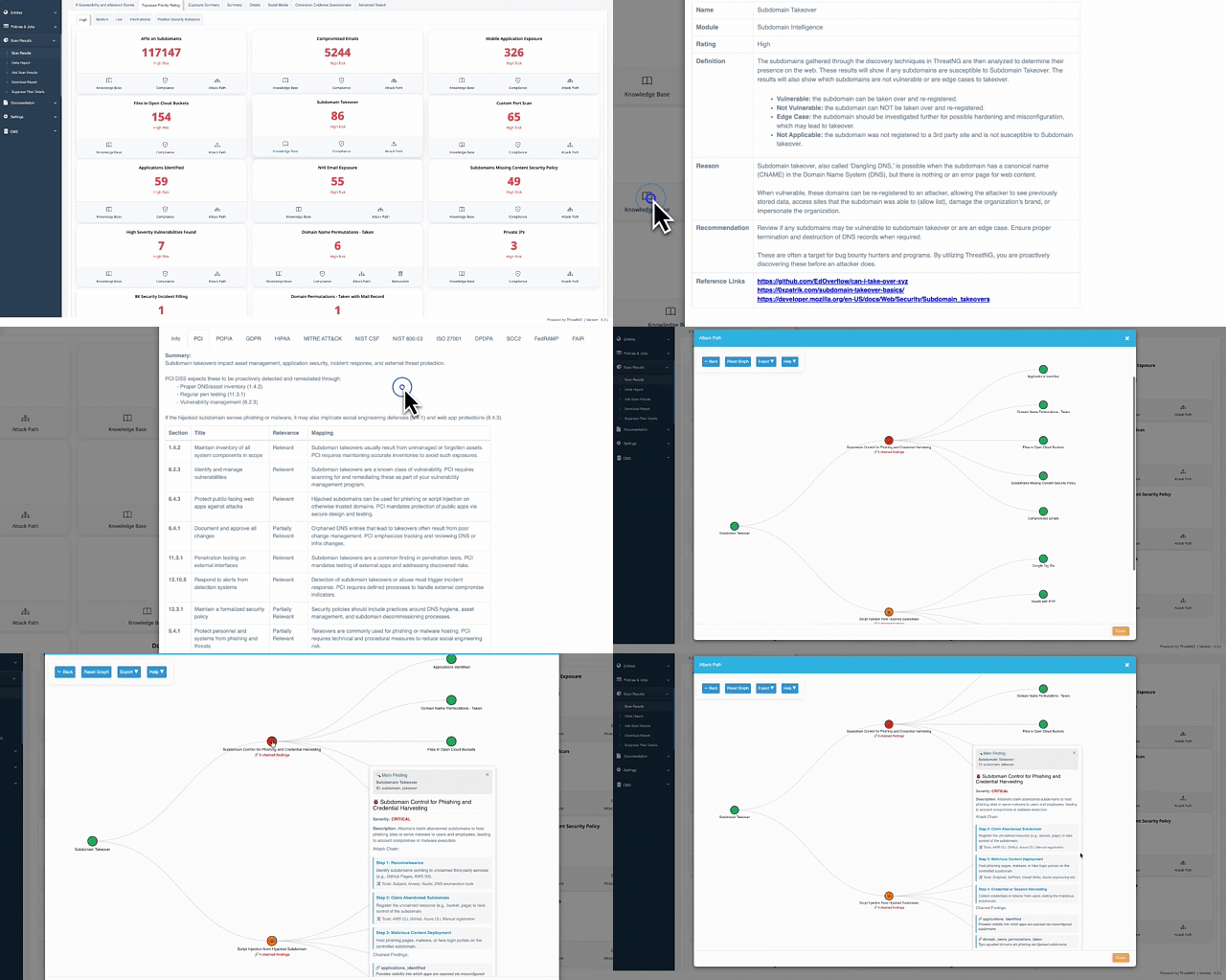
Think of traditional EASM tools like a check engine light: they flash a warning but offer no context, leaving your team to diagnose the problem blindly. The eXposure Priority View is the telematics chip for your external attack surface. It is not a static report; it is a living, dynamic workspace where unauthenticated discovery happens continuously. Instead of dumping a "pile of bricks" onto your SOC's desk, this interactive engine cuts through the noise. Using our frictionless, connectorless methodology, it safely maps your true external footprint without touching your internal systems, giving you immediate operational command.
Unified External Risk Management for the Modern Enterprise

The Map for the CISO
Defensible Cyber Risk Quantification (CRQ) Driven by DarChain
For the modern CISO, navigating boardroom expectations requires more than flat severity scores. The eXposure Priority View provides a visual, interactive map of your external risk posture. Powered by DarChain (Digital Attack Risk Contextual Hyper-Analysis Insights Narrative), it illuminates the critical "connective tissue" between seemingly unrelated findings. By translating technical exposures into defensible Cyber Risk Quantification (CRQ), this view provides the Fiduciary Shield needed to justify security budgets, confidently dispute inaccurate legacy ratings, and protect your cyber insurance premiums.
The Knowledge Base for the SOC
The Adversary's Playbook: A Complete Forensic Evidence Package
Eliminate the "Hidden Tax" of manual investigation that causes severe SOC burnout. This dynamic view acts as a continuous Knowledge Base for your security analysts, showing them the exact tools, tactics, and steps an adversary will use to execute an attack chain. By automatically correlating technical vulnerabilities with dark web intelligence, the platform generates a complete Forensic Evidence Package. Your team gains the exact Attack Path Choke Points necessary to break the kill chain with a single remediation effort—all without the nightmare of deploying complex internal agents.
The Compliance View for GRC
Automating the External GRC Assessment
Internal audits suffer from the "GRC Blind Spot" because they measure only adherence to internal policies and completely miss the external adversary's perspective. The eXposure Priority View bridges this gap with a dedicated Compliance View facilitated by External GRC Assessment. As the dynamic engine discovers unsanctioned shadow IT and third-party exposures, it automatically maps these technical findings directly to strict regulatory frameworks, including Open FAIR, FedRAMP, HIPAA, and GDPR.
Call-to-Action
The dynamic insights you gain here don't just stay on the screen. The visual DarChain mapping, SOC Knowledge Base forensics, and External GRC Compliance mappings can all be seamlessly exported for offline review, board presentations, and auditor hand-offs.
Need to hand this evidence over to the Board or an auditor? See how our Reporting Engine translates this view into defensible documentation.

eXposure Priority View Frequently Asked Questions
-
The Contextual Certainty Deficit is an industry-wide crisis in which traditional security tools generate massive volumes of technical alerts that are completely devoid of decisive business context. This forces exhausted Security Operations Center (SOC) analysts to manually investigate unverified alerts, creating severe alert fatigue. ThreatNG solves this using its patented Context Engine™, which automatically correlates isolated technical vulnerabilities with dark web intelligence, financial data, and legal context. Instead of a chaotic list of alerts, security teams receive a prioritized blueprint of real attack paths backed by irrefutable evidence.
-
Traditional External Attack Surface Management (EASM) tools often fall into the "Connector Trap" by demanding a labyrinth of API keys, internal software agents, and complex credential permissions. This creates an administrative nightmare that drains IT resources and leaves organizations blind to unsanctioned shadow IT. ThreatNG operates using a completely frictionless, connectorless methodology. It performs unauthenticated, outside-in discovery—using just a primary seed like a domain name—to map your entire external attack surface exactly as a sophisticated adversary sees it, requiring zero internal agents or administrative overhead.
-
An Attack Path Choke Point is a strategic intersection within a digital ecosystem where a single remediation effort can simultaneously disrupt dozens of potential adversarial exploit paths. ThreatNG identifies these using DarChain (Digital Attack Risk Contextual Hyper-Analysis Insights Narrative), a hyper-analysis engine that correlates seemingly unrelated technical, social, and financial vulnerabilities into a clear visual exploit chain. By focusing on these high-leverage choke points, security teams can stop treating isolated symptoms and effectively dismantle the attacker's entire narrative, vastly improving operational velocity and reducing manual investigation time.
-
Legacy security rating agencies often rely on slow, "black box" algorithms and context-blind scanners that penalize organizations for assets they do not own or fail to recognize active compensating controls, such as a Web Application Firewall. These unmerited failing grades can lead to skyrocketing cyber insurance premiums. ThreatNG provides "Legal-Grade Attribution" by fusing technical findings with real-world financial and legal context. This provides CISOs with the irrefutable forensic evidence required to confidently act as a "Score Auditor," allowing them to dispute algorithmic false positives and successfully defend their cyber insurance rates.
-
Many organizations are hesitant to use Artificial Intelligence for vulnerability reporting due to fears of leaking sensitive data to public models. ThreatNG solves this through an "Air-Gapped Handoff" using DarcPrompt (Data Assessment and Repeatable Context Prompt). Acting as a "Cognitive Exoskeleton," the platform synthesizes verified external data and regulatory context into a highly engineered text prompt. Security leaders simply copy this prompt and execute it entirely within their own secure, internally hosted Enterprise LLMs (such as Microsoft Copilot). This ensures absolute data privacy and "Bounded Autonomy" without exposing proprietary vulnerability data.
-
Traditional vulnerability scanners typically hand security teams a "pile of bricks"—thousands of flat, contextless Common Vulnerabilities and Exposures (CVEs) without any strategic guidance on what to fix first. The eXposure Priority View replaces this with "The Blueprint". It evaluates the true severity of every finding by triangulating three critical factors: Potential Impact, Exploitability, and Relevance to the specific digital environment. This translates raw technical vulnerabilities into a prioritized, board-ready business risk metric (Categorized into Critical, High, Medium, Low, and Informational), ensuring cross-functional teams instantly grasp immediate priorities.