


Orchestrating Confidence: The Evidence-Based External Risk Platform for the Modern CRO
Stop Driving with the Rearview Mirror. Command Your External Reality with "No Surprises."
You are no longer just the guardian of compliance; you are the architect of Business Confidence. Yet, in this Age of Uncertainty, many Risk Officers are forced to navigate with fragmented tools that create a "Risk Mystery House," a chaotic structure of siloed data and blind spots. You are asked to defend the organization against tomorrow’s threats using last quarter's reports.
ThreatNG Security empowers you to stop driving with the rearview mirror. We provide the External Risk Orchestration required to harmonize Cyber, ESG, Supply Chain, and Brand signals into a single, defensible narrative. Move beyond subjective questionnaires and internal assumptions. Use ThreatNG to transform from a technical gatekeeper into a strategic conductor, ensuring that when the Board asks, "Are we safe?", you have the evidence to answer, "Yes."
Why ThreatNG? Three Pillars of Orchestrated Resilience

Defensibility in the Boardroom: Replace "I Think" with "I Know"
The Pain: The "Contextual Certainty Deficit." Nothing erodes your credibility faster than answering a Board member’s specific question about a new threat with, "I’ll have to check with the team."
The Solution: ThreatNG delivers Legal-Grade Attribution and Contextual Certainty.
The Benefit: Walk into every executive committee meeting with a unified Executive Risk Scorecard. Whether the question is about a specific competitor’s breach or a new regulatory requirement, you will have real-time, evidence-based data at your fingertips. We translate technical signals (such as open ports or missing headers) into business terms, giving you the authority to drive strategic decisions and the peace of mind that your answers are irrefutable.
Evidence-Based TPRM: End the "Trust but Verify" Charade
The Pain: "Claims-Based Risk." You send thousands of questionnaires, and vendors tick "Yes" to every security control. But you know that questionnaires cannot detect Shadow IT, human error, or Non-Human Identity (NHI) exposures.
The Solution: The Correlation Evidence Questionnaire (CEQ) and Unauthenticated Discovery.
The Benefit: Stop relying on what vendors say and start managing what you can see. ThreatNG performs non-intrusive, outside-in discovery to validate your supply chain’s actual posture. We identify the "High Risk" cloud buckets and "F" rated web applications that questionnaires miss. Use ThreatNG to adopt a "Verify, Then Trust" model and protect your organization from vendor risks that hide in plain sight.
Total Orchestration: Silence the Noise of Siloed Risk
The Pain: The "Silo Effect." Your Cyber team sees a server; your Legal team sees a contract; your Marketing team sees a campaign. No one sees the Brand Damage or ESG Exposure that sits in the gaps between them.
The Solution: A Unified External Attack Surface Management (EASM) and Digital Risk Protection (DRP) platform.
The Benefit: ThreatNG acts as your conductor’s baton, harmonizing these disparate signals. We detect ESG violations in your digital footprint, Brand Reputation risks (such as domain squatting), and Regulatory Exposure (SEC 8-K filings), alongside traditional cyber vulnerabilities. The result is a holistic, "No Surprises" view of the enterprise that allows you to orchestrate resilience across every department.
How it Works: The “DarChain” Narrative
Turn Technical Data into Business Logic. We don't just dump data; we tell the story of the attack before it happens. Our DarChain (Digital Attack Risk Contextual Hyper-Analysis Insights Narrative) engine maps the adversary’s potential path:
(1) Reconnaissance
We find the "dangling CNAME" or forgotten subdomain.
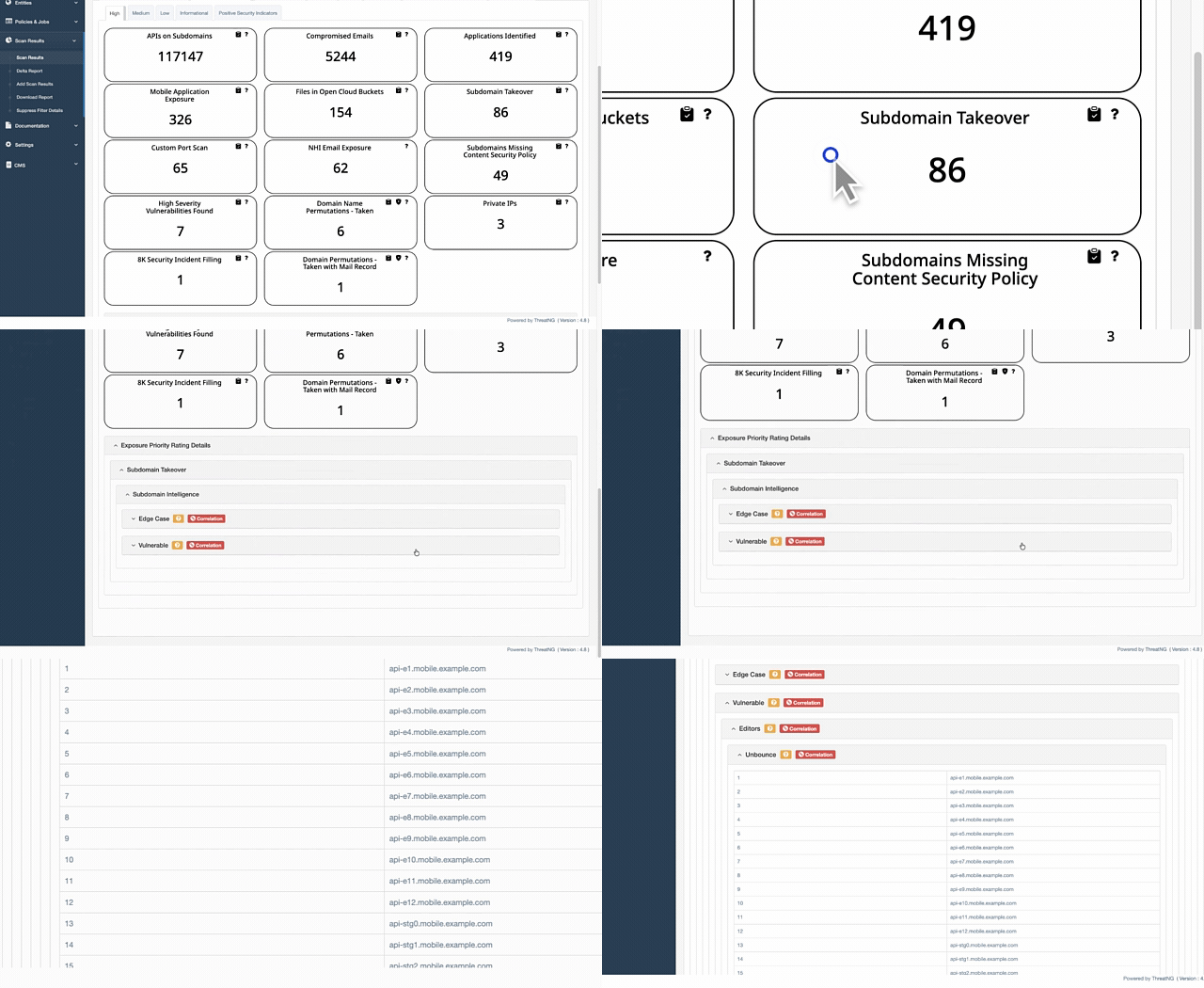
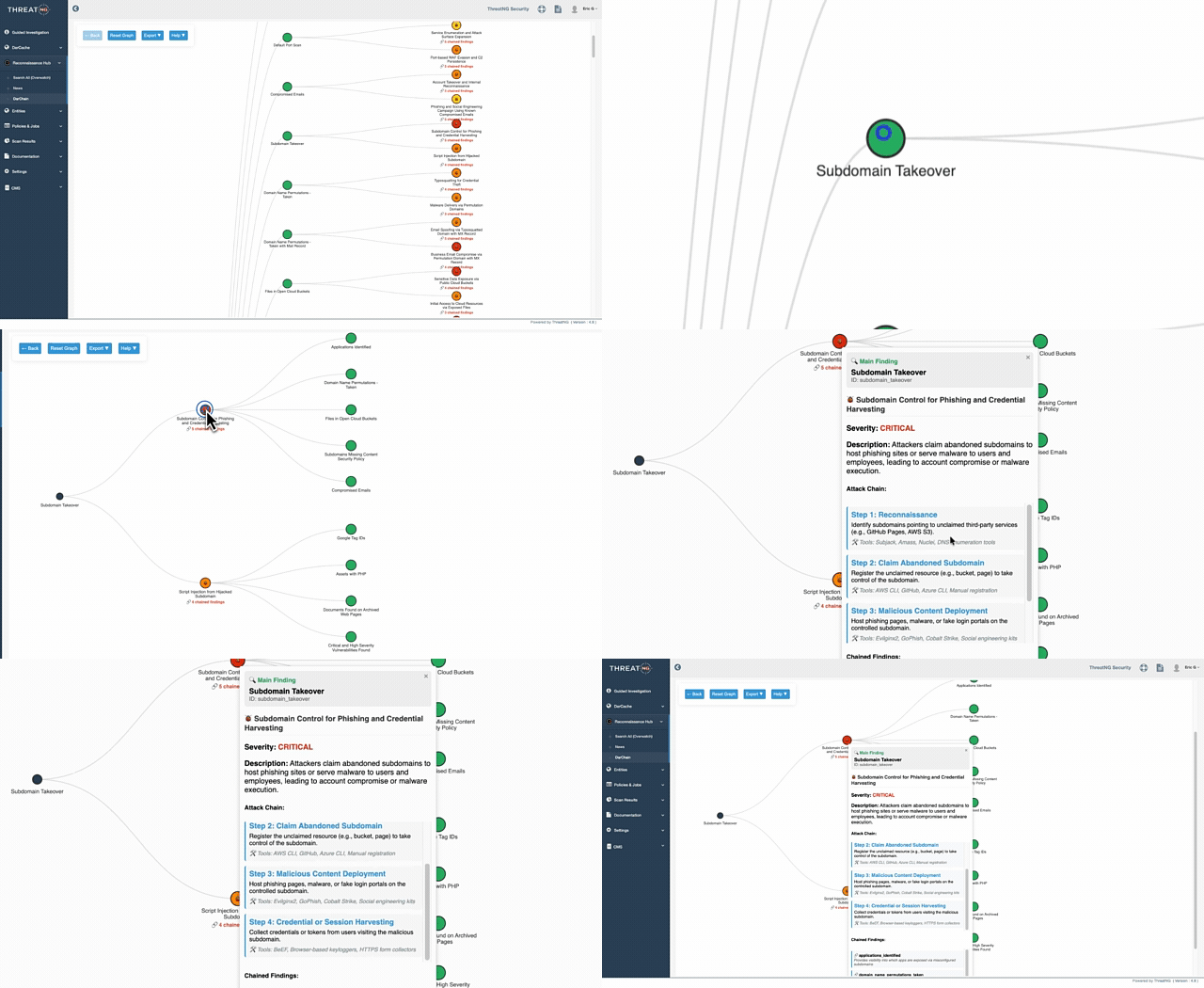
(2) Weaponization
We show how an attacker could stage a phishing campaign.
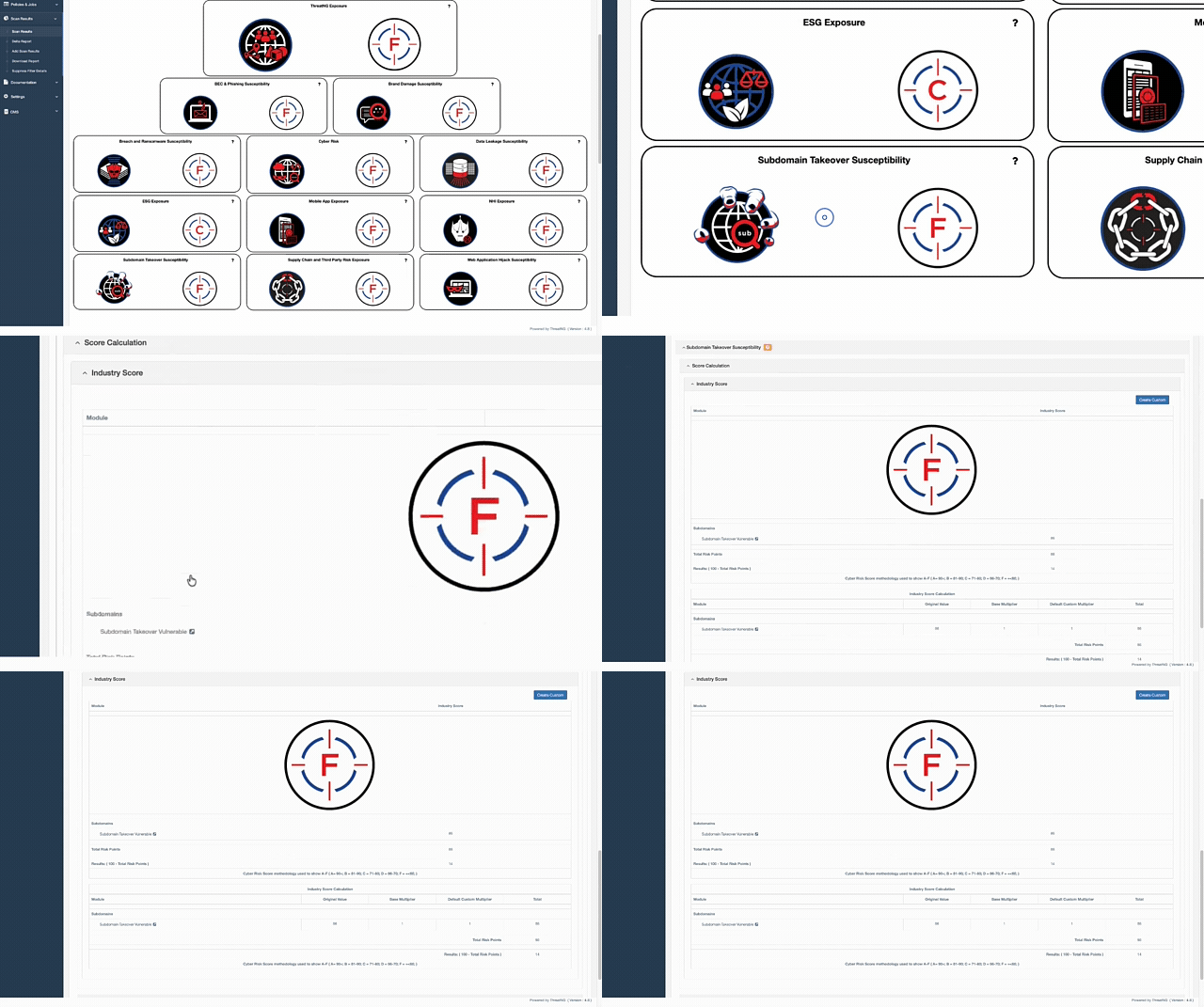
(3) Impact
We calculate the exposure and susceptibility.


Frequently Asked Questions (In General)
-
External Risk Orchestration is the strategic process of aligning all external risk signals including Cybersecurity, Legal, ESG, and Supply Chain into a unified governance framework. It moves the CRO from managing silos to managing a holistic "Adversary View" of the enterprise.
-
Vulnerability scanners (like Tenable or Qualys) are designed for internal assets you control. ThreatNG is designed for the external reality you don't control, including Shadow IT, third-party vendors, and brand impersonators. We find the blind spots your internal scanners miss.
-
Yes. ThreatNG includes specific modules for ESG Exposure, analyzing your digital footprint for governance risks, negative sentiment, and regulatory filings that could impact your ESG rating and corporate reputation.
-
"Claims-Based" risk relies on human assertion (e.g., a vendor answering "Yes" on a questionnaire). "Evidence-Based" risk relies on observable data (e.g., ThreatNG detecting a missing security header or exposed database). ThreatNG prioritizes evidence over claims.
Ready to Command Your Risk Reality?
Don't wait for the next surprise. Experience the power of Orchestration. Request your complimentary External Risk Assessment today and see your organization exactly as the adversary sees it.
The Modern CRO’s Guide to External Risk Orchestration: Frequently Asked Questions
Strategic Mandate: From Compliance to Orchestration
-
Traditional risk management often operates in silos (cyber vs. legal vs. operations), focusing on internal controls and compliance checklists. External Risk Orchestration is the strategic practice of harmonizing disparate signals into a single, unified view of the organization’s risk posture from the outside.
ThreatNG empowers the CRO to act as a "Conductor," integrating data from the entire external attack surface including Cyber, ESG, Supply Chain, and Brand Reputation to provide the business with confidence, not just compliance.
-
"Rearview Mirror Reporting" refers to risk programs that rely on static, point-in-time assessments (like quarterly audits or annual questionnaires) that describe past events rather than current reality. In an age of rapid digital expansion, this creates a "Contextual Certainty Deficit."
By the time you read the report, the risk has shifted. ThreatNG replaces this with Continuous External Reality Checks, functioning as a forward-looking navigation system that identifies emerging threats such as a subdomain takeover risk or a new ESG violation before they become incidents.
-
The "Risk Mystery House" is a metaphor for organizations where risk functions are built on the fly, creating "staircases to nowhere," which are siloed data that can’t be combined or compared. This causes blind spots and conflicting reports.
ThreatNG solves this by providing a standardized, Evidence-Based framework. We normalize technical data (such as open ports or missing headers) into business terms (Brand Damage, Regulatory Exposure), creating a common architectural blueprint that lets the CRO see the entire house at once.
Operational Reality: Evidence vs. Claims
-
Questionnaires represent Claims-Based Risk. They rely on what a vendor says they do, which is subjective and static. They cannot detect Shadow IT, human error, or Non-Human Identity (NHI) exposures that occur after the questionnaire is signed.
ThreatNG introduces Evidence-Based TPRM. We perform unauthenticated discovery to see what the vendor actually does. Our Correlation Evidence Questionnaire (CEQ) validates vendor claims against observable reality, allowing you to adopt a "Verify, Then Trust" methodology.
-
You use Unauthenticated Discovery. Just as a threat actor does not ask for permission to scan your perimeter, you should not need permission to audit your public-facing footprint.
ThreatNG passively maps the external attack surface of any entity using open-source intelligence (OSINT) and non-intrusive reconnaissance. This provides legal-grade attribution of risks, such as exposed S3 buckets or weak encryption standards, without requiring agents, credentials, or vendor cooperation.
-
No. Internal scanners (like Tenable or Qualys) are essential for managing your known assets behind the firewall. ThreatNG manages your unknowns outside the firewall.
We detect Shadow IT, forgotten cloud instances, and marketing microsites that your internal scanner misses because they aren't in the asset inventory. ThreatNG complements your internal view to close the gap between "what we manage" and "what is exposed."
Boardroom Confidence & Defensibility
-
Defensibility comes from data, not opinion. When a Board member asks, "Are we safe from [Current Threat]?", answering with "I think so" lowers credibility.
ThreatNG gives you Contextual Certainty. You can present an Executive Report that shows a real-time, evidence-backed score of your Cyber, ESG, and Brand exposure. This allows you to say: "We have verified that our external perimeter is secure against this specific exploit vector, and here is the evidence."
-
Yes. In the modern enterprise, a technical failure often becomes a reputation crisis. ThreatNG’s Brand Damage Susceptibility rating analyzes factors like Domain Squatting, Phishing Permutations, and SSL/TLS Hygiene.
We quantify how easily an adversary could impersonate your brand to defraud customers or partners, allowing you to treat Reputation Risk as a manageable metric rather than a vague concept.
Technical Capabilities and "The How"
-
DarChain (Digital Attack Risk Contextual Hyper-Analysis Insights Narrative) is ThreatNG’s proprietary engine that maps the potential "Kill Chain" of an adversary.
Instead of just listing a vulnerability, DarChain narrates the path an attacker would take: Step 1: Reconnaissance (Finding a dangling DNS record) -> Step 2: Weaponization (Hosting a phishing site) -> Step 3: Exploitation (Harvesting credentials). This narrative approach helps non-technical stakeholders understand the consequence of a risk, not just its technical name.
-
Risk is no longer just digital. ThreatNG’s ESG Exposure module scans for external indicators of governance failure, such as negative sentiment in public forums, regulatory filings (SEC 8-Ks), and associations with high-risk entities. This allows the CRO to view ESG not as a separate "compliance" task, but as an integral part of the enterprise risk profile.
-
ThreatNG specializes in finding assets that have "drifted" from central control. This includes:
Cloud & Infrastructure: Forgotten AWS S3 buckets, Azure blobs, and Heroku apps.
Development Artifacts: Exposed .git repositories, Jenkins servers, or JIRA instances.
Legacy Marketing: Old campaign domains and microsites that were never decommissioned and are now vulnerable to takeover.